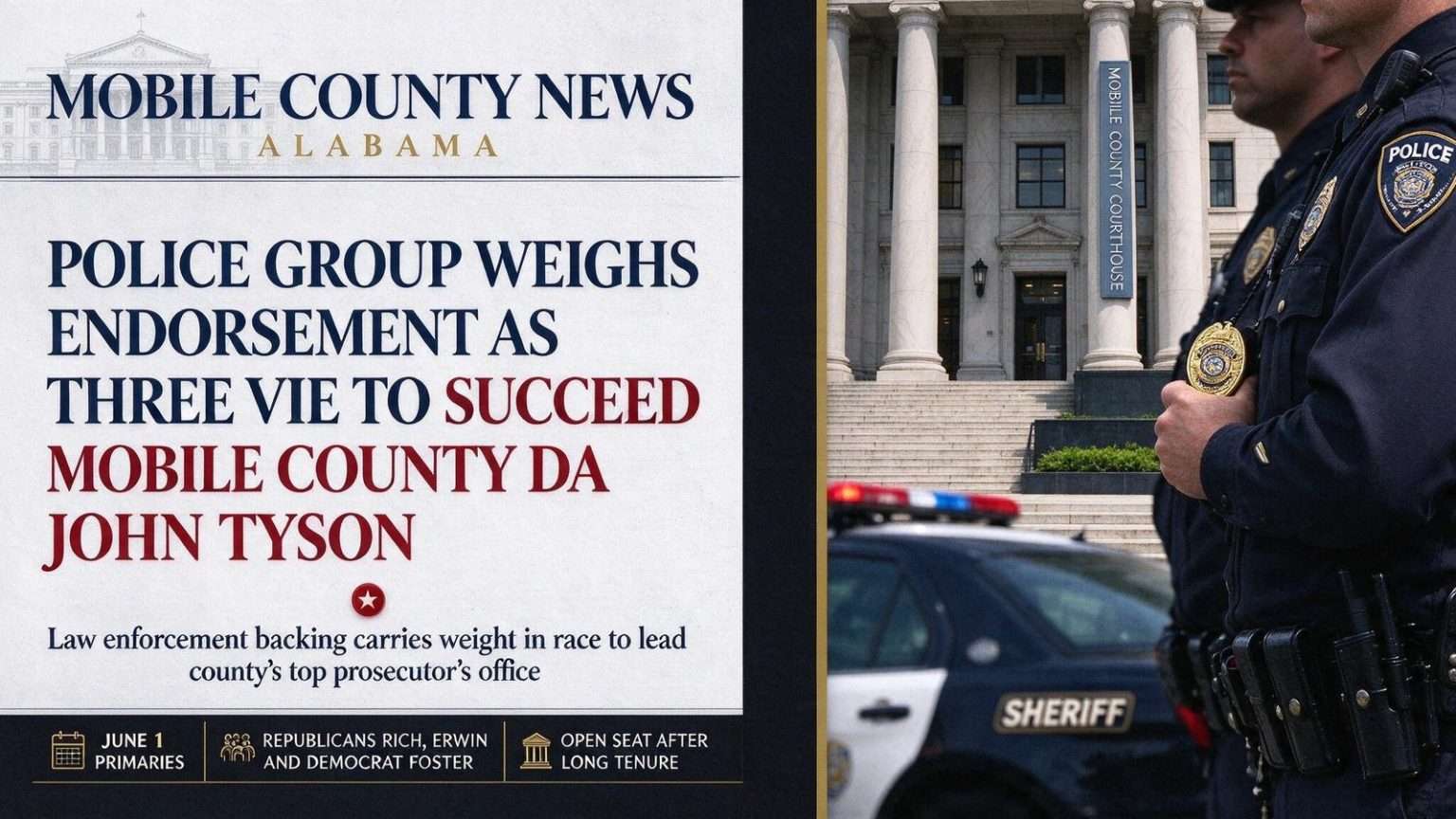
Mobile County’s largest association of law enforcement officers was expected this week to endorse a candidate to succeed District Attorney John Tyson Jr., whose long tenure as the county’s chief prosecutor is ending. A board of the Police Benevolent Association interviewed the three contenders in half-hour sessions Monday night: Republicans Ashley Rich and Mark Erwin, and Democrat Don Foster.
Donald Scott of the PBA said the panel’s decision would not be an easy one. All three candidates, he said, made strong impressions, arriving with experience, credentials and ideas that qualified them for the office. With no clear front-runner emerging from the interviews, the board was left to weigh three very different paths to the same job.
The endorsement carries real weight in a race that will be decided first in the June 1 party primaries and then in the November general election. District attorney is one of the most powerful offices in any Alabama county: the incumbent signs off on charges, sets plea policy, decides which cases go to a grand jury and directs the prosecution of every serious felony filed in the county’s courts. Tyson has held the post since taking office in 1993, and his retirement opens the first truly open seat in the office in nearly two decades.
For the candidates, the timing of the PBA’s decision matters as much as the endorsement itself. Early backing from law enforcement helps a campaign build momentum and credibility in the months before most voters begin paying attention, and it can shape the way the race itself is framed — which candidate is seen as the choice of the officers who actually build the cases.
The prosecutor
Ashley Rich, 41, has spent her career inside the office she now hopes to lead. Tyson hired her as an assistant district attorney in 1996, and she currently heads the office’s murder team, handling some of the most serious and highest-profile cases that move through Mobile County’s courtrooms. She describes herself as “a born prosecutor,” and her pitch to voters rests on continuity: experience accumulated case by case, year by year, in the very building she is asking to run.
Her name is a familiar one in local political circles. Her sister, Janet, once led the Republican Party organization in Mobile County, and her brother-in-law, Craig Pittman, holds statewide office as an appellate judge handling civil matters. That network gives her instant access to the donors and party activists who power a countywide primary campaign.
Rich already carries the endorsement of the Mobile County Law Enforcement Association, a smaller group that backed her shortly after she announced her candidacy. Landing the PBA’s nod as well would give her a sweep of the county’s major law enforcement organizations and a strong claim to the badge-and-badgeholder vote that looms large in a prosecutor’s race.
The municipal judge
Mark Erwin, also 41, comes to the race from a different direction. A former chairman of the Mobile County Republican Party, he entered law school after initially planning to enter the ministry — a background he has described as shaping his sense of justice as much as any courtroom experience. He interned in the district attorney’s office and clerked for Circuit Judge Rusty Johnston before building a practice that has been primarily civil in nature.
He now serves as presiding municipal judge in his native Saraland, one of the fastest-growing cities in the county, where he oversees the daily churn of misdemeanor cases, traffic dockets and ordinance violations. The role has given him a sitting judge’s perspective on the court system, along with a platform in a city whose voters will have outsized influence in a countywide race.
Erwin’s candidacy blends judicial experience with political organization. His years chairing the county Republican Party gave him a detailed map of precincts, volunteers and activists across Mobile County, and his campaign has leaned on that network while he argues that fresh leadership — from outside the district attorney’s office — is what the office needs after so many years under the same leadership.
The former U.S. attorney
Don Foster, the lone Democrat in the field, is a native of Foley who played college football at Georgia Tech. He has practiced civil law both before and after a six-year stint as President Bill Clinton’s appointee to lead the U.S. Attorney’s office for the Southern District of Alabama, the federal prosecutorial post covering the state’s southern counties.
In that post he oversaw a broad range of civil and criminal prosecutions, including the investigation of church burnings in Baldwin County and a rare federal capital case. The church-burning investigation, part of a wave of arson attacks on Southern congregations that drew national attention, put Foster’s office at the center of a response involving federal agents and local sheriff’s deputies across Baldwin County. The capital case, an uncommon proceeding in the district, added another dimension to a résumé that already mixed civil litigation with federal prosecution.
Foster’s candidacy gives the November general election a Democratic name with prosecutorial credentials, something the party has often lacked in Mobile County’s courthouse races. He has argued that offices within the legal system — both judicial and prosecutorial — probably ought to be decided in nonpartisan elections, in order to reduce any perception that decisions are politically motivated. It is an argument he acknowledges is a hard sell in an era of straight-ticket voting, but one he raises at nearly every forum.
Why the endorsement matters
Law enforcement endorsements are among the most sought-after prizes in a district attorney’s race, for reasons that are both symbolic and practical. Symbolically, the backing of rank-and-file officers signals that the people who build cases trust the person who will try them. In courthouses across Alabama, prosecutors work hand in glove with municipal police officers, county sheriff’s deputies and state investigators every day, and an association’s endorsement tells voters that those working relationships will not skip a beat under new leadership.
Practically, associations like the PBA can supply campaign money through their political action committees and manpower for the unglamorous work of putting out signs and knocking on doors. In a countywide race in Alabama’s second-largest county, that second piece — a ready-made corps of volunteers spread across Mobile, Prichard, Saraland, Satsuma, Citronelle and the communities in between — can matter as much as any television buy.
The candidates spent their half-hour interviews making their cases to the board, and the breadth of the field was not lost on the panel. Foster brought federal prosecutorial experience and a judge’s-eye argument about politics in the courthouse. Erwin offered a blend of judicial service and party organization. Rich presented a career’s worth of felony prosecutions inside the office itself. All three, by most accounts, would be credible occupants of the office — which is precisely what made the board’s choice difficult.
With the three candidates having made their cases, the decision now rests with the association’s board. Whichever Republican prevails in the June 1 primary will face Foster in the fall, in a contest to lead an office that handles the prosecution of every serious felony charged in Mobile County. For the men and women who wear the badge, the endorsement is a chance to signal which candidate they believe will stand behind the cases they bring; for the campaigns, it is a prize that money cannot buy and one that neither of the two primaries can decide on its own.
A changing county and a long shadow
The race arrives at a moment of transition for Mobile County itself. The county’s population has shifted over the years, with growth pushing westward and northward into communities like Saraland, Satsuma and Creola, while the City of Mobile remains the legal and economic center of the Gulf Coast’s busiest deepwater port. The district attorney’s office must cover all of it — dockets in municipal, district and circuit courts, juvenile matters, grand jury sessions and the steady flow of felony cases that comes with a major port city, two interstate highways and a busy tourist corridor.
Tyson’s long tenure casts a long shadow over the contest. In Alabama, where district attorneys face no term limits, an open seat of this kind is rare, and both parties understand that the June 1 primaries may effectively decide the office for years to come. Turnout in courthouse races is notoriously low and heavily influenced by name recognition, which is why endorsements from associations like the PBA and the Mobile County Law Enforcement Association carry such weight: they put a candidate’s name in front of voters through channels — newsletters, signage, word of mouth among officers and their families — that paid advertising struggles to replicate.
The mechanics of the election compound the importance of each early endorsement. Because Mobile County’s voters are split between a competitive Republican primary field and a single Democratic contender, the Republican side is expected to absorb the bulk of the intraparty combat, while Foster can husband his resources for the fall. Each campaign, meanwhile, is raising and spending under Alabama’s campaign finance rules, reporting contributions as they go and relying on PACs and association backing to stretch limited budgets.
Whatever the board decides, the interviews themselves marked the first time all three candidates faced the same panel of law enforcement representatives in the same week — a preview of the joint forums and candidate nights that will follow through the spring. The officers’ questions, participants said, focused on the practical: plea policies, communication with investigators, courtroom staffing and how each candidate would manage the office’s relationships with the dozen or so police departments that feed cases into the county system every day.