Sheriff Cochran Stays Neutral in Governor’s Race as Endorsements Shift Around Him
Mobile County Sheriff Sam Cochran flirted with backing Tim James for governor but stayed publicly uncommitted. Former Sheriff Jack Tillman is in the James camp.
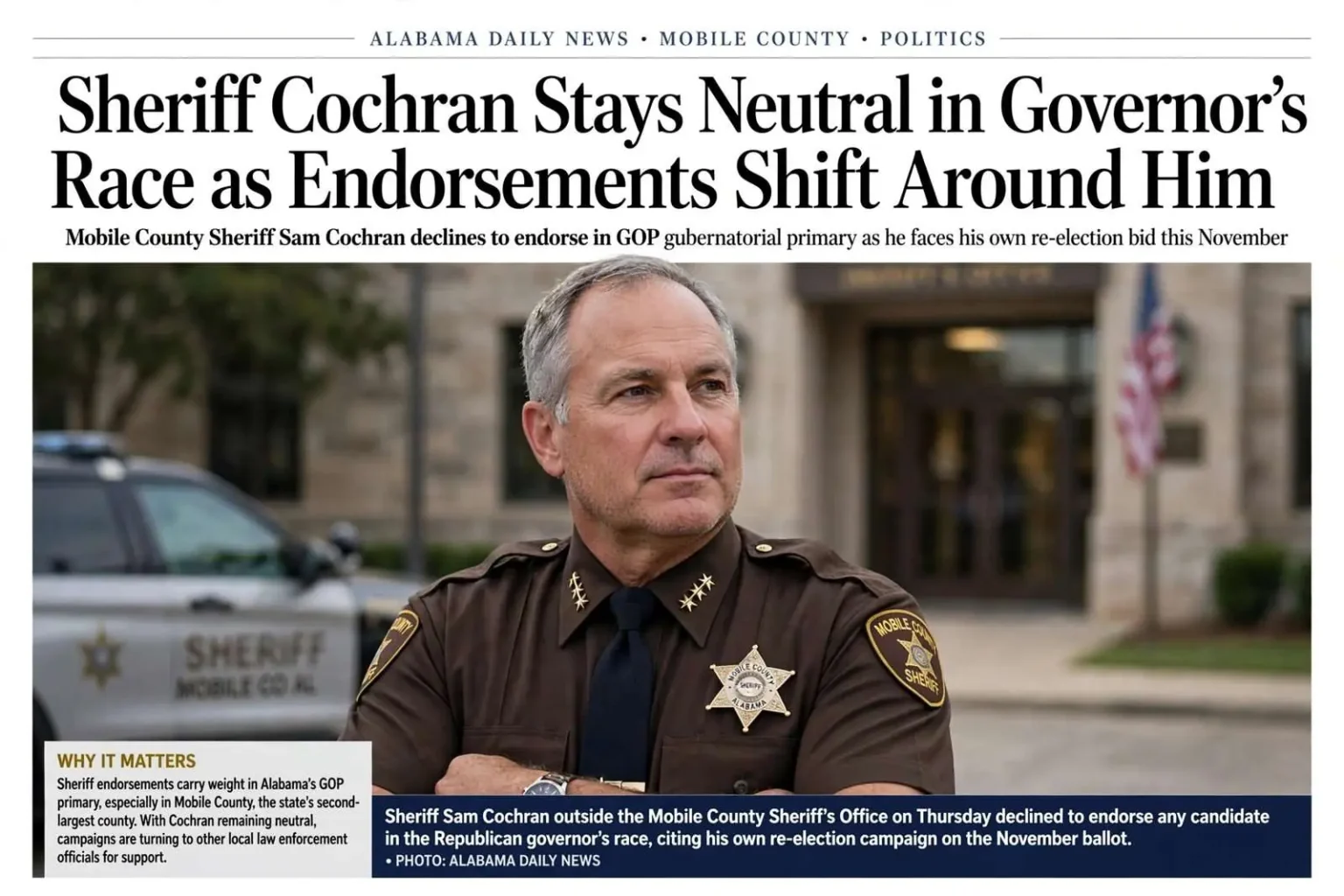
Mobile County Sheriff Sam Cochran looked closely at endorsing Tim James for governor, but has apparently decided to stay publicly uncommitted now that he has drawn an opponent in his own re-election bid. The decision makes Cochran one of the most prominent south Alabama law enforcement figures keeping his name out of the gubernatorial fray — and illustrates the careful arithmetic sheriffs run when their own names are on the same ballot.
Cochran is unopposed in the Republican primary on June 1 and will face Democrat Will Johnson in the general election in November. A sheriff who is on the ballot himself has obvious reasons to avoid picking sides in a bruising gubernatorial primary, and Cochran has evidently made that calculation. An endorsement in a contested Republican primary means writing off the supporters of every other candidate, and a sheriff’s job depends on goodwill that crosses party lines come November. Cochran, a former FBI agent who moved from the bureau’s Mobile field office into the sheriff’s department before winning the office outright, has built his political identity on professionalism rather than partisanship — a posture that a public gubernatorial endorsement would immediately complicate.
His caution has not stopped others in the sheriff’s orbit. Some of the department’s executive leadership is in the James camp, and former Sheriff Jack Tillman — Cochran’s predecessor — is squarely in James’ corner. The James campaign says it expects to announce several notable endorsements in south Alabama later this month, a signal that the Greenville businessman intends to contest the coast seriously rather than concede it to Bradley Byrne, who lives in Montrose on the Eastern Shore.
Why Sheriff Endorsements Matter
Law enforcement endorsements carry particular weight in a Republican primary. Sheriffs are among the most recognizable elected officials in Alabama’s rural and suburban counties, and their support signals to conservative voters that a candidate is sound on the issues they care about most — guns, illegal immigration, prison overcrowding and the Drug Enforcement Administration-style discipline of locking people up. A sheriff’s word travels through a county’s courthouses, veterans’ halls and hunting clubs in a way no television buy can replicate.
In Mobile County — the state’s second-largest county and a rich source of Republican primary votes — Cochran’s silence leaves a gap that the James and Byrne campaigns are both working to fill with lesser-known names. Endorsements from a sheriff’s deputies or a former sheriff carry much of the same currency, which is why Tillman’s public commitment to James matters more than its headline value suggests: Tillman held the office for 12 years, and old friendships inside the department run long. Deputies who served under Tillman, and command staff who owe their careers to appointments made across two administrations, read a predecessor’s endorsement as a signal of where the department’s institutional memory leans.
The timing also matters. Endorsements announced in the final weeks of a primary tend to cluster in the news cycle where voters are paying the most attention, and the James campaign’s promise of “several notable” south Alabama names later this month is calculated to build momentum in exactly that window. Each announcement gives the campaign a fresh local headline, a surrogate to send to radio shows and a reason for hometown newspapers to write another story — a rolling rollout that a single big name delivered early would not provide.
The Republican Contest on the Coast
The governor’s race on the Republican side is crowded, and Mobile County’s votes are a major prize. Bradley Byrne, who lives in Montrose on the Eastern Shore, entered the race with a base in Baldwin County and a profile built on his stint running the state’s two-year college system, where he was drafted to clean up after a scandal that ensnared legislators and college officials across the state. His presence on the ballot means the coast is not up for grabs in the usual sense — but Baldwin County loyalty does not automatically transfer across the bay into Mobile’s precincts.
Tim James, a Greenville businessman and the son of former Gov. Fenn James, has been working the state’s grass roots with a conservative message aimed squarely at primary voters. His campaign’s promise of notable south Alabama endorsements later this month is an attempt to build exactly the local credibility that Byrne already owns in Baldwin and that an uncommitted Cochran has declined to hand anyone in Mobile. In a field this fragmented, a sheriff-sized endorsement in the state’s second-largest county could move a meaningful block of votes, which is why both campaigns keep courting Cochran even as he stays quiet.
Jones Stands by Davis
On the Democratic side, Mobile Mayor Sam Jones announced his support for U.S. Rep. Artur Davis earlier this year with considerable ceremony at a media event at the Battle House downtown. Jones remains in Davis’ camp. The endorsement gave the congressman — who represents Birmingham’s second congressional district but has run statewide from the start — a visible foothold in the city where Democratic primary votes are most concentrated.
That is not to say the relationship has been free of friction. Like many Democrats, Jones disagreed with the congressman’s vote against the Obama administration’s health care reform legislation — the single act that has done the most to sour Davis with parts of his own party’s base. Davis, the only Southern member of Congress to vote against the Affordable Care Act, made the calculation that Alabama’s statewide electorate would punish a yes vote more than the primary would punish a no. Jones said he has made Davis aware of his position on the bill.
The mayor’s continued support matters in a primary where Davis faces Agriculture Commissioner Ron Sparks and where turnout in Mobile’s heavily Democratic precincts could be decisive. Jones is the most prominent Democratic officeholder in the state’s second-largest city, and his endorsement gives Davis an organizational foothold on the coast that Sparks has been working hard to undercut. Sparks, whose corn-and-peanut-commission profile plays well in rural counties, has been courting Black voters and labor groups across the state, betting that Davis’s health care vote and his Washington record can be turned against him in the precincts where Democratic primaries are actually won.
The Shape of the Coastal Map
Taken together, the endorsement maneuvering points to a familiar dynamic in south Alabama politics. Officeholders with their own races to run — like Cochran — tend to stay quiet. Officeholders who are safe, or out of office altogether, are free to commit early and loudly. That leaves campaigns competing for a relatively small pool of public blessings while quietly counting the private ones: the deputies, the department heads, the former sheriffs and the courthouse regulars whose word travels through a county without ever appearing in a press release.
The pattern repeats in county after county along the Gulf Coast. Baldwin County’s Republican establishment has largely organized around its own, Byrne. Mobile’s Republican officeholders, several of whom face contests of their own in November, are watching Cochran’s lead and following it into neutrality. That leaves the James campaign announcing endorsements one name at a time and the Byrne campaign banking on Baldwin’s vote totals to bleed across the causeway — while the genuinely contested ground, the precinct-level organizations of west Mobile and Prichard’s outskirts, waits to see who shows up in person.
On the Democratic side, the map runs in reverse. Mobile’s Democratic precincts are the state’s second-richest vein of primary votes, and Sparks has been working them aggressively against an incumbent-city-backed favorite. Jones’s endorsement of Davis is worth less than a unanimous one would be — the mayor’s health care disagreement is public, and Sparks’s supporters remind voters of it constantly — but it still anchors Davis in the city while he fights to hold his Birmingham base against the same argument.
Two Months to June 1
With the primaries set for June 1, both parties’ candidates have less than two months to convert that quiet support into something visible. For the Republican contenders, that means a sprint through county party functions, candidate forums and the fish-fry circuit that defines Alabama primary season — and a continued effort to lure a sitting sheriff off the fence. For the Democrats, it means turning an endorsement announced at the Battle House into precinct captains, yard signs and rides to the polls across Mobile’s neighborhoods.
Cochran, for his part, will spend the same two months doing what unopposed incumbents do: raising money for the general election, running his department and keeping his name out of the governor’s race entirely. Whether his neutrality costs him anything with either camp’s supporters, or buys him goodwill with all of them, is the kind of question Alabama politicians answer with experience — and Cochran, a former FBI agent who has spent decades reading people rather than press releases, has evidently decided that in an election year, discretion is the better part of endorsements.