The Establishment Holds: A Final Look at Super Tuesday’s Winners and Losers
In the concluding round of analysis, the area's observers found a single theme: for all the talk of an uprising, Alabama's established Republicans emerged from Super Tuesday stronger than ever.
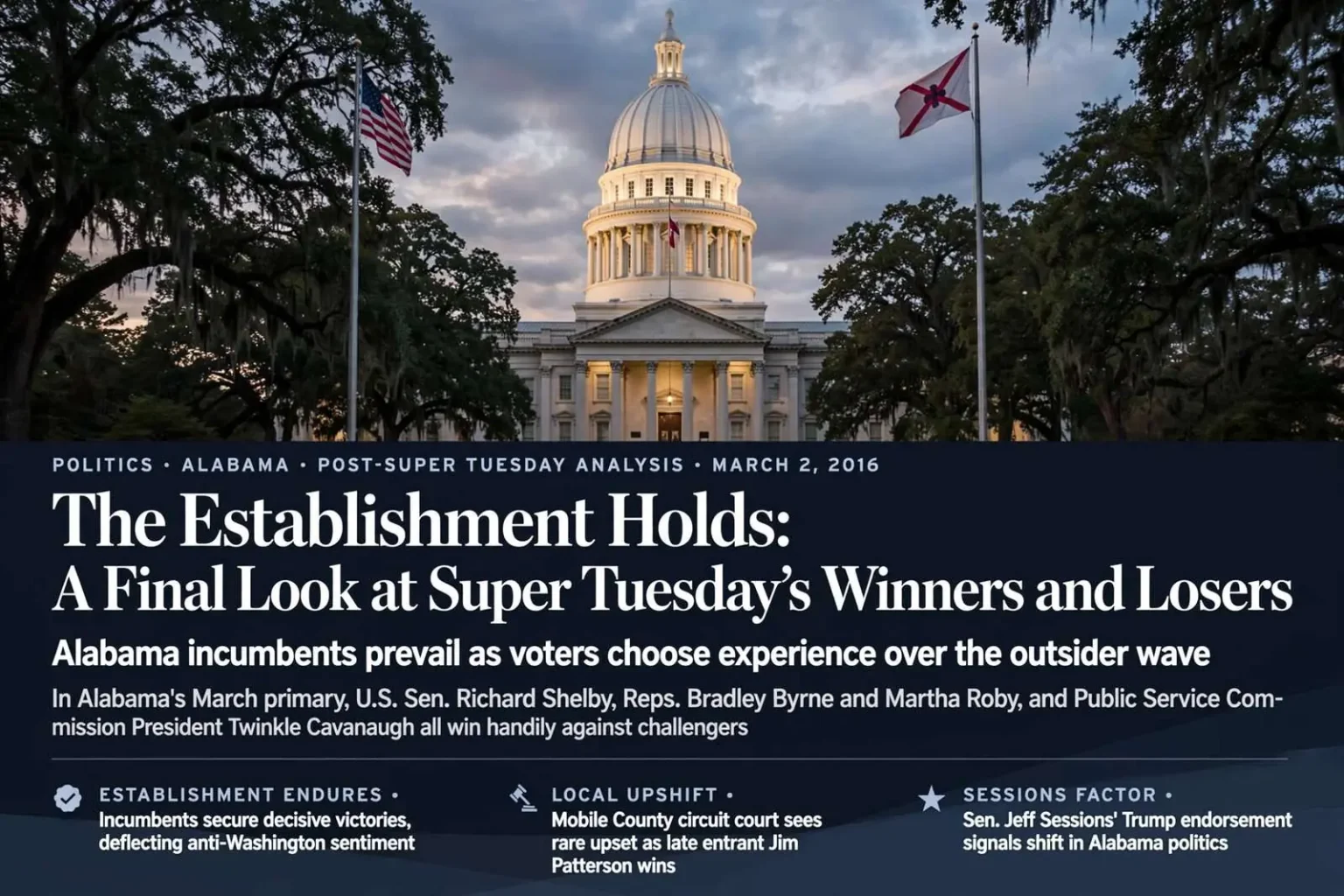
In the concluding round of post-Super Tuesday analysis, the area’s political observers returned to a single dominant theme: for all the talk of an anti-establishment uprising, Alabama’s established Republicans had emerged stronger than ever. The March primary had been framed, in much of the national coverage, as a season of revolt, with outsider candidates and insurgent challengers promising to sweep away the old order. What the returns actually delivered in Alabama, the panel agreed, was a night of confirmation for the officeholders who were supposed to be most at risk.
As with the earlier installments in the series, the comments are shared without names except where a contributor asked to be identified, in keeping with the long-standing custom of the panel. The anonymity is not decorative. Mobile and Baldwin County politics run on personal relationships, and the observers who assess campaigns each cycle often work for, against, or alongside the very candidates they are evaluating. Speaking off the record is what allows them to be candid about races that will still be shaping the courthouse and the congressional delegation long after the primary season ends.
‘Throw the bums out – except our bums’
One observer summed up the night as a classic case of voters wanting to clean house while keeping their own representatives. The phrase captured a contradiction that has governed Alabama primaries for decades: resentment of Washington and of distant political institutions, paired with genuine satisfaction toward the officials Alabamians actually send there. Voters may distrust the establishment in the abstract, the observer suggested, but they re-elect their own establishment figures by comfortable margins when the ballots are counted.
The results bore that out. U.S. Sen. Richard Shelby, U.S. Reps. Bradley Byrne and Martha Roby, and Public Service Commission President Twinkle Cavanaugh all won handily over challengers who tried to ride the national mood. Each had drawn opposition that sought to frame the race as part of a broader anti-Washington wave, and each dismissed it without apparent difficulty. In a state where the Republican primary is effectively the general election for most of these offices, surviving March meant the seats were settled for another term.
The lesson, in this reading, was that equating the presidential-year turbulence with a local tea-party wave badly oversimplified what was happening. Alabama’s conservative voters were angry at institutions, but they were not indiscriminate about it. They distinguished between a national Republican Party they saw as having failed them and a state delegation that had, in their view, consistently delivered the conservative record they were promised. Challengers who ran against “the establishment” without establishing a record or an organization of their own found the label did no work on Alabama ballots.
Shelby, the observer noted, was not merely an establishment senator but the very embodiment of the state’s political establishment, and he had won without being seriously pressed despite waging what looked like total war on his challenger. His seniority has made him one of the most consequential figures in the Senate on spending and defense matters, and the delegation he has built around Alabama’s military installations, aerospace employers, and federal facilities gives him a constituency that no ideological campaign message easily dislodges. Spending only a fraction of what he had available, he buried the challenge before it could gain definition.
Byrne, meanwhile, had insulated himself by governing well to the right of expectations, earning conservative credibility that blunted repeated attempts to paint him as an establishment figure. Since winning the southwest Alabama district in a special election, Byrne had compiled a voting record that challengers could not credibly characterize as moderate, and that record meant every attack ad had to fight the facts on the ground. The panel’s verdict was that a incumbent who does the work of building a record is far harder to beat than one who relies on the title alone.
Trump and Sessions
The panel read Donald Trump’s Alabama showing as the work of a candidate running, in effect, a third-party campaign inside the Republican primary. The formulation mattered, several observers said, because it explained both the intensity of his support and its durability. An independent candidacy would have split the anti-establishment vote in November and likely handed the state to the Democrats, as third-party bids have done to Republicans elsewhere in past cycles. By channeling the same energy through the primary instead, Trump captured voters who wanted to break the system without ever splitting the party’s general-election vote.
Several counted U.S. Sen. Jeff Sessions among the biggest winners of the cycle. The senior senator from Alabama had spent years arguing against the immigration consensus in Washington and against the trade and foreign policy establishments of both parties, positions that had made him a marginal figure within his own conference but made him one of the most credible validators in the country for the insurgent campaign. When Trump came to Alabama, the largest and most enthusiastic crowds of the primary season greeted him, and Sessions’s signature gave the movement a stamp of institutional respectability it had lacked.
By timing his endorsement of Trump to the eve of the Alabama vote, one observer argued, Sessions had positioned himself for a prominent role should Trump reach the White House. The judgment reflected an old rule of Alabama politics: an endorsement is worth most when it is both early enough to matter and late enough to be safe. Sessions had read the mood of his own electorate correctly, the panel agreed, and if the nomination went the way his home state had voted, he stood to be the establishment’s principal translator into a prospective administration. That calculation, more than any single election night, may have defined his standing in the cycle.
The courthouse, once more
The Mobile County circuit court race again drew comment, with Jim Patterson’s late-entry victory over the courthouse establishment’s preferred successor viewed as one of the more remarkable local outcomes. Patterson had entered the contest after the field was otherwise set, without the blessing of the legal community’s traditional power brokers, and had defeated a candidate whose support ran through the judges, lawyers, and officeholders who customarily decide courthouse races. Late entries rarely win in Mobile County judicial politics, where name recognition is usually accumulated over decades, which made the result the exception that proved the rule about the year’s volatility.
Observers wondered aloud how many supporters of the losing candidate would come around to help the winner, a question that spoke to the lingering tensions the campaign had exposed within the local bar. Judicial races differ from other contests in that the combatants must work alongside their rivals’ supporters for years afterward, and a campaign fought over the question of who the courthouse belongs to does not end at the polls. Several panelists noted that Patterson’s aggressive tactics had won the election but strained relationships that a new judge cannot easily replace, and that the true measure of the victory would only emerge as the professional community absorbed it.
The result also carried a warning for the courthouse’s informal leadership. For generations, an informal network of senior lawyers and sitting judges has effectively managed succession to the local bench, anointing successors and clearing fields. Patterson’s win demonstrated that the network’s endorsement, while still valuable, no longer guarantees anything on its own, a shift the panel attributed to the same voter impatience that was reshaping races far beyond Mobile County. Whether that shift is permanent or a quirk of an unusual presidential year was, the panel conceded, impossible to know.
The establishment endures
If there was a unifying verdict across the three installments of the panel’s analysis, it was that reports of the establishment’s demise had been greatly exaggerated. In race after race, the officeholders who were supposed to be most vulnerable to the year’s turbulence had instead run up comfortable margins, and the challengers who had positioned themselves as agents of revolt had been defeated by wide distances. The panel did not dispute that the mood was real; what they disputed was the assumption that the mood translated automatically into Alabama victories for whoever claimed it.
The distinction that mattered, several observers argued, was between anger at abstractions and judgment about individuals. Alabama’s voters could despise Washington while respecting a senator who chairs powerful committees, distrust the national media narrative while valuing a congressman who answers constituent mail, and reject the political class in the abstract while returning a public service commissioner who has stood for election in their living rooms for years. Anti-establishment campaigns that failed to do the work of distinguishing their own records from the system they denounced discovered that Alabama’s electorate was more discerning than the national storyline assumed.
The panel’s closing message was a caution against reading too much national narrative into Alabama’s returns, and a reminder that on the local ballots that would shape county government and the courts, experience and organization still counted for a great deal. Judicial races, county commission seats, and down-ballot offices are decided by turnout operations, endorsements, and years of accumulated familiarity, none of which a national wave can substitute for. The races that did upend expectations in March did so for local reasons, not because a national tide carried them.
The panel closed on a note of caution about the months ahead. With a presidential campaign certain to dominate the headlines through the summer and fall, the local officeholders who had just secured their nominations would still face general-election contests and the ordinary business of governing a fast-growing region. Road projects, court dockets, utility regulation, and the day-to-day demands of a expanding population do not pause for campaign season, and the panel noted that governing records compiled between elections are what give incumbents their protection in the first place.
Experience and organization had carried the day in the primary, the observers agreed, but the same volatility that scrambled expectations in March could just as easily return by November. The presidential contest would drive turnout patterns that no one could confidently predict, and a mobilized electorate does not automatically behave the same way in two different elections. That uncertainty left even the most seasoned handicappers reluctant to call the year before it was over, a rare admission in a state where primary night usually settles nearly everything that matters.