Senate Passes Homeland Security Bill Carrying Mobile River Bridge and Coast Guard Aircraft Money
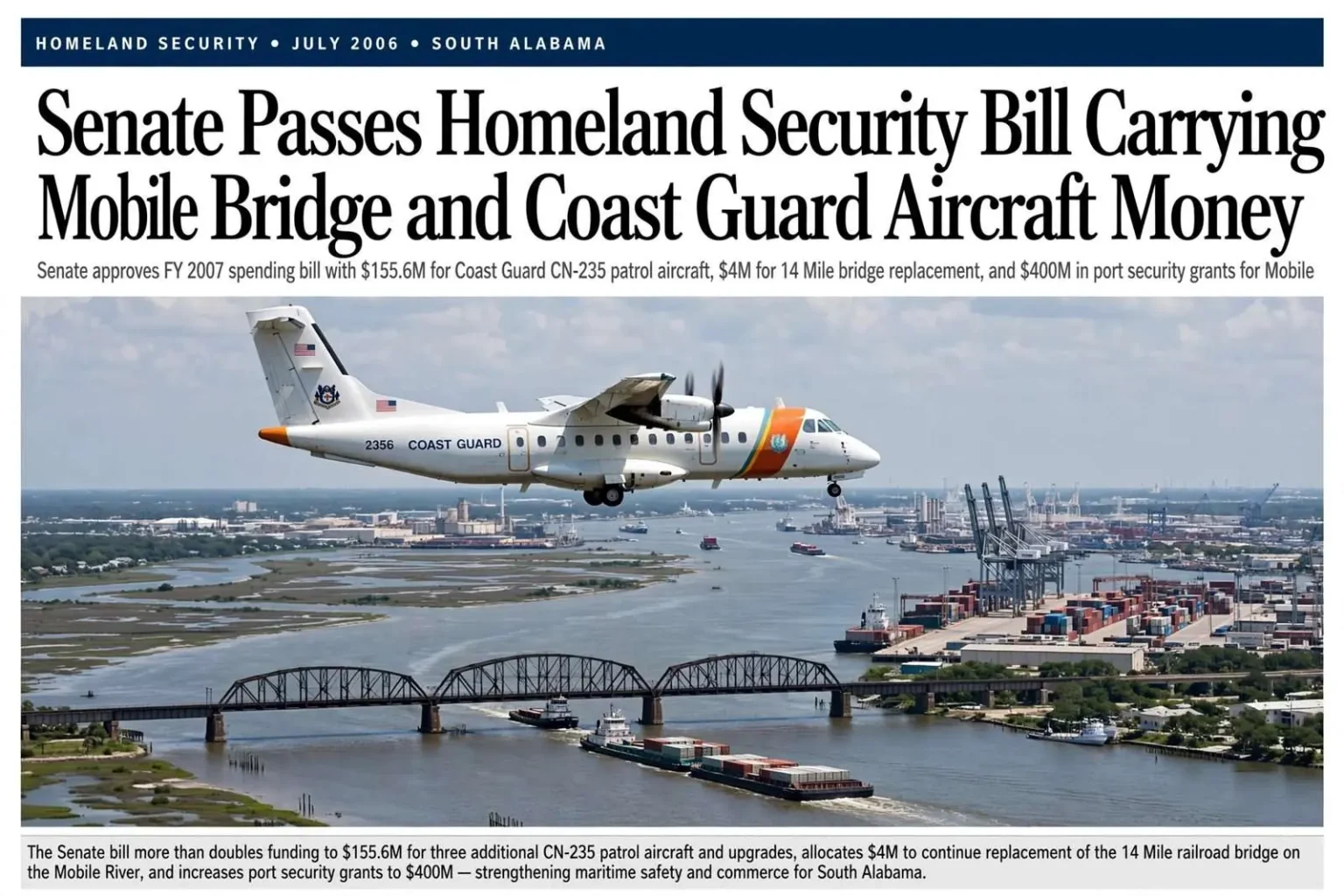
The full Senate approved a 2007 homeland security spending bill in July 2006 with $155.6 million for Coast Guard patrol aircraft trained on in Mobile and $4 million for the 14 Mile CSX bridge.
The full U.S. Senate approved a fiscal year 2007 homeland security spending bill in July 2006 that carried several items of consequence for South Alabama, sending the measure to a conference committee with the House of Representatives. U.S. Sen. Richard C. Shelby, R-Ala., a member of the Homeland Security Appropriations Subcommittee, announced the contents after passage. The Senate’s version was noticeably richer than the subcommittee draft that had cleared committee a few weeks earlier, most dramatically in its treatment of Coast Guard aviation.
For a region whose economy runs through its waterways — the Port of Mobile, the shipyards and terminals of the river system, the beaches and bays of the Gulf Coast — the bill’s aviation and navigation items were more than line entries in a spending measure. They represented the federal investment that keeps patrol aircraft over coastal waters and barges moving safely on the Mobile River, and they carried with them a direct connection to the aviation and maritime workforce of the Mobile area.
Patrol aircraft money more than doubles
The Senate bill contained $155.6 million for Maritime Patrol Aircraft, up sharply from the $77.6 million in the earlier subcommittee package. The larger figure funded the acquisition of three additional CN-235 aircraft and paid to missionize and outfit five previously acquired airframes to full mission-ready status. “The CN-235 Maritime Patrol Aircraft provides the patrol and surveillance capability necessary to keep our coastal waters safe,” Shelby said, calling the aircraft integral to the Coast Guard’s mission and to national security.
The doubling of the aircraft account was the single largest change between the subcommittee draft and the full Senate version, and it reflected the Coast Guard’s broader effort to modernize an aging fleet of patrol aircraft responsible for monitoring thousands of miles of coastline, shipping lanes and offshore facilities along the Gulf of Mexico and the Atlantic seaboard.
The program had a direct line to Mobile. In 2004, EADS North America announced an expansion into the city with a new EADS CASA facility, and all training for the CN-235 was to take place at the U.S. Coast Guard Aviation Training Center in Mobile. Every airframe Congress bought meant crews cycling through the Mobile training pipeline, sustaining the flight hours, maintenance work and instructor billets that made the training center a fixture of the region’s aviation economy.
The Aviation Training Center has long been one of Mobile’s quiet anchors of federal presence, housing Coast Guard aviation units and serving as the service’s primary site for rotary-wing training. Its role in the CN-235 program tied the city to the Coast Guard’s maritime patrol mission on a recurring basis: new aircraft, new crews, new courses of instruction, year after year, for as long as the procurement line remained funded.
The 14 Mile bridge again
The bill retained $4 million to continue replacing the 14 Mile CSX railroad bridge on the Mobile River, a structure long regarded as a hazard to barge traffic serving the Port of Mobile and the Black Warrior-Tombigbee waterway system. Shelby said replacement of the bridge would ensure safe marine navigation on the river, which he described as vital to the efficiency and reliability of waterways commerce through the port.
He added that a new bridge would save shippers millions of dollars each year in lost time and accidents and would assist the movement of cargo through the Alabama State Docks. The low-clearance span forces barge tows to slow, wait and sometimes break apart their consorts to pass beneath it, and every hour of delay on the river is an hour of added cost for the operators moving coal, timber, chemicals and grain between the port and the interior of the state.
The Mobile River corridor is the bottleneck where the Black Warrior-Tombigbee and Tombigbee waterways meet saltwater commerce. Tows that descend the river system funnel past the railroad bridge on their way to the port’s public terminals, and any restriction at that point backs up traffic for miles upriver. Replacement of the aging span had been a recurring request in Alabama’s federal appropriations asks for years, and the $4 million in the Senate bill represented another increment of funding toward a project whose total cost far exceeded any single year’s appropriation.
Port security grants jump
The Senate also expanded transportation security money to $567 million, up from $377 million in the subcommittee draft. The increase came almost entirely on the port side: port security grants rose to $400 million, from $210 million. The remainder was distributed as follows: $150 million for rail and transit security grants, $12 million for inter-city bus security grants and $5 million for trucking industry security grants.
“We have made great strides in improving our nation’s aviation security, but Americans deserve to have the government’s full attention devoted to the security of every mode of transportation,” Shelby said. In a working port city with an active waterfront, chemical terminals and a growing container trade, the shift of federal attention from airports to seaports was welcome news.
Port security grants had become the principal federal funding stream through which seaports hardened their facilities after the September 11 attacks — paying for surveillance systems, access controls, fencing, patrols and communications upgrades at terminals that handle everything from coal and forest products to petrochemicals. For the Port of Mobile and the private terminals along its waterfront, competition for those grants was perennial, and a doubled national pot improved the odds that Alabama projects would fare well in the next round of awards.
Training and firefighting
Two other large items rounded out the Alabama-relevant portions of the bill. The Center for Domestic Preparedness at Fort McClellan in Anniston received $57 million. Shelby described it as the cornerstone of the nation’s emergency responder training system and the only civilian live-agent training facility in the country, where law enforcement officers, firefighters and emergency medical personnel learned to respond to chemical and biological incidents.
The center’s status as the sole facility of its kind gave Alabama a recurring claim on the homeland security budget. First responders from across the country — and from the fire departments, sheriff’s offices and emergency management agencies of South Alabama — train there in realistic conditions involving actual chemical agents, a level of realism no simulated environment can match. Its funding line had to be renewed every year, which made the Senate’s $57 million figure an important signal to the departments that schedule their training calendars around it.
Firefighter Assistance Grants again drew $655 million, administered by the Department of Homeland Security’s Office of Domestic Preparedness. The grants could be spent on fire operations, firefighter safety programs, emergency medical services and firefighting vehicles, and were a significant source of equipment money for the volunteer and small-municipal departments spread across Mobile, Baldwin and Washington counties.
In rural Alabama, where a single volunteer department may cover dozens of square miles with a handful of used pumpers and a thin budget, the grant program often determines whether a department can replace a self-contained breathing apparatus, buy turnout gear that meets current safety standards, or put a dependable tanker in service. The program awards are competitive and require a local match, but for small departments the federal share frequently makes the difference between deferring a purchase for another year and equipping firefighters properly.
The bill also included $6 million for the National Center for Missing and Exploited Children, a comparatively small line in a measure of this size but one that supports the national clearinghouse and search network that local law enforcement agencies call on when children are reported missing or exploited.
Next steps
Senate passage did not settle the matter. The measure moved to a conference committee, where House and Senate negotiators would reconcile competing versions. Figures that looked generous in July could be trimmed before a final bill reached the president’s desk, a fact of legislative life that everyone from the Coast Guard to the volunteer fire departments of Mobile County understood well.
For the programs with Alabama ties, the Senate’s numbers set the upper bound of expectations. The conference with the House would produce the final fiscal 2007 allocations, and only when the president signed the appropriations measure would the aircraft purchases, the bridge work on the Mobile River and the next round of port and firefighter grants be assured.
The homeland security bill moved through the Senate with broad support, but its significance for South Alabama lay less in debate on the floor than in the arithmetic of its accounts. The Maritime Patrol Aircraft line, the 14 Mile bridge money, the port security grants and the responder training center each depended on a member of the Appropriations Committee — in this case Shelby, whose subcommittee seat gave Alabama influence over the exact programs that touch the Gulf Coast most directly.
That is how appropriations work in practice: a subcommittee member can move a program’s funding from the draft stage to the final bill, as the patrol aircraft account more than doubled between the subcommittee markup and full Senate passage. The port security increase followed the same path, rising by $190 million in a matter of weeks. Communities without a senior appropriator watch those numbers from the outside; Mobile, for reasons of seniority and the concentration of Coast Guard and port assets in the city, was inside the room.
The bill’s mix of items also illustrated how varied the homeland security budget had become in the five years after the 2001 attacks. In a single measure it funded aircraft for coastal patrol, navigation safety on an inland river, terminal security at the docks, training for the first responders of small-town Alabama, and equipment grants for volunteer fire departments — a reminder that the work of securing the country is carried out as much on waterfronts and rural roads as at airports and borders.