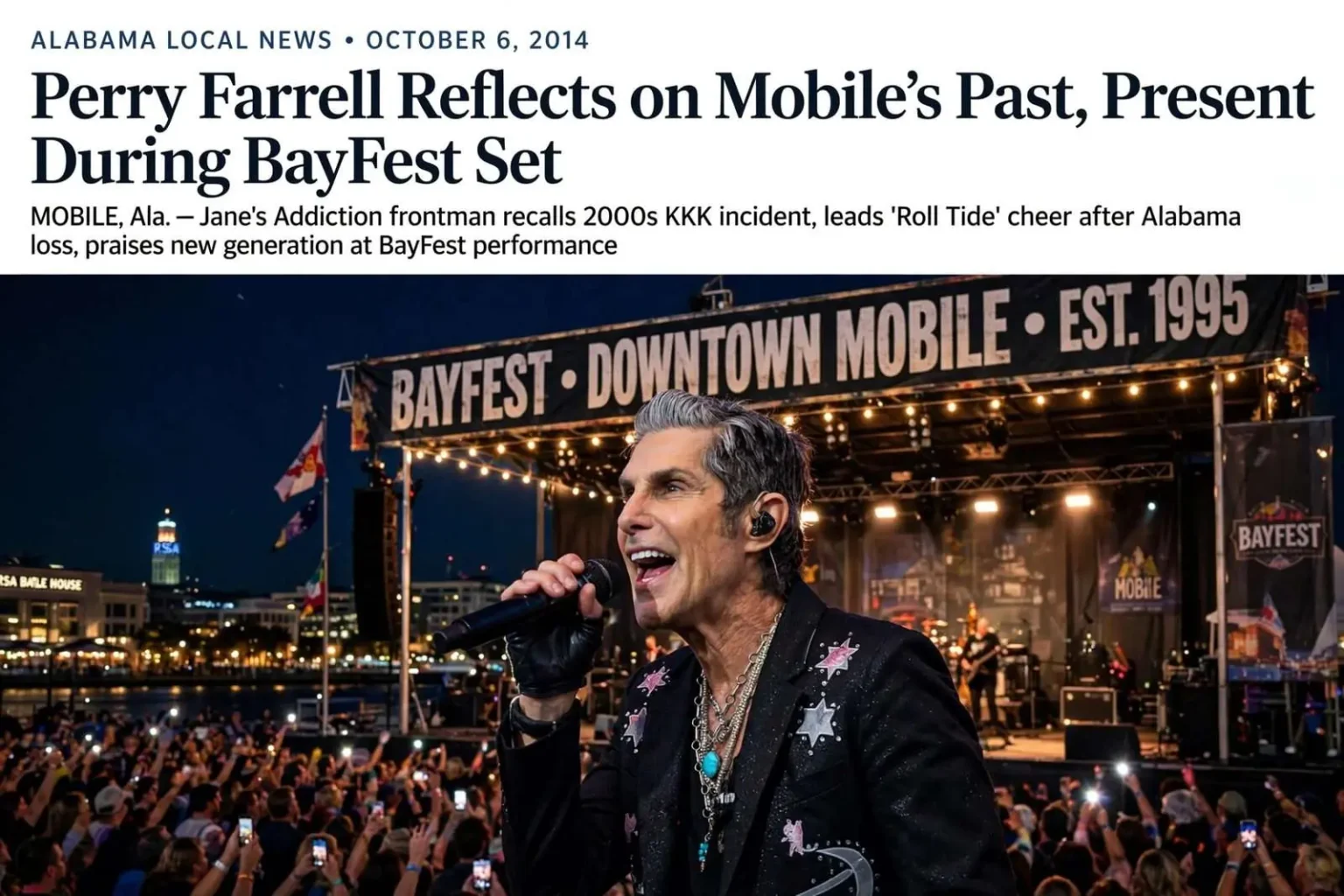
A band performs on stage at a Mobile music festivalJane's Addiction played a memorable set at BayFest in downtown Mobile.

MOBILE, Ala. — Perry Farrell knows how to read a room. Hours after Alabama’s football team suffered a tough loss to Ole Miss, the Jane’s Addiction frontman worked a hearty “Roll Tide” into his band’s set at BayFest in downtown Mobile, drawing an approving roar from the Crimson Tide faithful in the crowd.

But Farrell’s comments went well beyond football. Between songs, he told the crowd about Jane’s Addiction’s first visit to Mobile roughly two decades earlier, when he said members of the Ku Klux Klan harassed the band and left him with a lingering distaste for the city. On this night, though, Farrell said the atmosphere felt entirely different.

“This generation doesn’t give a (darn) about the KKK,” Farrell told the crowd, according to accounts of the performance. “We should all be proud we’re here tonight. This is the generation that got it right! You keep it up. This is the America I love!”

The moment stood out as one of the more memorable exchanges of this year’s BayFest, the multi-day music festival that draws national touring acts to Mobile’s downtown waterfront each fall. Jane’s Addiction, known for hits from the late 1980s and early 1990s alt-rock era, doesn’t list the Mobile stop on the band’s own official tour archives, making the appearance something of an under-the-radar moment for local fans who caught it live.

Video clips of the performance circulated online in the days that followed, capturing both Farrell’s frustration over the Crimson Tide’s 23-17 loss in Oxford, Mississippi, and his emotional pivot into the “Roll Tide” call a few minutes later. Because of some of the language used during the set, full video wasn’t widely rebroadcast, but clips and commentary spread quickly on social media, with concertgoers noting the band unexpectedly broke into a riff of “Sweet Home Alabama” mid-set — a nod to Southern rock that caught even longtime fans by surprise.

For a festival known for drawing acts from well outside the Gulf Coast, Farrell’s willingness to directly address Mobile’s history, and his read on how the city has changed, gave this year’s BayFest a moment of genuine local reflection amid the usual mix of national touring acts and hometown crowds.

Mobile is the county seat of Mobile County in southwest Alabama and the state’s only saltwater port. Situated where the Mobile River meets Mobile Bay near the northern Gulf of Mexico, the city has long served as a commercial and cultural gateway between Alabama and the wider Gulf Coast. Founded in 1702 as Fort Louis de la Louisiane and ruled in turn by France, Britain, and Spain before joining the United States in 1813, Mobile carries a layered heritage distinct from the rest of the state.

See also  Ambulance joyride results in moderate-to-major damage in Midtown Mobile

Today Mobile anchors a metropolitan area spanning Mobile County and neighboring Baldwin County, and it remains a center for shipping, aerospace, healthcare, and higher education in the region. Its downtown and waterfront have seen sustained revitalization, while historic neighborhoods preserve architecture from its colonial and antebellum past. The city’s identity is shaped as much by its working port and industrial base as by its festivals and food culture, making it a frequent focal point for news about growth and change in southern Alabama.

Alabama is a state in the southeastern United States bordered by Tennessee, Georgia, Florida, the Gulf of Mexico, and Mississippi. Often called the Heart of Dixie, it spans Appalachian foothills in the north and flat coastal plains in the south. Its largest cities include Birmingham, Montgomery, Huntsville, and Mobile.

Alabama’s history encompasses Indigenous roots, Spanish and French colonial settlement, a cotton-plantation economy, the Civil War and Reconstruction, and the Civil Rights Movement of the 1950s and 1960s, followed by a shift toward manufacturing, aerospace, and technology. Local news across the state frequently reflects this mix of tradition and change.

The Gulf of Mexico borders Alabama’s southern edge and defines much of the state’s coastal identity. Alabama’s Gulf coastline, centered on Dauphin Island, Gulf Shores, and Orange Beach, supports a tourism industry built around beaches, charter fishing, and marine recreation, while offshore waters host shipping lanes and energy interests.

The Gulf’s warm, shallow shelf and exposure to hurricanes make weather and disaster preparedness recurring concerns for communities from Mobile to Baldwin County. The marine environment also underpins commercial seafood harvests that have sustained Gulf Coast families for generations, tying the region’s economy and culture closely to the water.

Mobile lays claim to a long tradition of outdoor festivals and public celebration, most famously its Carnival or Mardi Gras season, which predates the better-known celebrations of New Orleans. Throughout the year the region hosts music festivals, food and arts events, and waterfront gatherings that draw visitors from across the Gulf Coast.

See also  Hangout Music Festival Unveils Star-Studded 2015 Lineup for Gulf Shores

Such events are economic and cultural anchors for the area, supporting hospitality, tourism, and local artists while fostering a sense of community identity. Organizing them involves coordination among city government, business sponsors, public-safety agencies, and volunteers, and they frequently appear in local news coverage of the region’s cultural life.

For many residents, these gatherings are also a point of civic pride and a way to mark the seasons. The mix of nationally known and local performers common to regional festivals reflects the area’s dual character as both a close-knit community and a stop on broader touring circuits.

The natural environment is central to life on the Gulf Coast, where barrier islands, bays, rivers, and wetlands support fisheries, recreation, and storm protection. Coastal Alabama faces challenges common to low-lying regions, including hurricane exposure, erosion, and the management of fragile ecosystems.

The Mobile-Tensaw Delta, one of the largest river deltas in the country, is a particularly significant natural asset. Conservation efforts, fisheries regulation, and shoreline restoration are frequent points of collaboration among state agencies, federal bodies like the Army Corps of Engineers, and environmental groups.

How the region plans for growth while protecting its natural assets is a recurring theme in local reporting. The tension between development pressure and ecological stewardship plays out in zoning fights, infrastructure projects, and disaster-recovery decisions that shape the coast for generations.

Collegiate athletics are a major part of life in southern Alabama, where the University of South Alabama in Mobile fields the Jaguars across a range of sports. The university’s football program, which began competition in the 2000s, has become a rallying point for students, alumni, and residents and a source of regional pride.

Beyond the campus, youth, high-school, and recreational leagues across Mobile and Baldwin counties sustain a deep local sports culture, and tailgating and game-day traditions reflect the social fabric of the community. Coverage of local teams regularly intersects with broader themes of economic impact, community engagement, and the role of athletics in mid-sized Southern cities.

Sports also serve as a lens on community investment. Stadium construction, scheduling, and the success of local programs ripple into nearby businesses and neighborhoods, making them a recurring and widely followed subject in regional reporting.

The history of South Alabama is shaped by its position at the crossroads of cultures and waters. Indigenous peoples, including the Muscogee (Creek) and Choctaw, lived in the region for centuries before European colonization by French, British, and Spanish powers.

See also  Free Breakfast Awaits Downtown Mobile Cyclists for Bike to Work Day

The cotton economy and the Civil War left deep imprints, as did the Civil Rights Movement, in which Alabama played a defining role. Understanding present-day debates in the region often requires appreciating this layered past, in which port commerce, racial history, and coastal geography have long intertwined.

That inheritance is visible in the architecture, street names, and institutions of the area. Public memory of the past informs contemporary conversations about growth, equity, and identity, and it frequently surfaces in coverage of local events and policy.

Local journalism serves as the connective tissue of communities like those across South Alabama, informing residents about government, schools, public safety, and the events that shape daily life. Outlets covering Mobile and Baldwin County help hold institutions accountable and give voice to neighborhood concerns larger media may overlook.

In an era of shifting advertising revenue and the rise of digital platforms, community news organizations have had to adapt how they gather and deliver information. The persistence of regional reporting remains important for civic engagement, particularly on issues such as coastal development, education, and local governance that directly affect residents.

The relationship between a local newsroom and its community is reciprocal: readers supply tips, context, and a sense of what matters, while the reporting provides a shared record of decisions and events. That loop is essential to a well-informed public.

Baldwin County sits directly east of Mobile County across Mobile Bay and is the largest county in Alabama by land area. It encompasses the Eastern Shore communities of Daphne, Fairhope, Spanish Fort, and Foley and stretches south to the beaches of Gulf Shores and Orange Beach along the Gulf of Mexico.

Long among the fastest-growing counties in the state, Baldwin blends suburban development near the bay with tourism-driven coastal economies. Its proximity to Mobile and its position on the Eastern Shore make it a recurring subject of regional news covering growth, infrastructure, schools, and the balance between development and coastal preservation.