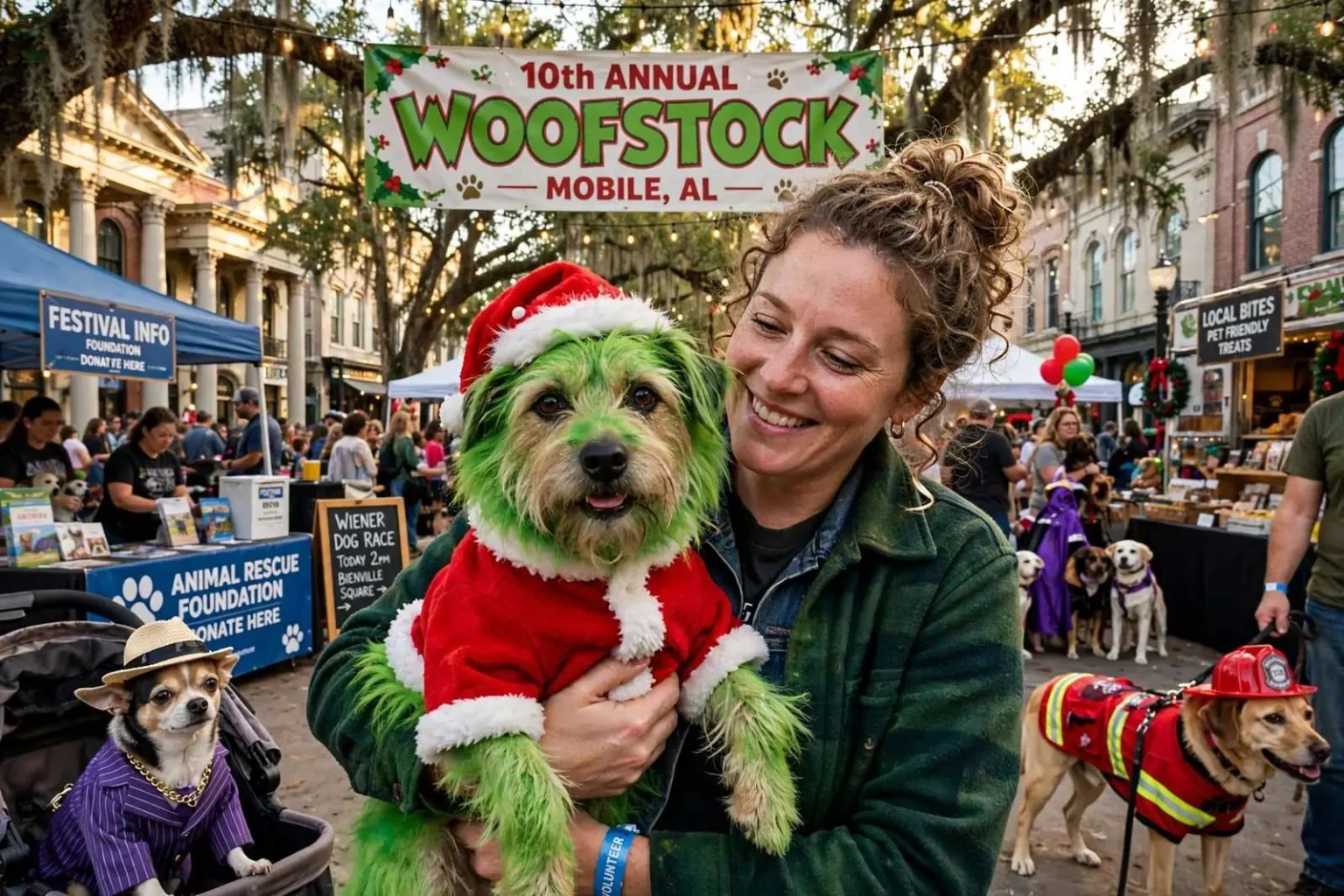
MOBILE, Ala. — Green fur, a Santa suit and a whole lot of holiday spirit were enough to make one Mobile terrier mix the star of this year’s Woofstock, the annual downtown festival that mixes pet pageantry with fundraising for the Animal Rescue Foundation.
Max, a terrier mix belonging to Mobile resident Seanna Mongan, took first place in the event’s doggie costume contest dressed as the Grinch, complete with green dye sprayed over his fur. Mongan said she sang “You’re a Mean One, Mr. Grinch” while getting him ready, a callback to last year’s costume, when Max went as fitness personality Richard Simmons. “I was elated,” Mongan said of the win. “It’s been five years in the making.”
Max edged out a colorful field of competitors, including a miniature Chihuahua dressed as a self-styled “gangster pimp,” a Labrador mix decked out as a firefighter, and a family that coordinated matching “Wizard of Oz” costumes with their three dogs. The contest included separate categories for small, medium and large dogs, plus a category for owners and pets who dressed to match.
Held in Bienville Square in the heart of downtown Mobile, Woofstock marked its 10th year drawing an estimated 5,000 people and their dogs. The festival, which benefits the Animal Rescue Foundation, typically raises between $25,000 and $50,000 for the organization through vendor booths, donations and event proceeds.
Beyond the costume contest, this year’s Woofstock featured live music from the Florida-based cover act Super Funk Fantasy, along with informational booths from local pet-focused organizations, food vendors and a wiener dog race that has become a crowd favorite in past years.
Mobile resident Alan Tolson brought his Siberian husky, Zeke, dressed as a yellow submarine for the occasion. “I think he’s just rocking it,” Tolson said of his dog’s costume as the two made their way through the crowded square.
For Mongan, the day was as much about her menagerie as the win itself. In addition to Max, she owns two other dogs, three cats and a rescued squirrel named Otis. Organizers say the event’s continued growth reflects Mobile’s deep affection for its four-legged residents — and its willingness to turn out downtown for a cause that helps them.
Mobile is the county seat of Mobile County in southwest Alabama and the state’s only saltwater port. Situated where the Mobile River meets Mobile Bay near the northern Gulf of Mexico, the city has long served as a commercial and cultural gateway between Alabama and the wider Gulf Coast. Founded in 1702 as Fort Louis de la Louisiane and ruled in turn by France, Britain, and Spain before joining the United States in 1813, Mobile carries a layered heritage distinct from the rest of the state.
Today Mobile anchors a metropolitan area spanning Mobile County and neighboring Baldwin County, and it remains a center for shipping, aerospace, healthcare, and higher education in the region. Its downtown and waterfront have seen sustained revitalization, while historic neighborhoods preserve architecture from its colonial and antebellum past. The city’s identity is shaped as much by its working port and industrial base as by its festivals and food culture, making it a frequent focal point for news about growth and change in southern Alabama.
Mobile lays claim to a long tradition of outdoor festivals and public celebration, most famously its Carnival or Mardi Gras season, which predates the better-known celebrations of New Orleans. Throughout the year the region hosts music festivals, food and arts events, and waterfront gatherings that draw visitors from across the Gulf Coast.
Such events are economic and cultural anchors for the area, supporting hospitality, tourism, and local artists while fostering a sense of community identity. Organizing them involves coordination among city government, business sponsors, public-safety agencies, and volunteers, and they frequently appear in local news coverage of the region’s cultural life.
For many residents, these gatherings are also a point of civic pride and a way to mark the seasons. The mix of nationally known and local performers common to regional festivals reflects the area’s dual character as both a close-knit community and a stop on broader touring circuits.
Charitable and nonprofit organizations form a vital safety net across South Alabama, addressing needs from hunger and homelessness to disaster relief and holiday assistance. Groups such as The Salvation Army operate local corps that provide shelter, food, and seasonal programs funded largely by community donations.
The generosity of Gulf Coast residents, often mobilized after hurricanes and economic hardship, underscores how tightly knit many of these communities are. Local philanthropy also relies on volunteers and corporate partners, and the progress of fundraising efforts is a recurring subject of regional news because it reflects the community’s capacity to care for its most vulnerable members.
Holiday campaigns in particular reveal the scale of need and the reach of volunteer networks. The rhythm of annual giving, from food drives to toy distributions, is woven into the regional calendar and into the coverage that keeps residents informed about how to help and where support is most needed.
Baldwin County sits directly east of Mobile County across Mobile Bay and is the largest county in Alabama by land area. It encompasses the Eastern Shore communities of Daphne, Fairhope, Spanish Fort, and Foley and stretches south to the beaches of Gulf Shores and Orange Beach along the Gulf of Mexico.
Long among the fastest-growing counties in the state, Baldwin blends suburban development near the bay with tourism-driven coastal economies. Its proximity to Mobile and its position on the Eastern Shore make it a recurring subject of regional news covering growth, infrastructure, schools, and the balance between development and coastal preservation.
Mobile Bay is a shallow estuary in southern Alabama where freshwater from the Mobile, Tensaw, and other rivers mixes with saltwater from the Gulf of Mexico. It is among the largest estuarine systems in the United States and supports commercial and recreational fishing, shipping through the Port of Mobile, and wetlands that buffer the coastline from storms.
The bay’s Eastern Shore, in Baldwin County, includes Daphne, Fairhope, and Spanish Fort, while the Western Shore lies in Mobile County. Its ecology and economy have guided settlement for centuries, and the bay figures in regional debates over development, navigation, and conservation. Events on either shore are routinely covered as part of the interconnected life of the Mobile metro area.
The Gulf of Mexico borders Alabama’s southern edge and defines much of the state’s coastal identity. Alabama’s Gulf coastline, centered on Dauphin Island, Gulf Shores, and Orange Beach, supports a tourism industry built around beaches, charter fishing, and marine recreation, while offshore waters host shipping lanes and energy interests.
The Gulf’s warm, shallow shelf and exposure to hurricanes make weather and disaster preparedness recurring concerns for communities from Mobile to Baldwin County. The marine environment also underpins commercial seafood harvests that have sustained Gulf Coast families for generations, tying the region’s economy and culture closely to the water.
Alabama is a state in the southeastern United States bordered by Tennessee, Georgia, Florida, the Gulf of Mexico, and Mississippi. Often called the Heart of Dixie, it spans Appalachian foothills in the north and flat coastal plains in the south. Its largest cities include Birmingham, Montgomery, Huntsville, and Mobile.
Alabama’s history encompasses Indigenous roots, Spanish and French colonial settlement, a cotton-plantation economy, the Civil War and Reconstruction, and the Civil Rights Movement of the 1950s and 1960s, followed by a shift toward manufacturing, aerospace, and technology. Local news across the state frequently reflects this mix of tradition and change.
The Federal Bureau of Investigation is the principal investigative arm of the United States Department of Justice, tasked with protecting the country against terrorist threats, foreign intelligence operations, cyber attacks, and major criminal activity. Established in 1908, the bureau operates a network of field offices across the country, each responsible for federal law-enforcement matters within its region.
Field offices such as the one serving Mobile work closely with state and local agencies, reflecting the bureau’s reliance on partnerships rather than unilateral action. The director, appointed by the president and confirmed by the Senate, sets national priorities that cascade down to individual offices handling everything from counterterrorism to public-corruption and civil-rights investigations.
Because federal agents are seldom the first to notice a threat in a community, much of the bureau’s effectiveness depends on tips and vigilance from local residents and police. That reality has made community outreach, including visits by senior leaders to field offices, a deliberate part of how the FBI maintains trust and communication with the public it serves.
Local law enforcement across South Alabama is carried out by municipal police departments, county sheriff’s offices, and state agencies that together cover a mix of urban, suburban, and rural territory. City departments handle policing within municipal limits, while sheriff’s offices provide courthouse security, jail operations, and patrol in unincorporated areas.
Cooperation among these agencies, and with federal partners, is central to tackling problems that cross jurisdictional lines, from drug trafficking to violent crime. Joint task forces that pair federal agents with local officers have become a standard mechanism for sharing information and concentrating resources on threats that no single agency could address alone.