Mobile Police Identify Woman Killed in I-10 Crash Near George Wallace Tunnel
Mobile police identified a 24-year-old woman ejected from a pickup truck after a rear-end crash on I-10 near the George Wallace Tunnel.
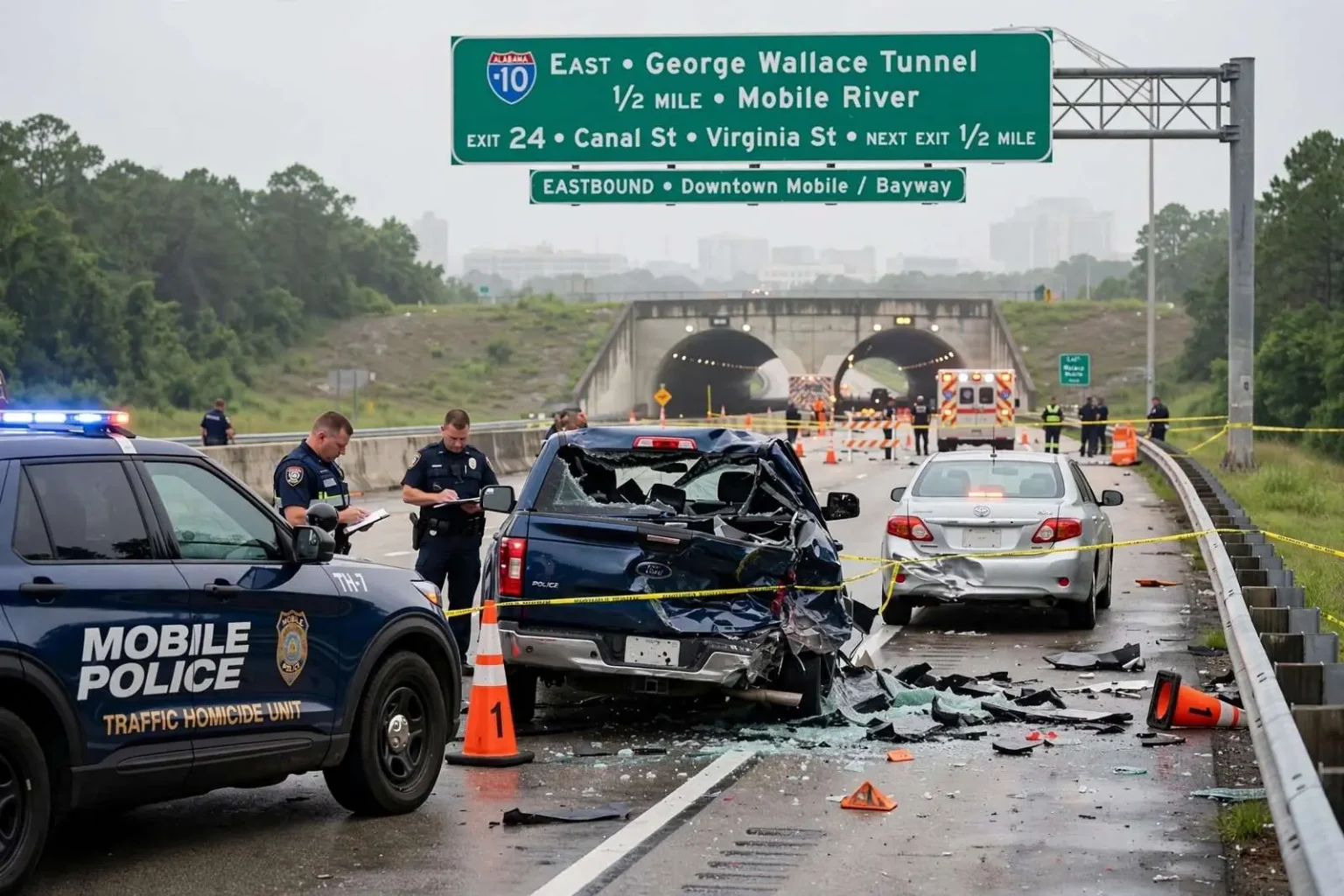
Mobile police have released the identity of a woman killed in a highway crash near the George Wallace Tunnel, an incident that unfolded on the Fourth of July along one of the city’s busiest interstate corridors. According to a Mobile Police Department spokesman, 24-year-old Vanessa Morales was riding in the back seat of a pickup truck traveling in the eastbound lanes of Interstate 10 between Canal Street and Virginia Street when the truck struck the rear of a stopped 2012 Toyota Corolla. The impact ejected Morales through the truck’s rear window, and she died as a result of the crash.
Police said officers responded to the scene shortly before midday, arriving to find a chaotic wreck on a stretch of interstate that carries heavy traffic through downtown Mobile even on a holiday. The timing could hardly have been worse for the corridor: the Fourth of July is one of the heaviest travel days of the year on the Gulf Coast, and the eastbound approach to the tunnel already slows to a crawl during routine weekday rush hours. Holiday travelers bound for the beaches and family gatherings across the region were moving through the area when the collision occurred.
Investigators determined that the pickup truck had been traveling at a high rate of speed and was unable to stop before colliding with the Corolla, which had already come to a stop in traffic ahead. A 14-year-old passenger in one of the vehicles was also injured in the crash, though police did not release additional details on the extent of those injuries or which vehicle the teenager had been riding in. Investigators said early indications did not point to drugs or alcohol as contributing factors in the crash, though the department stopped short of ruling out other possible causes tied to speed or following distance.
The Investigation Ahead
Officials also did not immediately say whether the driver of the pickup truck would face any criminal charges as the investigation continued. Police have not indicated whether additional charges or updates are expected as the investigation moves forward. The Mobile Police Department’s traffic homicide unit typically handles the follow-up investigation into fatal collisions of this kind, reviewing vehicle speeds, road conditions and driver statements before any charging decisions are finalized.
That process is methodical by design. Traffic homicide investigators reconstruct the sequence of a fatal wreck from skid marks, vehicle damage, witness accounts and the physical layout of the roadway before recommending charges, and in cases involving multiple vehicles in a congested corridor the reconstruction can take weeks. Until that work is complete, the department generally releases only the preliminary findings — the identities involved, the sequence of impact, and any early indications about impairment — which is what Mobile police did in the hours after the holiday crash.
A Corridor Known for Sudden Stops
The stretch of I-10 near the George Wallace Tunnel is a frequent chokepoint for Mobile traffic, funneling vehicles through downtown and under the Mobile River. Rear-end collisions and sudden slowdowns are common complaints from drivers who use the corridor daily, and Fourth of July travel typically adds to congestion as holiday traffic moves through the area. The tunnel itself — which carries the interstate’s four lanes beneath the river in two bores — narrows the roadway just as the approach curves drop vehicles into the downtown interchange, creating the stop-and-go pattern that locals know well.
The names of the roads involved tell locals exactly where the wreck happened. The eastbound lanes in that stretch pass between the Canal Street area and Virginia Street, on the downtown side of the river crossing where the interstate transitions from open highway to the tighter geometry of the tunnel approach. In that short distance, drivers go from interstate speeds to brake-lights-and-crawl in a matter of seconds — a stretch where a stopped car, a lane change and a fast-approaching truck all converge in the same few hundred feet of asphalt.
The corridor’s problems are structural. I-10 is the primary east-west artery for the entire Gulf Coast, linking Florida’s beach communities to the ports, refineries and population centers of south Alabama and Mississippi, and every one of those vehicles converges on the tunnel crossing at downtown Mobile. Commercial trucks, commuter traffic and tourist volume all compete for the same two-lane bores, with no shoulder for breakdowns and limited sight lines on the approach. When one driver brakes, the wave of sudden deceleration behind them is exactly the environment where high-speed rear-end collisions like this one happen.
Residents who travel that stretch of interstate regularly say the crash serves as another reminder of the risks posed by speeding and sudden stops in the tunnel approach, an area already known among local drivers for unpredictable traffic patterns during peak travel periods and holidays. The eastbound side, where Morales was riding, handles the outbound flow of weekend beach traffic and is often the busier of the two directions on holiday Fridays. Longtime residents have learned to leave early, reroute through the old surface streets, or simply avoid the tunnel approach altogether on days like the Fourth.
A Long-Debated Fix
The crash also lands in the middle of a decades-long civic debate about the future of the corridor. Planners and state officials have studied for years how to replace or supplement the tunnel crossing, and proposals for a new I-10 bridge over the Mobile River have been discussed publicly across multiple administrations. Any long-term solution would be one of the largest transportation projects in the state’s history, and in the meantime, the existing crossing continues to carry traffic volumes its mid-century designers never anticipated.
Until that debate produces something, the safety burden falls on driver behavior in a constrained space. Troopers and city police regularly patrol the tunnel approach, and safety campaigns aimed at the corridor emphasize the same fundamentals this crash illustrates: following distance, speed management through the curves, and attention to the brake lights that stack up without warning. A stopped vehicle in the eastbound lanes — whether from congestion, a breakdown or a prior collision — is a routine occurrence on this stretch, which is precisely what makes closing speeds on the approach so dangerous.
Aftermath and Reminders
For Morales’s family, the investigation’s technical timetable will matter far less than the fact that a 24-year-old died on a holiday morning in the back seat of a truck. The 14-year-old injured in the wreck adds another layer of grief to a crash that injured at least two people and shut down traffic through the corridor when police closed lanes to investigate and clear the scene. Holiday travelers already delayed by congestion faced extended slowdowns while emergency crews worked the wreck.
Police have not indicated whether additional charges or updates are expected as the investigation moves forward, and the department’s final determinations — on speed, on charges, on any contributing mechanical or roadway factors — will come only when the traffic homicide unit’s review is complete. What is already clear is the pattern: yet another serious rear-end collision in the tunnel approach, on a day when the corridor was at its most crowded, and another entry in the long record of why Mobile drivers treat that stretch of interstate with such caution.
How Mobile Police Handle Fatal Wrecks
The release of a victim’s name is typically the first formal step in a public accounting that unfolds over weeks. Mobile police follow a consistent protocol in fatal collisions: secure and document the scene, identify the deceased, notify next of kin, gather witness statements while memories are fresh, and hand the reconstruction work to specialists trained in traffic homicide investigation. Those specialists measure and photograph the roadway, download data from vehicle systems where possible, and reconcile the physical evidence with the accounts drivers give in the days afterward.
Only after that review do prosecutors weigh charging decisions, which in cases like this one can range from traffic citations to serious felony counts depending on what the evidence shows about speed, attention and driver judgment. The department’s careful early statement — acknowledging speed as a factor while declining to speculate about charges — reflects that process. Nothing in the preliminary findings suggested impairment, which distinguishes this case from the drunk-driving fatalities that drive most holiday-weekend traffic deaths on the Gulf Coast.
The Fourth of July is consistently among the most dangerous travel periods of the American year, and Alabama’s Gulf Coast corridors see their share of that risk. Holiday weekends combine three conditions that make crashes more likely and more severe: more vehicles on the road, more drivers unfamiliar with local roadways, and more drivers making long trips at the end of a long day. A rear-end collision at highway speed in a crowded holiday lane is the scenario those conditions most reliably produce.
For now, the investigation continues, the Corolla’s occupants and the pickup’s driver are left with the legal and human aftermath, and the eastbound approach to the George Wallace Tunnel goes back to being what it always is in summer: a narrowing, curving funnel of traffic where the distance between routine slowdown and tragedy is measured in seconds of following distance.