Mobile Habitual Offender Serving Life Denied New Appeal Hearing
The Alabama Court of Criminal Appeals has denied a rehearing petition from a Mobile man serving life without parole for a gas station robbery.
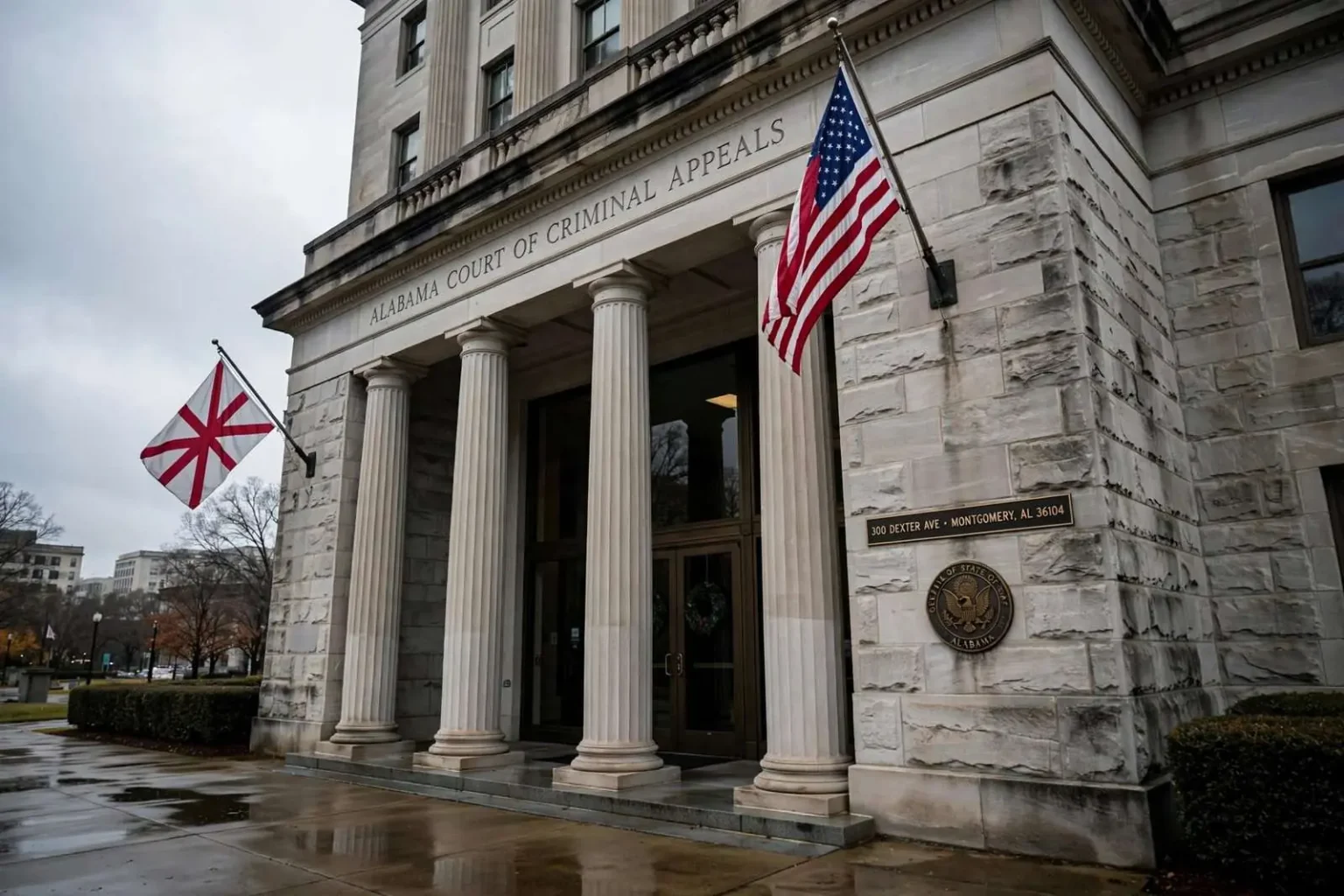
A Mobile man serving life in prison without the possibility of parole will not get another shot at an appeal, after the Alabama Court of Criminal Appeals denied his request for a rehearing. The decision effectively closes the latest chapter for Bryan Matthew Kennedy, now 38, whose case has become a pointed example of how Alabama’s habitual offender laws convert a repeat criminal record into a mandatory life sentence.
Kennedy was convicted by a jury of robbing a Summitt gas station in Mobile, marking his third robbery conviction since 1995. Court records show Kennedy had already served more than ten years in prison for earlier offenses before committing the gas station robbery that led to his current sentence, a history that placed him squarely within the reach of the state’s sentencing enhancement statute.
Circuit Court Judge John Lockett handed down the life-without-parole sentence under Alabama’s Habitual Felony Offender Act, which mandates that punishment for defendants previously convicted of a Class A felony who are found guilty of another qualifying offense. Because of Kennedy’s criminal history, the sentence was not discretionary once the jury returned its guilty verdict, meaning the judge had no latitude to impose a shorter term regardless of the circumstances of the individual case.
At trial, prosecutors built their case entirely on circumstantial evidence, telling jurors that cellphone records tied to Kennedy were the key piece of evidence linking him to the crime. There was no dispute about the underlying robbery itself: investigators say the robbery took place in January 2012, when a man used a 9mm pistol to hold up the gas station. What the jury weighed was whether the records and other circumstantial threads proved that the man holding the pistol was Kennedy.
Kennedy’s attorney represented him throughout the trial and subsequent appeal process, but the state’s appellate court found no grounds to grant a rehearing, effectively closing off that avenue for challenging the conviction and sentence. The denial leaves Kennedy serving the mandatory term, with the loss of a rehearing marking the end of the standard appellate route through the state courts.
The appellate ruling also underscores the practical weight that a prior record carries in Alabama courtrooms. By the time the gas station case reached trial, the outcome had effectively been predetermined by the intersection of the new conviction and the old ones: whatever the jury decided about the evidence, a guilty verdict carried an automatic sentence under the enhancement statute, and the appeal could not revisit the wisdom of that structure, only whether the conviction itself had been reached properly.
How the Habitual Felony Offender Act works
Alabama’s Habitual Felony Offender Act is one of the toughest sentencing enhancement laws in the country, and it operates in a fundamentally different way from the “three strikes” statutes found in some other states. Rather than simply lengthening a sentence, the law instructs courts to impose specific, elevated penalties based on the number and severity of a defendant’s prior felonies, and for defendants with a prior Class A felony conviction who are convicted of another Class A felony, the range includes life without the possibility of parole.
The law has been on the books in various forms for decades, and its defining feature is the removal of judicial discretion at sentencing. In an ordinary robbery case, a judge might weigh a defendant’s background, the circumstances of the offense and the recommendation of prosecutors before selecting a term of years. Under the enhancement, once the jury’s verdict establishes the conviction and the state proves the prior record, the sentence follows automatically, which is precisely what happened in Kennedy’s case before Judge Lockett.
Supporters of the statute argue that it is designed to keep repeat violent offenders off the streets by removing the discretion that might allow a career offender to receive yet another chance at rehabilitation. The law’s defenders point to cases in which defendants with lengthy records, including multiple robbery convictions, returned to armed crime after earlier prison terms, and they argue that the mandatory structure protects the public from the judgment calls that might otherwise set a repeat offender free.
The case highlights how Alabama’s habitual offender laws can result in mandatory life sentences for repeat offenders, regardless of whether the underlying offense in a given case involved violence resulting in injury. Kennedy’s robbery conviction stemmed from a holdup in which a pistol was displayed, but no injuries were reported, a fact that has colored the broader debate over how the statute treats first-degree robbery offenses committed without physical harm to victims.
Circumstantial evidence and the burden of proof
The reliance on cellphone records in Kennedy’s trial reflects the way modern prosecutions are built across the country, as location data and call records have become central tools for placing a defendant near a crime scene. Prosecutors in such cases walk jurors through the technical records step by step, arguing that the pattern of pings and calls corroborates the timeline of the offense and excludes innocent explanations.
Circumstantial cases also illustrate the appellate hurdles defendants face. A jury’s verdict is entitled to a strong presumption of correctness on appeal, and reviewing courts ask only whether there was substantial evidence from which jurors could reasonably reach the conclusion they did. When the evidence consists of records, timing and inference rather than eyewitness identification, appellate courts still defer to the jury’s assessment of what the pattern of evidence adds up to, which is why rehearing requests like Kennedy’s rarely succeed.
Legal experts say the law is designed to keep repeat violent offenders off the streets by removing judicial discretion once a defendant’s criminal history meets the statute’s threshold. That structure means appeals generally focus on the conviction itself, the admissibility of evidence or the validity of the prior convictions used for enhancement, rather than on whether the resulting sentence is proportionate to a particular offense.
Enforcement in Mobile County
Mobile prosecutors have used the Habitual Felony Offender Act in a number of high-profile cases in recent years, arguing that repeat robbery convictions and similar records justify the statute’s harshest penalties. The practice reflects a prosecutorial philosophy that treats the enhancement as a tool for the most serious repeat offenders, and it has made Mobile County one of the jurisdictions where the law’s consequences appear with regularity in sentencing records.
The use of the statute has tracked broader trends in Alabama criminal justice, where the state’s prisons hold a significant population of inmates serving enhanced sentences. Debates over the law surface periodically in Montgomery, with proposals over the years to adjust the eligibility thresholds, restore some measure of judicial discretion or expand earned-release opportunities, while victims’ advocates and prosecutors have pushed to preserve the statute as written.
What the denial means going forward
The denial of a rehearing is a routine procedural step in Alabama’s appellate system but a consequential one for the defendant. When the Court of Criminal Appeals denies a petition for rehearing, the court is saying that its written opinion adequately resolves the issues raised, and the case’s judgment becomes final within the court’s jurisdiction after the mandate issues. Defendants sometimes ask for a rehearing as a prelude to further review, but the overwhelming majority of such requests are denied without additional opinions, leaving the original decision intact.
For Kennedy, the denial of a rehearing means the life sentence stands, and his remaining options narrow considerably. A defendant in his position could seek further review from the Alabama Supreme Court, which accepts only a small fraction of petitions, or pursue post-conviction challenges in the trial court that raise issues outside the direct appeal, such as claims about the constitutional validity of prior convictions used to enhance the sentence.
Those avenues are narrow by design, and success is uncommon. Prior convictions used under the Habitual Felony Offender Act must have been valid, and challenges to them occasionally succeed where constitutional defects can be documented, but such claims require specific factual showings rather than general objections to the fairness of a life term for a non-injury robbery.
The case also offers residents a window into how sentencing works in Alabama’s courts, where the difference between an ordinary conviction and an enhanced one can be measured in decades. A jury that convicts on a robbery charge may not realize at the time that the defendant’s record has already fixed the outcome at sentencing, since the enhancement is determined by the court afterward based on the prior record the state proves.
With the appellate court’s denial now on the record, Kennedy will continue serving the mandatory life sentence imposed by Judge Lockett, and the Summitt gas station robbery of January 2012 stands as the third robbery conviction that put him there. For the courtroom observers and legal researchers who track Alabama’s habitual offender prosecutions, the case joins a long line of examples illustrating the reach of the state’s sentencing enhancement law — and the limited room that remains once it is applied.