Appeal Denied for Mobile Man Convicted of Beating Friend to Death With Bat
Alabama's Court of Criminal Appeals has upheld the murder conviction of a Mobile man who killed a former friend with a baseball bat.
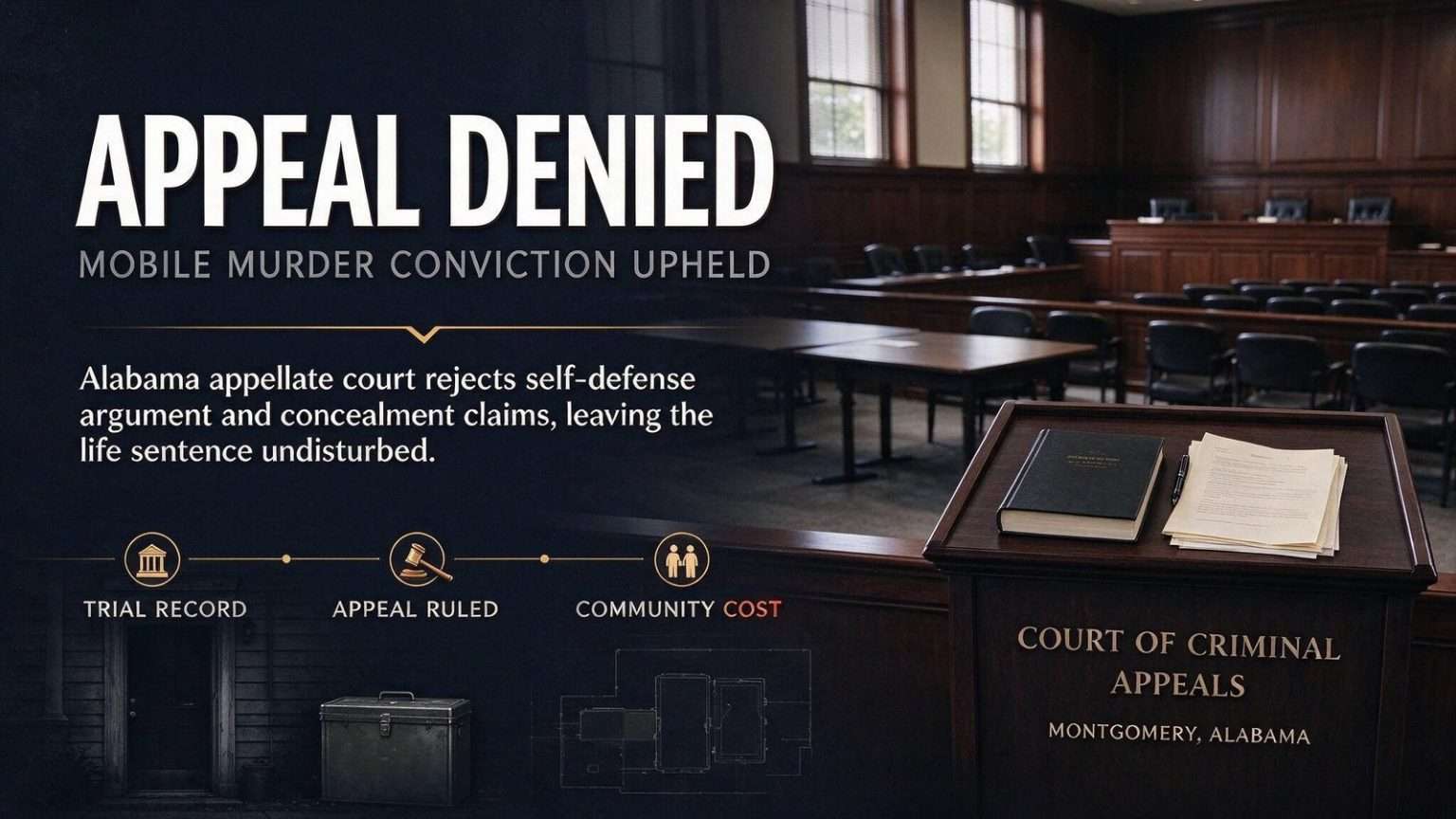
A Mobile man’s murder conviction will stand after Alabama’s Court of Criminal Appeals rejected his bid to overturn the verdict, closing another chapter in a case that shook the local community two years ago.
The defendant stood trial in the summer of 2013, accused of killing a 25-year-old man and hiding the body inside a toolbox. The two had graduated together from a Mobile high school in 2005 and remained friends for years afterward, according to testimony presented at trial.
The case drew significant attention locally because both the victim and the man convicted of killing him came from families that neighbors and acquaintances described as stable and close-knit, making the violence especially jarring for people who knew them. Neither family fit the profile that homicide investigations typically prepare the public for, and the trial testimony held a community’s attention precisely because of it.
According to court testimony, the defendant never denied causing the death but argued throughout the trial that the killing happened in self-defense after an argument escalated into a physical fight. The defense asked jurors to see a friendship gone suddenly, fatally wrong — a fight between two men who had known each other since their school days rather than a planned act of violence.
Prosecutors told a different story: that the killing was a settled matter of motive — money owed and a life taken to escape the debt — followed by a deliberate effort to conceal what had been done. The jury sided with the state after deliberating on evidence that included the circumstances of the victim’s disappearance and the eventual discovery of his body.
The case first came to light in the fall of 2012, when the victim failed to show up for work at his family’s construction business. His absence set off the search that unraveled the case: a young man with steady habits, gone without a word from a job where he was expected.
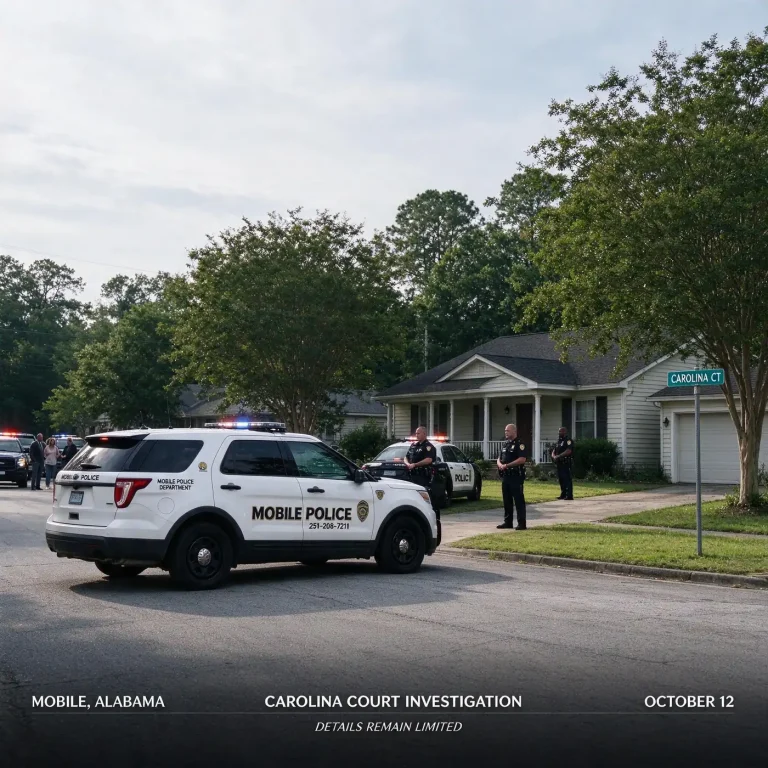
His mother went to check on him and discovered blood inside his home, along with signs that a violent struggle had taken place. There was no sign of her son. The scene a parent confronts in that moment — a missing child, blood on the floor, furniture displaced — became the starting point of a homicide investigation that Mobile police worked for months.
Investigators later determined that the victim’s wallet, backpacks, phone and a handgun were missing from the home, along with an aluminum bat his mother had given him for personal protection. That bat would turn out to be the murder weapon.
The Investigation
The missing belongings gave investigators a picture of a scene disturbed in more than one way. A wallet and phone suggest robbery; a handgun and a baseball bat suggest weapons removed from the home; backpacks suggest an effort to carry things away without leaving traces. Detectives piecing together those details faced a case in which the victim’s body — the center of any murder case — was still missing.
The victim’s body was eventually located inside a storage container on property belonging to the defendant’s parents. The discovery transformed the investigation: a missing-person case became a murder case with a location, a container and a family connection to the property where the body had rested.
For prosecutors, the hiding place answered the question juries always ask in such trials — what happened after the violence. A body concealed in a locked container on residential property pointed to someone with access to that property and a reason to keep the death hidden, testimony in the case indicated.
Testimony indicated the defendant struggled with drug use and owed the victim a sizable sum of money, which prosecutors argued was a motive for the killing. Debt between friends is among the most common motives in killings that otherwise confound investigators, and the state built its case around the argument that the victim had become an obstacle the defendant could no longer afford.
The defense countered with the self-defense narrative, pointing to the fight, the escalation and the argument that preceded it. But the concealment of the body — and the removal of the victim’s belongings from the house — cut hard against a claim that the death was an unplanned act of survival, and jurors evidently found the state’s account the more persuasive.
Despite the self-defense claim, a jury convicted him in June 2013, and a Mobile County circuit judge sentenced him to life in prison two months later. The sentence — the mandatory term for murder in Alabama — removed any discretion about punishment and left the defendant’s future to the appellate courts.
The Alabama Attorney General’s office handled the case throughout the appeals process. The state’s appeals lawyers defended the conviction by pointing to the trial record — the testimony about the debt, the struggle scene at the victim’s home, the body’s hiding place and the bat — and the Court of Criminal Appeals found no error that would warrant disturbing the verdict.
The appellate court’s review covered the standard questions raised in murder appeals: whether the evidence was sufficient to support the verdict, whether trial rulings favored the defense unfairly or the prosecution improperly, and whether the jury’s instructions matched the law. Rejection of an appeal at that level is the ordinary end of the road for most Alabama convictions, with the Alabama Supreme Court and, in rare cases, federal habeas review remaining as further but unlikely steps.
The trial itself had been a painstaking presentation of circumstantial and physical evidence. Investigators and witnesses walked jurors through the victim’s last known days, the scene at his home, the search that followed and the eventual discovery of the container on the family property. Cases built without eyewitnesses to the killing itself ask juries to draw conclusions from what surrounds a death — the debts, the struggle, the concealment — and the verdict here indicated that jurors followed that chain to its end.
Sentencing followed the conviction by two months, a brief interval by the standards of Alabama capital-adjacent litigation but a long one for the families involved. At sentencing, courts in such cases typically hear from the victim’s relatives, whose statements become part of the permanent record, and from the defense, which may present evidence of the defendant’s background and struggles in seeking the shortest lawful term. Life in prison was the required result for a murder conviction of this kind, leaving the judge no room to go lower.
The Court of Criminal Appeals, which decided the case, sits in Montgomery as one of Alabama’s two intermediate appellate courts and handles every criminal appeal from the state’s circuit courts. Its written opinions in murder cases like this one lay out the evidence in detail and address each claim of error the defense raises, creating a public record of the case that often reads as the most complete account of what happened that anyone will ever assemble.
Self-Defense Claims and Alabama Law
The case highlighted how Alabama’s self-defense law works in practice — and how hard the claim is to sustain when a killing is followed by concealment. State law allows a person to use deadly physical force when he reasonably believes it necessary to protect himself from death or serious physical injury, and Alabama’s stand-your-ground provisions remove any duty to retreat from a place a person lawfully occupies.
But the claim must survive the physical evidence. Prosecutors argued that a fight that ends with a victim beaten to death with his own protective bat, his house stripped of valuables and his body hidden in a storage container tells a story of more than panicked self-preservation. Juries in Alabama, as elsewhere, weigh the aftermath of a killing heavily when self-defense is asserted, because what a person does in the minutes and days after a death often reveals what he believed had happened.
The appellate court’s decision leaves that judgment undisturbed. The defendant will serve his life sentence, and the case now stands as the final word on an afternoon in the fall of 2012 that took one young man’s life and consigned another to prison.
The Broader Cost
For the victim’s family, the resolution brought the legal closure that families of homicide victims describe as only partial relief. A construction business lost a son; a mother who went looking for a missing child found instead the scene of his death; and the years of trial and appeal that followed kept the wound open through courtrooms and continuances.
For the defendant’s family, the case meant losing both men in different ways — one to death, one to a life sentence served in the Alabama prison system. Families on both sides of local murder cases often describe the experience as a shared catastrophe, and the ties between the two households here — school classmates, longtime friends, neighbors in the same city — made the aftermath harder still for the community that watched it unfold.
Mobile County’s circuit courts handle some of the heaviest criminal dockets in Alabama, and murder trials of this kind — where the accused and the victim grew up blocks apart — have become familiar entries on that docket. Prosecutors and judges in the county have long pointed to the pattern as evidence of how violence between acquaintances, not strangers, accounts for the bulk of the city’s killings.
The appellate ruling closes the legal case, but the questions it leaves — how a friendship ends in a beating death over money, what might have interrupted the path from debt to violence — belong to the community, not the courts. What the courts could decide, they have: the conviction stands, the sentence is final, and a Mobile family’s long wait for the law to finish its work is over.