Parole Denied for Serial Rapist Known as the Bay Minette Rapist
The Baldwin County District Attorney office fought and won the denial of parole for Anthony Terrell McCants, the serial rapist who terrorized Bay Minette in the early 1990s and is serving multiple life sentences.
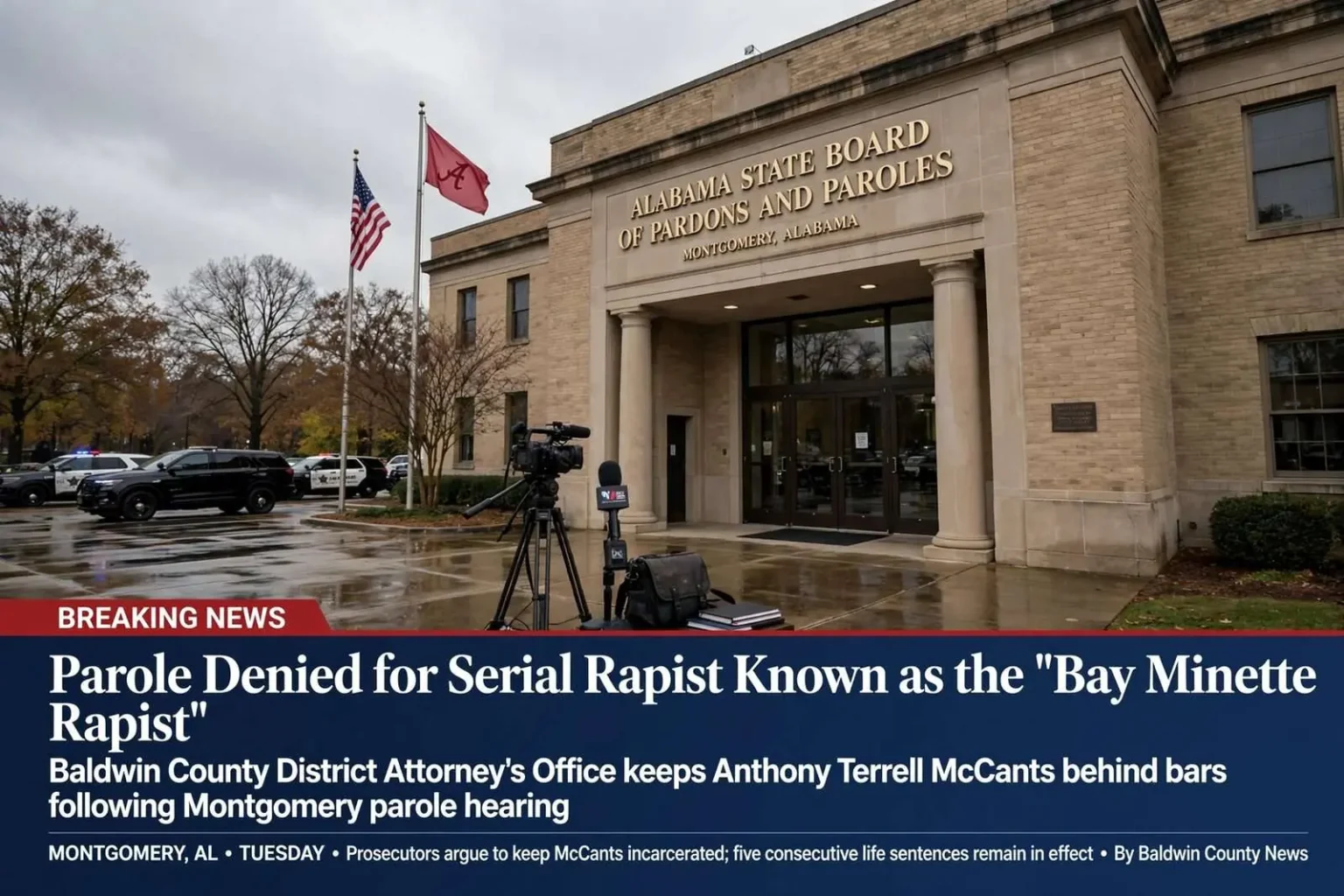
Parole was denied for Anthony Terrell McCants, the serial rapist who became known as the “Bay Minette Rapist,” after the Baldwin County District Attorney’s Office pressed the State Board of Pardons and Paroles to keep him behind bars, District Attorney Hallie Dixon announced.
The decision came at a Tuesday morning parole hearing in Montgomery, where the board weighed McCants’s case years after the crimes that terrorized the Baldwin County seat in the early 1990s. For the victims whose homes he invaded and the community that lived through his string of attacks, the hearing was the recurring moment when a decades-old conviction must be defended all over again — and the outcome confirmed that the sentences imposed then continue to carry their full weight today.
A hard-won denial
Dixon said her office considered it essential to appear in person when a violent offender like McCants came up for parole. “We feel that it is important for someone from our office to make the trip to Montgomery when a serious and violent felon such as McCants comes up for parole,” she said.
Deputy Chief Assistant District Attorney Rushing Payne attended the hearing and argued against his release. The appearance was not ceremonial. Alabama’s parole process allows prosecutors, victims and community members to present information and argument, and a board decision can turn on how fully the record before it reflects the nature of the original crimes — facts that grow fainter with every year that passes since conviction.
The practice Dixon described reflects a policy choice her office has made about the obligations that follow a conviction. Every sentence a court imposes runs through the parole system, and sentences like McCants’s — five consecutive life terms — remain subject to periodic review regardless of how certain the original punishment sounded in a courtroom. An office that chooses not to attend cedes the argument to whoever does; Baldwin County has chosen, in cases like this one, never to cede it.
The crimes
During the early 1990s, McCants — then 48 — terrorized Bay Minette, breaking into the homes of his victims and raping them. His victims ranged in age from 22 to 80, a span that made every woman in the community a potential target and gave the fear he spread its particular grip: no household could assume it was outside his pattern.
Home-invasion rapes are among the most destabilizing crimes a small city can experience. Unlike street crime, they penetrate the place residents expect to be safest, and a serial pattern means each news of another attack renews the alarm across the whole community — locks double-checked, weapons considered, women living alone watching their windows. Bay Minette lived through that season in the early 1990s, and the name the crimes attached to their perpetrator became shorthand for it.
The courts’ response was among the heaviest Baldwin County has imposed. McCants was convicted of five counts of rape, drawing five consecutive life sentences, and of two counts of attempted rape, for which he received sentences of life and 75 years. Consecutive sentences are the legal mechanism that makes such punishment stick: rather than merging into a single term, each life sentence begins where the previous one ends, meaning the parole board’s decision on any one term does not exhaust the rest.
“McCants had many victims — both young and old — who will feel safer knowing he is still behind bars,” Dixon said.
How Alabama’s parole system works
The State Board of Pardons and Paroles, sitting in Montgomery, holds authority over the release of prisoners serving indeterminate sentences, including those convicted of the most serious violent offenses. The board conducts hearings at which it reviews the inmate’s record in prison, the nature of the original offense, statements from prosecutors and victims, and any opposition filed. Decisions are announced at the hearing, and in cases of denied parole the board typically sets a future date when the case will be reconsidered — which is why convictions from decades ago continue to generate hearings, and why district attorney’s offices maintain files on offenders whose cases will return again and again.
For victims, the structure of the system means the original sentence is not the end of their engagement with the case. Each parole cycle reopens the record, and victims who wish to oppose release — in person, in writing or through a representative — must do so within each review window. Victim advocacy offices across Alabama exist largely to help victims navigate that recurring obligation, and prosecutors’ attendance at hearings like McCants’s serves those victims when they cannot make the trip themselves.
The board’s standard in violent cases weighs the gravity of the original offense heavily, and a serial pattern of home-invasion rape with elderly victims among them presents the kind of record that historically has produced denials. But the outcome is never automatic, which is the point the Baldwin County District Attorney’s Office has made by showing up: the argument must be made, every time, by someone.
Standing with victims
The parole denial reflected a commitment by the district attorney’s office to remain engaged long after a case ends. That posture carries practical significance for how justice functions in Baldwin County. Prosecutors’ offices handle hundreds of cases at a time, and older cases — especially those from decades past — can drift toward the margins as staffs turn over and files age. Dixon’s office has positioned itself against that drift in McCants’s case, treating the trip to Montgomery as a duty attached to the conviction itself.
For the residents of Bay Minette who lived through the fear McCants sowed two decades earlier, the outcome offered reassurance that resolve to keep him imprisoned had not softened. The women he attacked — whose ages ranged from 22 to 80 — and their families have carried the case longest, and the board’s decision confirmed that their stake in the outcome is still recognized by the system that convicted him.
By making the trip to Montgomery and speaking against release, prosecutors underscored that a conviction carried an ongoing obligation to the people it was meant to protect.
What comes next
Parole denials of this kind do not close the file permanently. The board sets a future reconsideration date, and McCants’s case will return to a Montgomery docket on that schedule — with the Baldwin County District Attorney’s Office signaling its intention to be present each time. Payne’s argument at this hearing, Dixon’s announcement of the result, and the public record both created will form part of the case file the board reviews next time.
The sentences themselves remain the strongest safeguard: five consecutive life terms plus the attempted-rape sentences of life and 75 years mean that release, if it ever comes, would not be a single decision but a sequence of them. For now, the board has weighed the case and answered as the victims and the community asked — the Bay Minette Rapist remains behind bars, and the office that put him there plans to keep arguing that he stays.
Baldwin County’s system for keeping violent offenders in
The McCants hearing illustrates a prosecutorial practice that has taken root across Baldwin County: treating parole opposition as a standing program rather than a case-by-case reaction. Under that approach, the district attorney’s office tracks the parole schedules of its most serious violent offenders, prepares for each hearing as the date approaches, and sends an experienced prosecutor to Montgomery to argue against release in person. The logistics matter — Montgomery is hours from Bay Minette, hearings fall on working days, and the costs accumulate with every cycle — which is why many offices limit their participation to written filings.
Dixon’s office has concluded that in-person advocacy produces different results, and her public statements frame the choice in terms of duty to victims. When a deputy chief assistant district attorney stands before the board and recounts the facts of the original crimes — the broken-in doors, the ages of the women, the string of attacks that gave the perpetrator a nickname — the board hears those facts with the force of the office that proved them in court. A written summary of the same facts reads differently, and offices that attend hearings consistently say the difference is real.
The community’s long memory
Bay Minette’s experience with McCants belongs to a category of crime that small Southern cities remember for generations. The city, the seat of Baldwin County government, is a close-knit community of historic neighborhoods and church networks where word of a home invasion travels within hours and a serial predator’s pattern redraws daily life — lights left on, doors double-locked, families rearranging their evenings until an arrest restores some normalcy.
When the arrest came and the courts imposed sentences of five consecutive life terms plus life and 75 years for attempted rape, the community’s part in the case shifted from fear to vigilance: the understanding that prison sentences in the parole era require periodic defense. That understanding has now spanned decades, and the most recent hearing showed it intact — the same office, the same argument, the same result.
For the victims, whose ages at the time of the attacks ranged from 22 to 80, each parole cycle is a decision about whether to engage again. Some speak for themselves; others rely on the district attorney’s office to carry their opposition. The office’s commitment to attend every hearing involving offenders like McCants exists precisely so that no victim’s protection depends on her ability to travel to Montgomery and relive the crimes in person.
The meaning of consecutive life sentences
The structure of McCants’s punishment deserves attention because it explains both the board’s options and their limits. Sentences imposed consecutively run one after another rather than at the same time, so parole eligibility arises term by term: even if the board someday found grounds to release on one life sentence, the next would follow, and the next. It is the sentencing structure prosecutors seek in serial-crime cases precisely because it makes release a sequence of high bars rather than a single gate.
Parole boards respond to that structure in predictable ways when the underlying crimes are as grave as these. A serial offender whose victims spanned the adult lifespan, whose method was home invasion, and whose crimes number in the multiple counts presents a record that boards have historically treated as disqualifying — but only when the record is put before them with the fullness the original trial produced. That is the work Payne performed at Tuesday morning’s hearing, and the work Dixon’s office has pledged to repeat whenever the case returns.
The denial keeps a decades-old promise to the women of Bay Minette: that the man who broke into their homes and attacked them would answer for it for the rest of his life. The board’s decision this week upheld that promise, and the Baldwin County District Attorney’s Office made clear it will be in Montgomery to defend it again the next time the question comes up.