Stockton Family Brings New Life to 1911 Farmhouse on Historic Bryant Property
A retired Robertsdale native has spent nine years restoring a century-old farmhouse and its outbuildings on a 60-acre Stockton property.
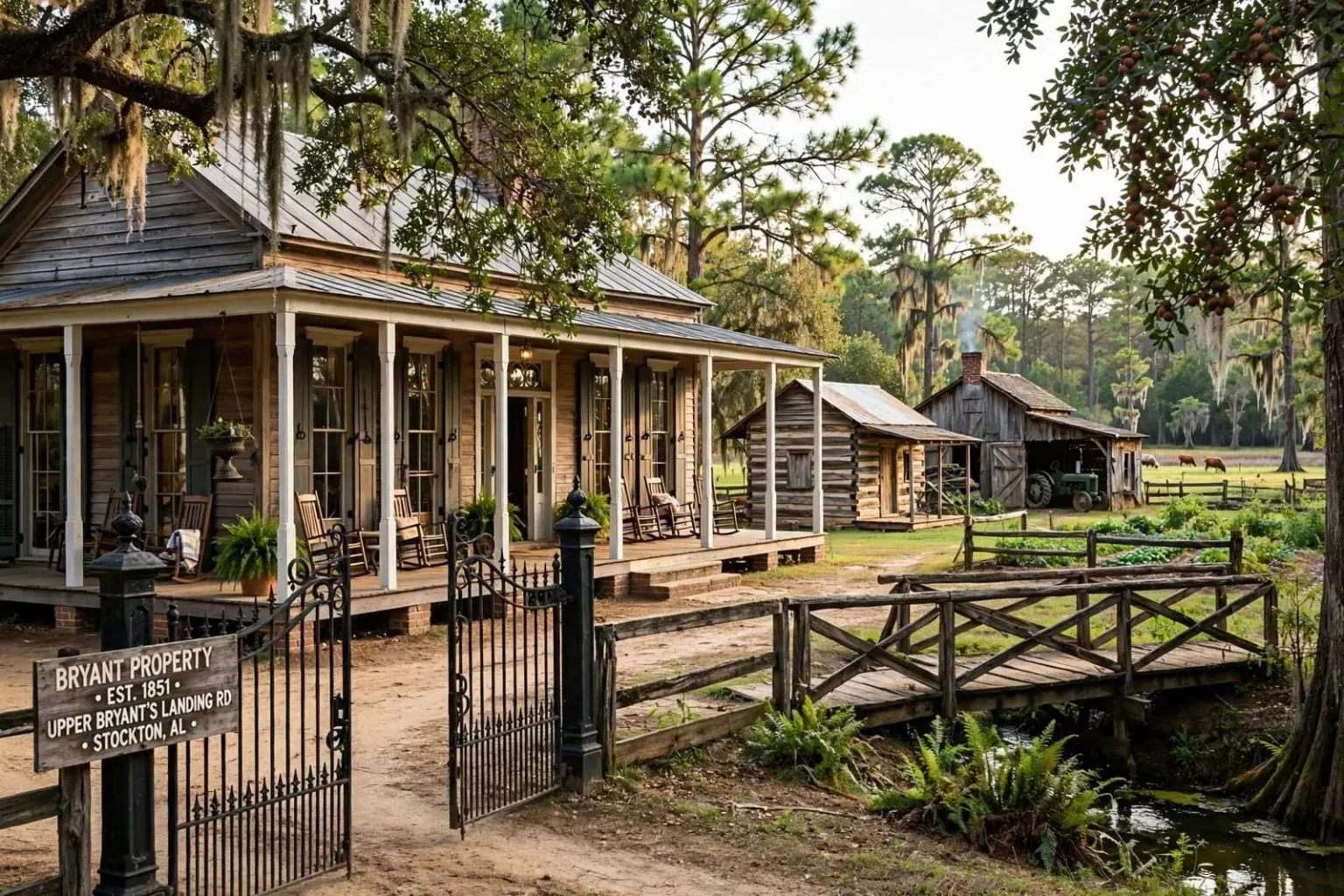
STOCKTON — Tucked behind a black iron gate off Upper Bryant’s Landing Road in Stockton sits a piece of south Alabama history that one retired local resident has spent nearly a decade bringing back to life. The 71-year-old retiree, who grew up working odd jobs in Robertsdale as a child, bought the roughly 60-acre property on a whim back in 2005 after his daughter urged the family to attend an antiques sale being held there.
What he found was a circa-1911 farmhouse and a collection of outbuildings that had sat overgrown and neglected for years, dating back to a family that had owned the land since around 1900. Before that, the property had belonged to another family who built a one-room house and barn on the site back in 1851. The layers of ownership trace the agricultural history of northern Baldwin County, where family farms along the Tensaw River drainage supported generations of settlers who raised cattle, timber and crops in the piney woods above Mobile Bay.
Since acquiring the home at auction, the new owner has restored the farmhouse board by board. The 4,000-square-foot structure is built entirely of tongue-and-groove pine, with 14-foot ceilings, a central hallway designed to channel cooling cross-breezes, and a wraparound porch. Original transoms discovered stored in the barn have been reinstalled above interior doorways, and long-forgotten window weights were tracked down and restored so the home’s floor-to-ceiling windows can still be opened during mild weather.
The restoration philosophy has been preservation rather than renovation. Every board that could be saved was saved, and the features that made the house workable in an era before electricity and air conditioning — the deep porches, the high ceilings, the breeze-catching central hall — were treated as assets to be maintained rather than inconveniences to be engineered away. In an age of new construction, the farmhouse stands as a working example of how south Alabama’s builders once designed homes around the climate itself.
Outbuildings That Tell Their Own Stories
The surrounding grounds tell just as rich a story. Behind the main house sit several weathered outbuildings tied to the property’s earliest owners, including a one-room home built in 1851 that is now heated, cooled and used as guest quarters, along with a smokehouse and a barn believed to have sheltered Confederate soldiers and their horses during the Civil War.
The 1851 structure is the oldest building on the property and among the older surviving dwellings in that part of Baldwin County. Its conversion into guest quarters kept its simple one-room footprint intact while making it livable for modern visitors, and family members say staying in the little house is a favorite part of any visit for grandchildren who want to sleep in a building that predates the Civil War.
The barn, meanwhile, has taken on a second life as a working outbuilding and a favorite play spot for the owner’s grandchildren. Today it houses a vintage 1937 tractor, an operational piece of farm equipment from the same era the property’s fields were last worked intensively, and the building’s worn timbers carry the accumulated history of more than a century and a half — from its believed wartime sheltering of soldiers and horses to its modern role as a curiosity and playground for the family’s youngest generation.
Smokehouses like the one still standing on the property were once essential to every rural farmstead in Baldwin County, providing a way to preserve pork through the Gulf Coast’s humid summers before refrigeration. Its survival on the Stockton property offers a rare physical reminder of the self-sufficient farming cycle that sustained families here — slaughter in the cool months, curing in the smokehouse, gardens and orchards through the growing season.
A Gathering Place for a Baldwin County Family
The family, based mainly in Bay Minette, uses the farm as a gathering place for holidays and weekends, raising cattle, tending a vegetable garden and harvesting pecans from trees on the property. The working-farm rhythm gives the restoration a purpose beyond aesthetics: the pasture, garden and pecan trees tie the modern family to the agricultural uses the land has seen since the 1800s.
A creek on the land eventually feeds into the Tensaw River, and a bridge built by the owner crosses it near the back of the property. The waterway connection underscores the property’s setting in the Mobile-Tensaw Delta country, one of the most ecologically rich regions in Alabama, where bottomland forests, creeks and rivers thread north from Mobile Bay through some of the wildest remaining landscape in the southern part of the state.
Furnishings throughout the home reflect the family’s decades of collecting, including handmade early-1900s pieces and a working antique phonograph with more than 100 records. The phonograph in particular has become a conversation piece at gatherings, spinning period recordings in a house whose era it was built to soundtrack, and the handmade furniture — much of it collected at the same antiques sales that brought the family to Stockton in the first place — fills rooms built by craftsmen working a century ago.
The antiques connection is fitting. Stockton and the surrounding northern Baldwin County countryside have long been a destination for collectors, with antiques shops and seasonal sales drawing buyers from Mobile and Baldwin County’s growing suburban communities. It was precisely that tradition that put the property in front of the family in 2005, when a daughter’s suggestion to attend an antiques sale turned into the purchase of a lifetime.
From Auction Find to Family Legacy
The purchase in 2005 set off a restoration project that has consumed the better part of two decades for the retiree, who began the work with no formal preservation training but with the practical skills of a lifetime of odd jobs around Robertsdale and Baldwin County. Board by board, the farmhouse came back — structural repairs first, then the careful reassembly of the details that give the home its character: transoms, window weights, tongue-and-groove walls and the broad porches that wrap the structure on all sides.
Projects of this scale on historic homes are unusual in fast-growing Baldwin County, where new subdivisions have transformed much of the county’s landscape over the past two decades. The survival of a circa-1911 farmhouse with its 1851 outbuildings intact offers a counterpoint to that growth, preserving in one place a cross-section of how life along the upper Tensaw looked from the mid-nineteenth century through the early twentieth.
The family has already hosted weddings at the property, with another planned for a grandchild later this year, continuing a tradition of bringing celebration back to a home that once sat empty and forgotten. Those events have turned the farm into more than a private restoration project — each gathering fills the wraparound porch and the grounds with the same kind of community life the property knew in its farming era.
For the 71-year-old owner, the decade-plus of work has been its own reward. The farmhouse that emerged overgrown and neglected from behind the black iron gate now stands restored, its 14-foot ceilings open, its floor-to-ceiling windows lifting on their original weights, its barn and smokehouse and one-room guest house still marking the passage of more than 160 years on the same patch of Baldwin County ground. What began as a whim on the way to an antiques sale has become a legacy the family intends to keep — a working farm, a gathering place and a preserved piece of south Alabama history on Upper Bryant’s Landing Road in Stockton.
The pecan trees on the property represent another layer of south Alabama agricultural heritage. Pecan orchards have been a fixture of Gulf Coast farming since the late nineteenth century, when commercial groves spread across Baldwin County’s sandy soils, and the trees still bearing nuts on the Stockton farm give the family an annual harvest that connects the modern property to its farming past. Fall gatherings at the farm often include gathering pecans from the same trees earlier owners would have harvested, alongside the vegetable garden that supplies the family’s holiday tables.
The cattle operation, meanwhile, keeps the pastures in agricultural use, and the sight of livestock grazing behind the restored farmhouse completes the picture of a property that has never entirely stopped being a farm. Across northern Baldwin County, former farmland is steadily being carved into residential development along the corridors between Bay Minette, Stockton and the Interstate 65 communities, making working farms of this scale increasingly rare in the area.
Historic preservation experts often note that the survival of structures like the 1851 one-room house depends almost entirely on owners willing to maintain them, since no legal protection attaches to most private rural buildings of that era. The Stockton farmhouse and its outbuildings survived their years of neglect in large part because the tongue-and-groove pine construction was sound enough to endure, and they will survive the next century because of the restoration work now complete — repaired, painted, roofed and furnished, with a family committed to using the property rather than merely maintaining it.