A Spanish Fort Food Pantry Gave Away 1.4 Million Pounds of Food Last Year. It’s About to Get Even Bigger.
Prodisee Pantry gave away 1.4 million pounds of food to more than 11,000 Baldwin County families last year, and is now raising money to open a second location near Stockton.
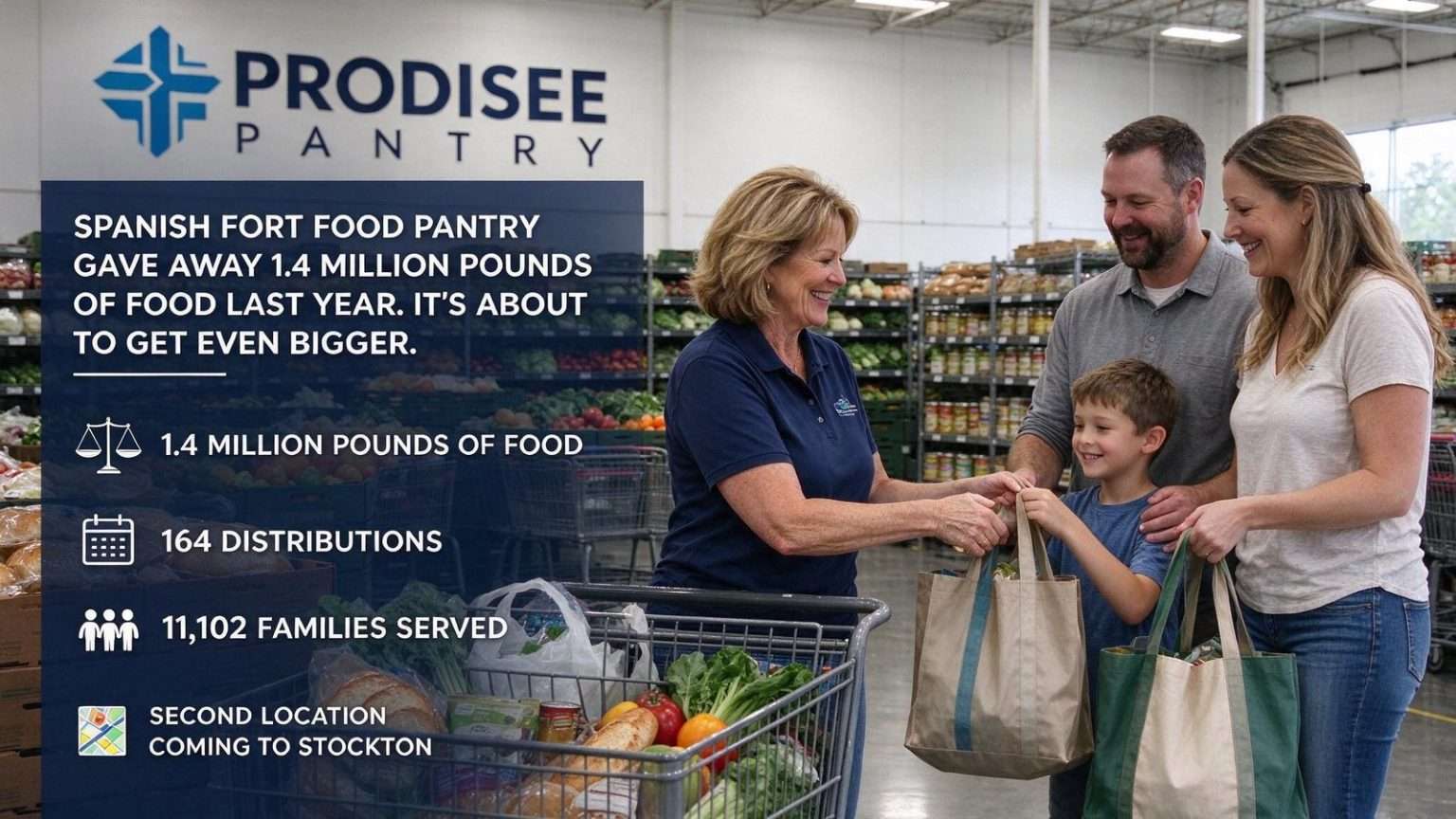
Spanish Fort’s Prodisee Pantry has quietly become one of Baldwin County’s most essential institutions. Last year, the emergency food bank and disaster relief nonprofit gave away 1.4 million pounds of food across 164 distributions to 11,102 families throughout Baldwin County. Now the organization is preparing to grow again, with plans for a second location intended to reach families further north in the county.
Executive Director Deann Servos, this year’s Reader’s Choice Award winner for “Best Baldwinian Right Now,” said the pantry’s model goes beyond simply handing out groceries. “You can feed someone forever, but that’s not our goal,” Servos said. “I like our model because we get to know people and can help them change their situation. If someone needs food, something else is going on that needs to be addressed. If we can help somebody get a job, then that’s life-changing.”
That philosophy shapes how the pantry operates week to week. Every week, Prodisee Pantry holds distributions primarily out of its Spanish Fort location, sending families home with shopping carts full of fresh food, at least 100 pounds per family. The volume matters for households stretching a budget across rent, utilities, transportation and medical bills, but the pantry treats the food as a starting point rather than a finished service.
Representatives from partner organizations attend distributions to help connect families to additional services beyond food. The Lighthouse women’s shelter, the Drug Education Council and Veterans Affairs all send representatives, meaning a family that comes in needing groceries can leave with information about housing support, substance abuse treatment or benefits they had never accessed. The model turns a food distribution into a hub for the wider network of assistance available along the Eastern Shore.
“We understand by the grace of God, any of us could be in the situation where we need help,” Servos said. “I always say it could be a couple missed paychecks, a natural disaster, a pandemic. Anything could put you in line for groceries.” The framing reflects how the pantry talks about hunger: not as a permanent condition of the people it serves, but as a crisis any household can fall into when circumstances turn.
A grassroots ministry that grew
Prodisee Pantry began small. Servos founded the grassroots ministry with two church friends in 2003 and has led it since 2005, building it from a church-based effort into a countywide operation with paid staff, volunteer teams and formal partnerships with food suppliers across the region. Staff say they aim to treat every family that comes through with “dignity and grace” no matter how many times they return, a standard that shapes everything from the layout of the distribution line to the way volunteers greet returning households.
The pantry sources food through a mix of channels designed to keep costs down and quality up. It purchases at reduced rates from partners like Feeding the Gulf Coast, the regional food bank network member that supplies pantries across the central Gulf Coast. Donations arrive from local vendors as well, including Publix and area farmers such as Grass Hopper Farms in Robertsdale and Ole House Farms in Loxley. The relationships with local growers mean fresh produce moves through the pantry alongside shelf-stable goods, a difference families notice in their carts.
Storage capacity became the next frontier. In May, the pantry installed a 24-by-24-by-12-foot freezer room to expand its frozen food storage capacity, allowing it to accept and distribute more frozen protein and prepared items than its previous setup could hold. For an operation distributing more than a million pounds annually, freezer space translates directly into the variety and nutritional quality of what families take home.
Going north to Stockton
The bigger change is still to come. Prodisee Pantry is preparing to break ground on a second facility, Prodisee Pantry North, near Bicentennial Park in Stockton, on 4.5 acres of land donated by the Baldwin County Commission. The pantry is actively fundraising to construct the new building and hopes to be operating there by next summer.
The location is no accident. “Historically, 42 percent of our families have come from Stockton, north,” Servos said. “Baldwin County’s huge. We’re a county the size of Rhode Island, and that northern part of the community has been more marginalized over time.” Families in Stockton and the smaller communities around it have faced a long drive to Spanish Fort for distributions, a trip that gets harder for households without reliable transportation or with jobs that do not allow time off for a midweek errand.
Baldwin County’s geography explains the challenge. The county stretches from Mobile Bay across piney woods and farmland to the Florida line, one of the largest counties in Alabama by area. Its population growth has concentrated along the I-10 corridor in cities like Daphne, Spanish Fort, Fairhope and Gulf Shores, while rural communities in the northern part of the county have seen services and infrastructure lag behind. A food pantry sited in Spanish Fort serves the population center well but leaves the northern end of the county with the longest trip and the fewest alternatives.
The county commission’s donation of land near Bicentennial Park signals public recognition of that gap. Stockton sits at the crossroads of U.S. 31 and Highway 59, a logical hub for reaching residents of Communities like Bay Minette’s outskirts, Perdido and Little River. A distribution site there cuts the distance for the 42 percent of pantry families who historically come from the northern county, and puts the food closer to the small towns where grocery options are already thin.
What hunger looks like in Baldwin County
The pantry’s numbers tell a story about Baldwin County that contradicts its postcard image. A county known for beach tourism, fast-growing suburbs and rising home values also supports a food operation that reaches more than eleven thousand families a year. The families in those lines include working households whose wages have not kept pace with rents, retirees on fixed incomes absorbing rising costs, and families recovering from disasters in a region that has weathered hurricanes, floods and pandemic disruptions over the past two decades.
Servos’s point about missed paychecks captures how quickly a household can cross the line from stability to need. A car repair, a hospital bill or a reduction in hours at work can cascade into missed rent, and once a family falls behind, food is often the first flexible expense to cut. Emergency food pantries exist precisely for that window, and Prodisee Pantry’s model tries to use the crisis as an opening to address whatever caused it.
The connection to services at each distribution reflects years of relationship-building with partner agencies. When a Veterans Affairs representative stands in the same room as families picking up groceries, the barrier between a veteran and an earned benefit shrinks to a conversation. When the Drug Education Council has a presence, a family dealing with a loved one’s addiction finds a referral where they already feel comfortable asking for help. That design, embedding social services inside the food line, is what Servos means when she describes helping people change their situation rather than only feeding them.
The fundraising campaign for Prodisee Pantry North will determine how quickly the Stockton facility becomes reality. The pantry hopes to break ground soon and to be operating by next summer, moving from a plan to a second weekly distribution point serving the northern half of the county. If the opening meets that timeline, families who now drive an hour or more round trip will find their groceries much closer to home, and the ministry that started with two church friends in 2003 will operate from two campuses serving both ends of one of Alabama’s largest counties.
Why the model draws attention
The Reader’s Choice recognition of Servos as “Best Baldwinian Right Now” reflects how visible the pantry has become in county life. Baldwin County residents vote on that honor, and a food pantry director winning it signals that the community sees the work as its own, not as a distant charity. That local ownership has practical value too: volunteers, food donations and fundraising all flow from a community that considers the pantry part of itself.
The dignity-first approach also distinguishes the pantry in an area where assistance can carry stigma. Families who return week after week are treated as returning neighbors rather than repeat cases. Staff and volunteers learn names, ask about jobs and children, and follow up on earlier conversations. For households already strained by the embarrassment of needing help, that tone can determine whether they keep coming back or quietly go without.
The disaster relief role in the pantry’s mission deserves attention as well. Baldwin County sits in hurricane country, and the region’s storms have repeatedly displaced households and disrupted food supply chains. An organization with warehouse capacity, freezer storage and distribution experience becomes a piece of local emergency infrastructure when a storm hits, able to move food into affected neighborhoods faster than outside responders can arrive. The new freezer room expands that capacity along with the pantry’s everyday work.
The partnerships with Feeding the Gulf Coast and local farmers show how modern food banking actually operates. Food banks buy in bulk at reduced rates, stretch donated funds further than individual shoppers can, and fill the gaps between retail donations with purchased staples. Local farm donations add freshness that mass distribution channels rarely deliver, and they keep money circulating within the county’s agricultural economy, from Robertsdale to Loxley to the pantry’s distribution floor.
What happens next depends on the fundraising campaign, and the pantry’s leadership has framed the Stockton expansion as a community project rather than an institutional one. Donors large and small are being asked to help build a facility that will serve a part of the county that has watched growth pass it by. The county commission’s land donation established the public side of the partnership; the construction campaign is the private side answering it.
For the eleven thousand families the pantry reached last year, and the unknown number it will reach as the county keeps growing, the expansion represents something more than a new building. It is a bet that Baldwin County’s response to hunger should match its geography, serving the whole county rather than only the parts easiest to reach. The 1.4 million pounds distributed last year came from one location; the second location near Bicentennial Park in Stockton is designed to make the next 1.4 million pounds reach families who have been driving past the point where help should have been waiting.