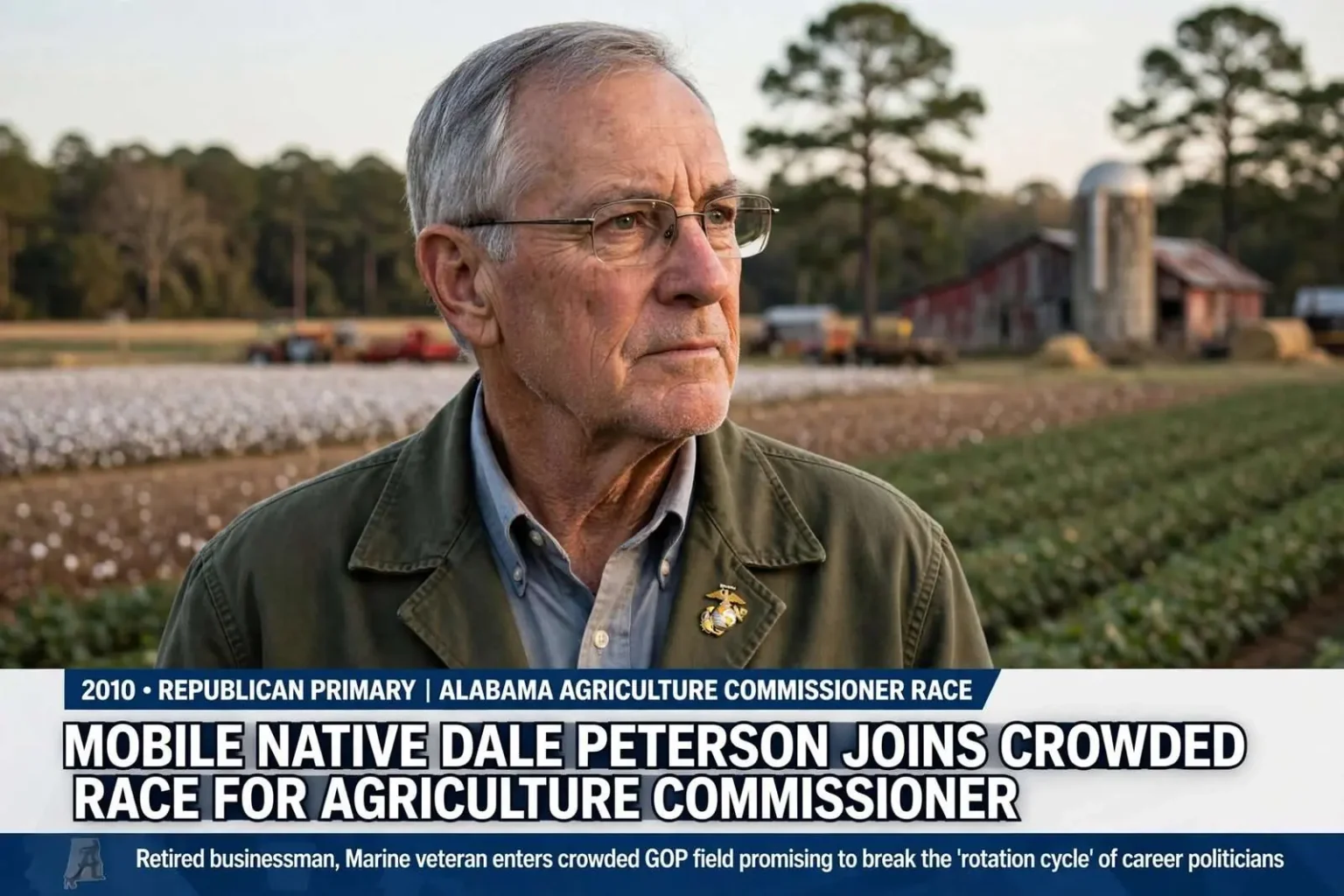
Dale Peterson, a Mobile native and retired businessman, has entered the Republican race for Alabama commissioner of agriculture and industries, joining a primary field that already carried a distinct South Alabama accent. Peterson, 64, now lives in Shelby County with his wife, Kathy, to whom he has been married more than 30 years. He describes himself as a “retired, successful businessman who has never had political aspirations, but is offering to give back and break the rotation cycle of the same ol’ state office-hopping and state committee-hopping politicians.” The agriculture commissioner’s race rarely draws much attention in an election year dominated by legislative and congressional contests, but the 2010 cycle was shaping up differently, with an open seat, a crowded field and a statewide electorate in an unsettled mood.
From the Marine Corps to blue jeans
Peterson’s biography is not the standard resume of an Alabama agriculture commissioner. He moved from Mobile to Birmingham at the age of eight. He joined the Marine Corps in 1963, returned to Birmingham in 1967 and became a police officer. After earning a sociology degree from the University of Alabama, he worked in marketing and production for a national industrial laundry chain. The path from a beat in Birmingham to the state’s agricultural leadership is an unlikely one, and Peterson made no pretense that it was anything else — his pitch to voters was precisely that he had never been a part of the agricultural establishment he hoped to lead.
In 1977 he struck out on his own, opening what he says was Alabama’s first pre-washed blue jeans laundry facility in Opp, in Covington County. He later sold the operation to a national blue jeans manufacturer. The business was built on a simple commercial insight: retailers wanted jeans delivered looking already worn soft, and somebody had to industrialize that finishing process. That it happened in Opp, a small Covington County town better known for timber and peanuts than for apparel technology, was a point of pride for a man who would spend the rest of his career proving that serious industry could be built in small-town Alabama.
He then took a different idea to state government: outsourcing Alabama’s institutional laundry needs. He won a competitive bid, built what he describes as the largest industrial laundry facility in the Southeast, in Tuscaloosa, and eventually sold that business as well. The second venture put him in direct contact with the machinery of state government — bidding, procurement, the politics of who gets state contracts — and gave him the material for his campaign argument that the state’s own operations could be run more efficiently by people who had actually made a payroll. By the time he entered the race, he had built, sold and exited two significant industrial businesses, the kind of record he argued Montgomery needed more of.
His self-description doubled as his platform: a break from “the same ol’ state office-hopping and state committee-hopping politicians.” In Alabama, where the same names tend to circulate among statewide offices for decades, that framing has deep resonance, and Peterson delivered it with the bluntness of a man who had spent his working life outside the capital. He positioned himself as someone with nothing to lose and no next office in mind — a claim few of his opponents could match.
His pitch: bring young people back to the farm
Peterson said one of his objectives in office would be to draw young people back to the family farm. He pointed to a number that had worried Alabama’s agricultural establishment for years: fewer than 50,000 farmers remained in the state, and their average age was 55. Behind the statistic was a generational problem the state had been discussing without solving — the sons and daughters of working farms were finishing school, finding the economics unpromising and leaving, and the average age of the people left running those farms was climbing every year.
The aging of the farm population is not an abstraction in the counties north and west of Mobile. In Washington, Clarke, Monroe and Escambia counties, timber and row-crop operations that once passed routinely from father to son were being sold or leased, and the young people who might have taken them over were leaving for wage work in Mobile, Birmingham or out of state. The pattern had remade the social fabric of the region: school consolidations, declining rural churches, and farmland increasingly held by heirs who lived elsewhere and leased it to the neighbors who remained. Anyone campaigning for agriculture commissioner in those counties would find voters who could name the problem in a single sentence.
An agriculture commissioner has limited tools to reverse that — the office regulates, inspects, promotes and administers grant programs rather than setting farm policy outright — but the commissioner is the most visible advocate agriculture has in Montgomery. The department inspects everything from grocery scales to gasoline pumps, polices the movement of plants and livestock, runs the state’s farmers markets promotion and administers a shelf-full of federal programs aimed at keeping farm families on the land. A commissioner who wanted to reverse the youth drain could use the office’s promotional power to connect young farmers with capital, markets and the state’s growing local-food appetite — a modest lever, but one Peterson promised to pull hard.
A crowded Republican field
Peterson was not running alone. Also seeking the Republican nomination were John McMillan of Stockton in Baldwin County, a former state forestry commissioner and former legislator, and Dorman Grace, a past president of the Alabama Poultry & Egg Association. The contrast with Peterson was sharp: McMillan and Grace were career figures of the very agricultural establishment Peterson was running against, with long records in the industries and agencies the department touches. Each carried a distinct constituency — McMillan the timber counties and Baldwin County, Grace the poultry belt that stretched across northeast Alabama and generated one of the state’s largest agricultural outputs.
McMillan’s candidacy gave the race a direct Baldwin County stake. Stockton, a small community in the county’s rural north end near the Tensaw River, is a long way from the beach condominiums that dominate outside impressions of Baldwin, and McMillan’s background in forestry spoke to an industry that remains one of the largest employers across the pine belt of southwest Alabama. Timber economics — land prices, tax policy, the health of the paper and wood products industries — quietly shape more of south Alabama’s rural economy than any other single factor, and a former forestry commissioner understood that economy from the inside. His entrance also signaled that the party’s establishment intended to contest the seat seriously rather than concede it to the outsider field.
Grace’s bid made the same case from the poultry industry, whose contract growers and processing complexes represent a different kind of Alabama agriculture — industrial in scale, concentrated in the northern part of the state, and dependent on regulation, trade and feed prices more than on weather. Together with Peterson, the field offered Republican primary voters a clear set of choices: the establishment forester, the poultry-industry veteran, and the businessman who promised he had never asked Montgomery for anything before.
Why the seat was open
The office was open because its occupant wanted a bigger one. Agriculture Commissioner Ron Sparks, a Democrat, was running for governor rather than seeking another term, leaving one of the state’s few remaining statewide Democratic offices without an incumbent. Sparks had spent two terms building a profile beyond the agriculture department — most visibly as a champion of legalizing and taxing electronic bingo as a revenue source — and the governor’s race was the logical next step. His departure changed the arithmetic in the down-ballot race he left behind.
That vacancy mattered. Alabama Republicans had spent the decade steadily converting statewide offices, and an open agriculture commissioner’s race in a year when the national political climate favored the GOP looked to many strategists like a seat that could flip. The crowded Republican primary reflected that calculation: credible candidates rarely line up for a sleepy down-ballot office unless they believe the political wind is at their back. Democrats, for their part, would have to field a nominee without the advantage of incumbency in an office the party had held through years of losing nearly everything else at the statewide level.
The calendar compounded the intensity. Primaries for both parties were set for June 1, with the general election to follow on Nov. 2. That gave the Republican candidates barely a spring to introduce themselves across a state where agriculture commissioner campaigns are traditionally fought at county farmers federation meetings, catfish fry fund-raisers, timber industry breakfasts and the ag pavilions that anchor rural county fairs. Name recognition, never high for down-ballot offices, would be won one civic club at a time.
The style of the campaign
Peterson’s framing — an outsider, a businessman, a Marine, running against career politicians who rotate from one office to the next — was a familiar Alabama posture, and one that had worked before. The state’s electorate has repeatedly rewarded candidates who promised to bring the private sector’s habits to public office, and in a year of anti-establishment feeling the message was landing on receptive ears across the Republican electorate. His military service and his two built-and-sold businesses gave the pitch a concrete biography behind it.
Whether it would work in a race decided largely by rural voters who knew the agricultural establishment well would be answered in June. The farmers, foresters and poultry growers who dominate the primary electorate in an agriculture commissioner’s race tend to know exactly what the department does and who has done it well, and they can be skeptical of candidates who discover agriculture only at election time. Peterson was betting that in 2010, the anti-establishment wave would reach even the down-ballot offices — and that a Marine-turned-laundryman from Mobile by way of Opp and Tuscaloosa could beat the insiders at their own game. The primary would tell him, and the party, whether the tide ran that far down the ballot.