University of South Alabama Mobile
Mobile County EMS Just Donated a Birthing Simulator So Future Paramedics Can Practice Delivering Babies Before It’s the Real Thing
Mobile County EMS donated a birthing simulator to University of South Alabama EMS students, giving future paramedics hands-on practice with emergency field deliveries before facing the real scenario.
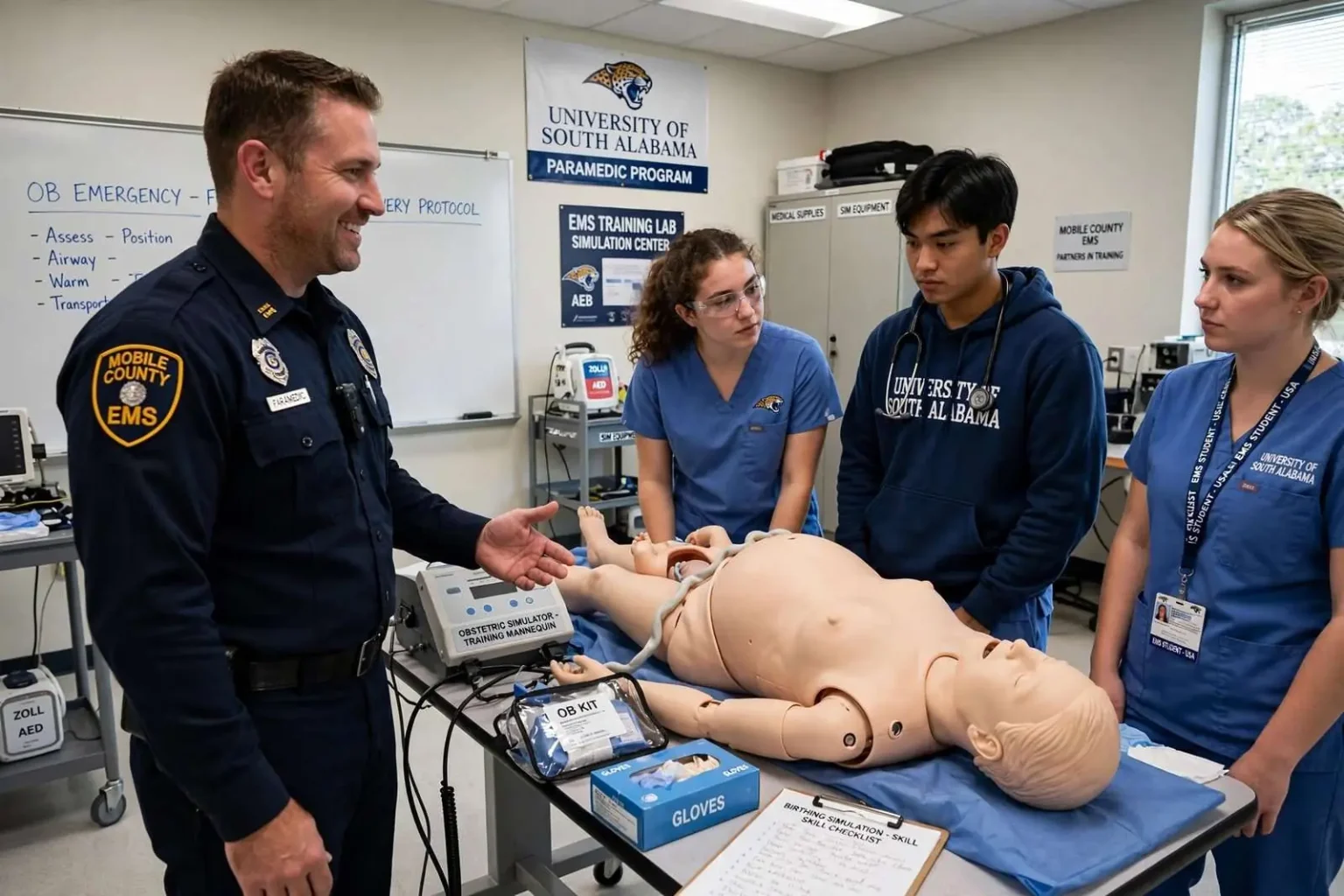
Mobile County EMS has donated a birthing simulator to help train University of South Alabama students preparing for careers in emergency medicine, giving future paramedics and EMTs a way to practice one of the more high-stakes scenarios they can face in the field before ever encountering it with a real patient. The equipment allows students to rehearse the physical steps and rapid decision-making involved in an emergency delivery inside a controlled classroom environment, where mistakes carry no consequence and every step can be reviewed, corrected and repeated.
Field deliveries — babies born outside a hospital setting, whether in an ambulance, at a patient’s home, or in a parking lot while a crew is still en route — are among the rarest calls an EMS provider will answer during a career. They are also among the most stressful. Unlike cardiac arrests or traumatic injuries, which most paramedics encounter regularly, obstetric emergencies arrive with little warning, and a provider may go years between them. That rarity is precisely the problem: skills that are used infrequently fade quickly, and there is no way for a crew to know in advance when the next delivery call will come. Regardless of how infrequently it comes up in an individual paramedic’s career, EMS providers must be prepared for the scenario every shift.
The birthing simulator addresses that gap directly. Modern obstetric simulation mannequins are designed to replicate the mechanics of labor and delivery, allowing trainees to practice positioning the mother, assessing progress, supporting the baby through the birth canal, clearing the newborn’s airway and managing complications that can arise in the final moments before a hospital is reachable. Instructors can pause a scenario, point out what went well and what did not, and run it again — a loop that simply does not exist on a real 911 call.
Why simulation matters in prehospital training
Simulation has become a cornerstone of emergency medical education across Alabama and the nation for exactly this reason. Classroom lectures can teach the sequence of steps for an emergency delivery, and clinical rotations can expose students to births in hospital settings, but neither fully reproduces the conditions of a field delivery: limited lighting, confined space, anxious family members present, and no additional help minutes away. A simulator bridges that distance, letting students work through the entire scenario with their hands, not just their notes.
For students at the University of South Alabama, the donation means that rehearsal can happen repeatedly rather than rarely. Repetition builds the kind of muscle memory that holds up under pressure. When a provider has gone through the steps of an emergency delivery dozens of times in training, the real call becomes a matter of executing a familiar sequence instead of improvising under stress. Educators in emergency medicine have long noted that the difference between a confident provider and a hesitant one is often simply the number of reps they have logged before the first real patient.
The timing of such preparation matters as well. In Mobile County, ambulance response times are generally strong across the urban core, but the county’s geography — stretching from the city of Mobile out to communities like Citronelle, Mount Vernon, Grand Bay and Theodore — means that some calls occur far from a hospital, and weather events can stretch response resources thin. A delivery that begins with a long transport ahead of it leaves the crew fully in charge of the outcome, making hands-on preparation all the more valuable.
A continuing partnership between Mobile County EMS and USA
The donation reflects an ongoing relationship between Mobile County’s emergency medical services system and the University of South Alabama’s EMS training programs, giving local students hands-on access to specialized training equipment that individual academic programs might not otherwise be able to afford on their own. High-fidelity medical simulators represent a significant investment, and for a university program, access to equipment donated by the very agencies that graduates will go on to work for keeps training aligned with the realities of local practice.
The arrangement benefits both sides. Students gain access to equipment that mirrors what they will encounter in the field, while the county’s EMS system gains a pipeline of graduates who arrive already trained on the specific scenarios local crews face. Mobile County operates one of the busiest emergency medical services systems on the Gulf Coast, serving a population concentrated in and around the city of Mobile along with the county’s smaller municipalities and unincorporated communities. When a local agency invests in the education of local students, it strengthens the workforce that ultimately answers those calls.
The University of South Alabama has long served as a major training ground for health care professionals across the central Gulf Coast, and its emergency medicine and paramedicine programs feed paramedics and EMTs into agencies across Mobile and Baldwin counties and beyond. Partnerships like this one extend that mission into the prehospital side of care, where the University’s students get direct exposure to the equipment, protocols and expectations of the agencies they may join after graduation.
What paramedics actually do on a field delivery call
When a 911 call comes in for a delivery in progress, responding crews work through a rapid series of assessments and preparations. They gather pertinent history, including the mother’s due date, any complications during the pregnancy, and how long labor has been underway. They prepare their obstetric kit, position the mother appropriately, and continuously reassess as delivery approaches. Most field deliveries progress without major intervention — the paramedic’s role is largely to support the natural process and be ready for problems.
Those problems are what training is built around. A newborn who does not breathe immediately after birth needs immediate stimulation and, in some cases, ventilation with bag-valve mask. The umbilical cord may be wrapped around the baby’s neck and need to be gently managed. Excessive bleeding after delivery requires prompt recognition and intervention, and keeping the newborn warm is a constant priority, because infants lose body heat quickly and cold stress can complicate their transition to breathing on their own. Each of these steps must happen in minutes, often inside the confined space of an ambulance.
Practicing on a simulator lets students make these assessments over and over until the correct sequence is second nature. Instructors can introduce complications deliberately, forcing students to recognize them and respond, something a routine hospital observation would almost never provide. The result is a graduate who has already seen — in simulation — the complications that a working paramedic might encounter only a handful of times in a decade.
What the donation means for Mobile County residents
For the public, the value of a donation like this one is measured in outcomes on the worst days of people’s lives. The delivery of a baby is a moment of joy in a hospital, but on the side of the road or in a living room it is a race against complications with only a small crew and whatever is on the ambulance. A provider who has rehearsed that scenario on a simulator until the steps are automatic is better positioned to keep both mother and child stable until a hospital takes over.
The training also carries over into other areas of prehospital care. The same assessment habits, communication skills and calm under pressure that simulation builds for obstetric calls transfer directly to pediatric emergencies, trauma responses and cardiac arrests. Programs that invest in high-quality simulation consistently produce providers who are more composed in the field, because they have already made mistakes and corrections in a setting where no one was harmed.
By building field-delivery training into the standard curriculum for USA’s EMS students, Mobile County EMS is aiming to ensure that the next generation of local paramedics enters the field having already rehearsed one of the rarer, higher-stress calls they might eventually answer for real. Rather than hoping a new paramedic happens to be riding along on someone else’s field delivery before facing one alone, the system makes sure every graduate has logged the repetitions in advance.
The donation also signals the broader direction of emergency medical services training along the Gulf Coast. As simulation technology has become more sophisticated and more widely available, agencies and academic programs across the region have leaned on partnerships to bring that technology within reach. Equipment that a single program might struggle to fund becomes attainable when the agencies that depend on the program’s graduates share the investment.
Students and instructors alike point to another practical benefit: consistency. When every graduate of a program has trained on the same scenarios using the same equipment, crews in the field can expect a shared baseline of skills, and preceptors overseeing new hires know what their trainees have already seen. That shared foundation shortens the orientation period for new paramedics and builds confidence on both sides of the preceptor relationship, benefits that follow from investments in simulation long after the students who trained on it have moved into the workforce.
For students in Mobile preparing for emergency medical careers, the message is a practical one: the county’s EMS system is not waiting for them to learn on the job. It is putting the tools in front of them now, so that when the rare call does come — a mother in labor far from a hospital, a newborn needing help taking a first breath — the provider standing beside them has already been there before, in training, dozens of times over.