A Prichard Business Owner Got a $700 Water Bill and No Water. Now He Wants to Know Why.
A Prichard business owner is questioning a $700 water bill he received despite having no running water, the latest complaint to surface amid broader scrutiny of the city's finances.
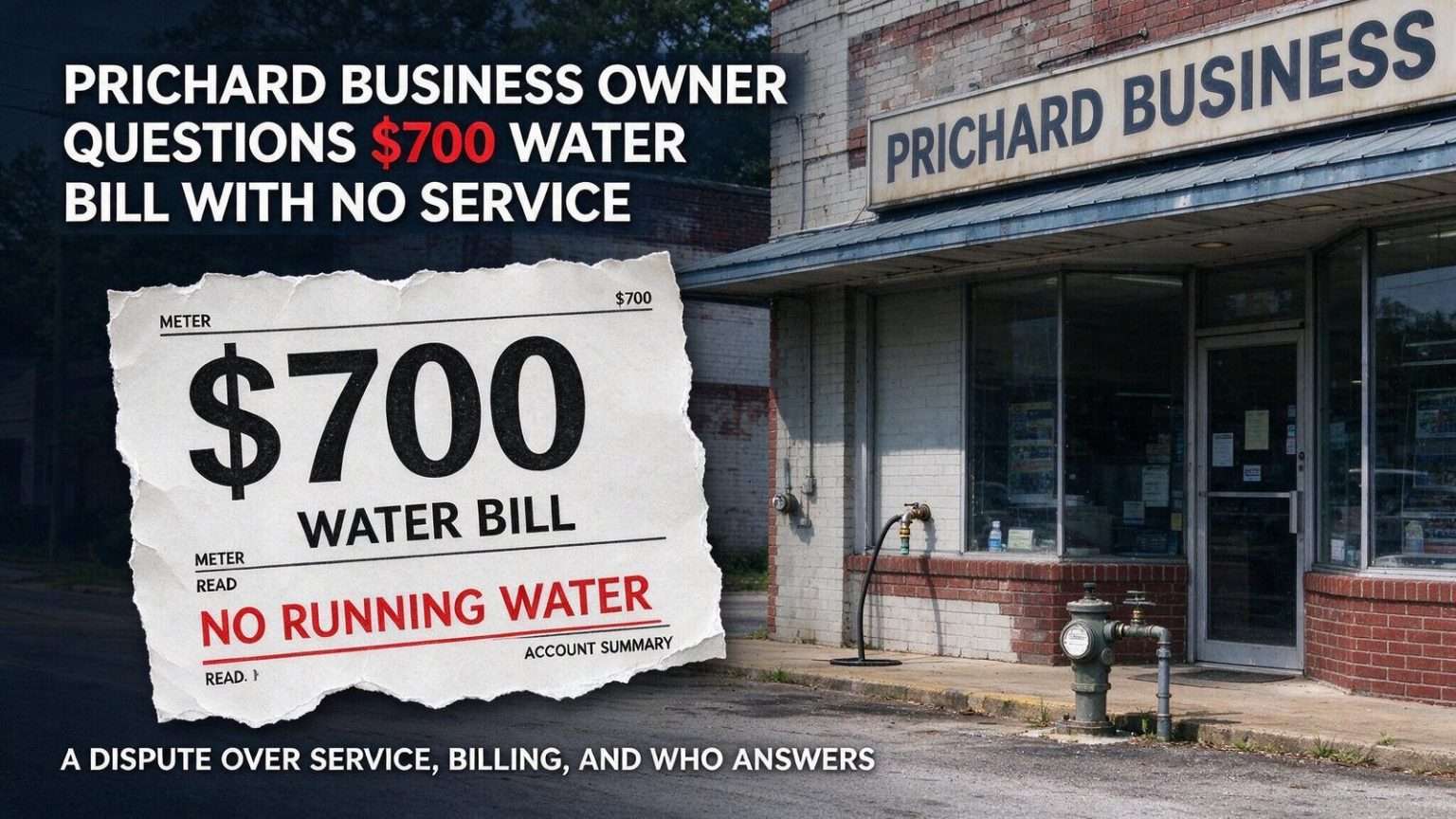
A Prichard business owner says he received a $700 water bill despite having no running water at his business, raising fresh questions about billing and service reliability in a city already facing scrutiny over its finances. The complaint lands in a community that has seen this movie before: a customer staring at a bill that seems disconnected from the water — or lack of water — actually coming through the tap, and a city hall whose ability to manage money is already under a magnifying glass.
The billing dispute surfaces amid a broader, ongoing fight between Prichard’s mayor and city council over control of municipal spending — a fight that has already exposed gaps in the city’s ability to keep current on some of its own obligations, including a lapse in city employee dental and vision insurance earlier this summer. Against that backdrop, a $700 bill for a property with no water service is not just one customer’s grievance. It is another data point in a running argument about whether the city and the utilities tied to it are being managed well enough for the people who pay their bills there.
What the Business Owner Is Facing
The core of the complaint is simple and hard to dismiss: a bill arrived for $700, and the business it was billed to had no running water at the time. Under any reading, that combination demands an explanation. Either the bill reflects accumulated usage from an earlier period, an estimated reading, a leak on the customer’s side of the meter, or an administrative error — and sorting out which requires records, meter data and a responsive utility office.
It was not immediately clear whether the business owner has received a response from the city on the disputed charge, or whether other Prichard customers have reported similar billing issues. That uncertainty is itself part of the story. In well-run systems, a disputed bill follows a predictable path: a service call, an account review, a meter check, a written adjustment or denial. When customers instead describe silence, disputes tend to migrate to social media, the city council chamber and sometimes the news — where Prichard’s utility troubles have appeared repeatedly over the years.
Commercial customers carry particular stakes. A business that cannot rely on water service cannot operate normally, and a $700 surprise on top of a service interruption can be the difference between a profitable month and a loss. For small businesses in a city where the commercial base has thinned over decades, each unresolved dispute is not only a personal hardship but a signal to other owners about how their money might be treated.
Billing Problems Are Common in Aging Systems
Billing disputes involving high charges without corresponding service are not unusual in municipal water systems with aging meter infrastructure or administrative backlogs, and Prichard’s system fits the profile. Older meters can under-report for years and then, when they finally fail or are replaced, produce estimated catch-up bills that shock the customer. Manual reading errors, misposted payments, accounts attached to the wrong address and slow adjustment processes are recurring complaints in small cities across the country — and Mobile County’s older municipalities are no exception.
The mechanics matter. In a system with accurate, recently read meters, a “no water but big bill” complaint can usually be resolved with one record check. In a system with decades-old meters, gaps in reading history and a billing staff stretched thin, the same complaint can bounce for months. Estimates are often involved: when a meter cannot be read, the utility bills an average, then reconciles later — and the reconciliation can arrive as a four-figure bill that the customer never saw coming.
Leaks compound the problem. A customer-side leak — a cracked service line, a running fixture in a vacant building — can flow for weeks before anyone notices, especially at a commercial property with no one on site. Utilities generally hold that the water passed through the meter and is owed, even when the customer never benefited from it; some offer one-time adjustments or leak forgiveness policies, others do not. Whether any of that applies in this case is not publicly known, which is precisely why the unanswered question has drawn attention.
The Broader Fight Over Prichard’s Money
The timing here — arriving as Prichard’s broader financial management is already under a magnifying glass — has added extra scrutiny to what might otherwise be treated as a routine customer service complaint. The mayor and city council have been locked in a running dispute over control of municipal spending, the kind of institutional conflict that tends to surface in budget votes, appointment fights and public arguments over who has authority to pay vendors and approve expenses.
That fight has already produced visible casualties. Earlier this summer, the city’s dental and vision insurance for employees lapsed — the kind of quiet administrative failure that hurts real families in real time, when an employee discovers at a dentist’s office that coverage is not there. A city that misses its own insurance obligations while its customers question their water bills is a city where every financial complaint now lands on skeptical ears, both inside the council chamber and outside it.
Prichard’s history gives that skepticism a longer memory. The city of roughly 20,000 residents just north of Mobile has weathered severe fiscal crises before, including a widely covered municipal bankruptcy rooted in pension obligations, and years of state-level scrutiny of its books. Residents and business owners have watched city government cycle through austerity budgets, contested leadership and recovery plans for so long that a new dispute — even one about a single $700 bill — is immediately read as part of a pattern rather than an isolated error.
Who Runs the Water
One structural detail matters for anyone following the complaint: water service in Prichard has historically been governed separately from city hall. The Prichard Water Works and Sewer Board operates as its own public entity, with its own board, budget and rate-setting authority — a structure common in Alabama, where municipal water boards were created to insulate utility operations from city politics. That separation means the business owner’s dispute may technically belong to the board rather than the mayor and council, even though residents and the city’s own elected officials tend to treat water problems as city problems.
The blurring is understandable. Customers see one city, one bill and one place to complain. And the water board’s governance has been controversial in Prichard for more than a decade — the subject of public calls for reform, state attention and resident complaints about rates and responsiveness. When a fresh billing dispute arrives, it lands on top of that accumulated history, which is why a single customer’s grievance can quickly become a referendum on the whole system.
For the mayor and council, the dispute is also awkward in a different way. City leaders have limited direct authority over a separately governed water board, but they own the city’s overall financial reputation. A business owner publicly asking why he owes $700 for water he never received — while the city itself struggles to keep employee insurance current — hands ammunition to every critic of how Prichard is run.
What Remedies Exist for the Customer
Customers disputing municipal water bills in Alabama typically have a few routes, and their usefulness depends on the system’s responsiveness. The first stop is the utility’s own customer service office, requesting the account history, actual meter readings and the basis for the charge. If the response is unsatisfactory, formal appeal to the board or commission that governs the utility is usually next, often during a public meeting where the dispute becomes part of the record.
Beyond the utility itself, options include the city’s elected officials — who, even without direct authority, can pressure a board through public comment and appointments — and, in persistent cases, the Alabama Public Service Commission’s consumer office, though the PSC’s authority over municipally owned systems is limited. Media attention, as this case shows, remains the fastest escalator of all: nothing moves a stalled billing dispute like a news story with the number printed in it.
Practical documentation matters too. Customers in disputes like this are advised to keep the bill and envelope dates, photographs showing conditions at the property, records of any shut-off or no-service periods, and a written log of every call and visit to the utility office. In meter disputes, the physical meter itself — its reading, serial number and access condition — is often the decisive evidence, and it disappears from the record once replaced.
Why Reliability and Billing Are the Same Question
It is tempting to treat the no-water complaint and the $700 bill as separate problems — one about service reliability, one about billing accuracy. In practice they are usually the same problem wearing two faces. A system that loses track of what flows through its pipes is generally a system that also loses track of what to charge for it. Deferred maintenance on meters and lines produces both service failures and billing distortions, and administrative backlogs produce both slow repairs and slow corrections.
That is why water disputes in small cities so often become catalysts for broader demands. Residents do not only want one bill adjusted; they want to know how old the meters are, how often they are read, whether estimates are used, and who signs off on adjustments. A utility that can answer those questions quickly defuses disputes. One that cannot — or will not — finds each new complaint stacking onto the last.
For Prichard’s business community, the stakes are cumulative. Commercial growth in the city has lagged for decades, and existing businesses cite reliability — of services, of city administration, of basic predictability — when asked why they stay or leave. A water system that bills $700 against no service, and takes no visible action to explain it, feeds the most damaging narrative a struggling city can accumulate: that even paying customers cannot count on the basics.
What Happens Next
As of now, the open questions are the familiar ones. Has the utility reviewed the account and the meter records? Does the $700 reflect accumulated usage, an estimate, a leak, or an error? Has the business owner received any written response at all? And are other Prichard customers seeing similar bills — the pattern that would turn one complaint into a systemic finding?
None of those questions is answered publicly yet, and until one is, the dispute sits exactly where the city can least afford it: on top of a mayor-council spending fight, a lapsed insurance benefit for city employees and a long history of fiscal scrutiny. A single corrected bill could quiet the matter quickly. An unanswered one will keep echoing, because in Prichard the question is no longer just “why is this bill $700?” but “why does this keep happening — and who is accountable when it does?”
The South Alabama News will continue to follow the dispute and any response from the city or the water system, including whether the charge is adjusted, whether the service failure is explained, and whether other customers come forward with comparable experiences.