Prichard Launches Emergency Garbage Collection to Clear Backlog Citywide
Prichard's emergency garbage collection contract with A1 McDuffie Sanitation took effect Saturday, deploying four trucks citywide to clear a backlog of uncollected trash after the City Council approved a 90-day emergency deal.
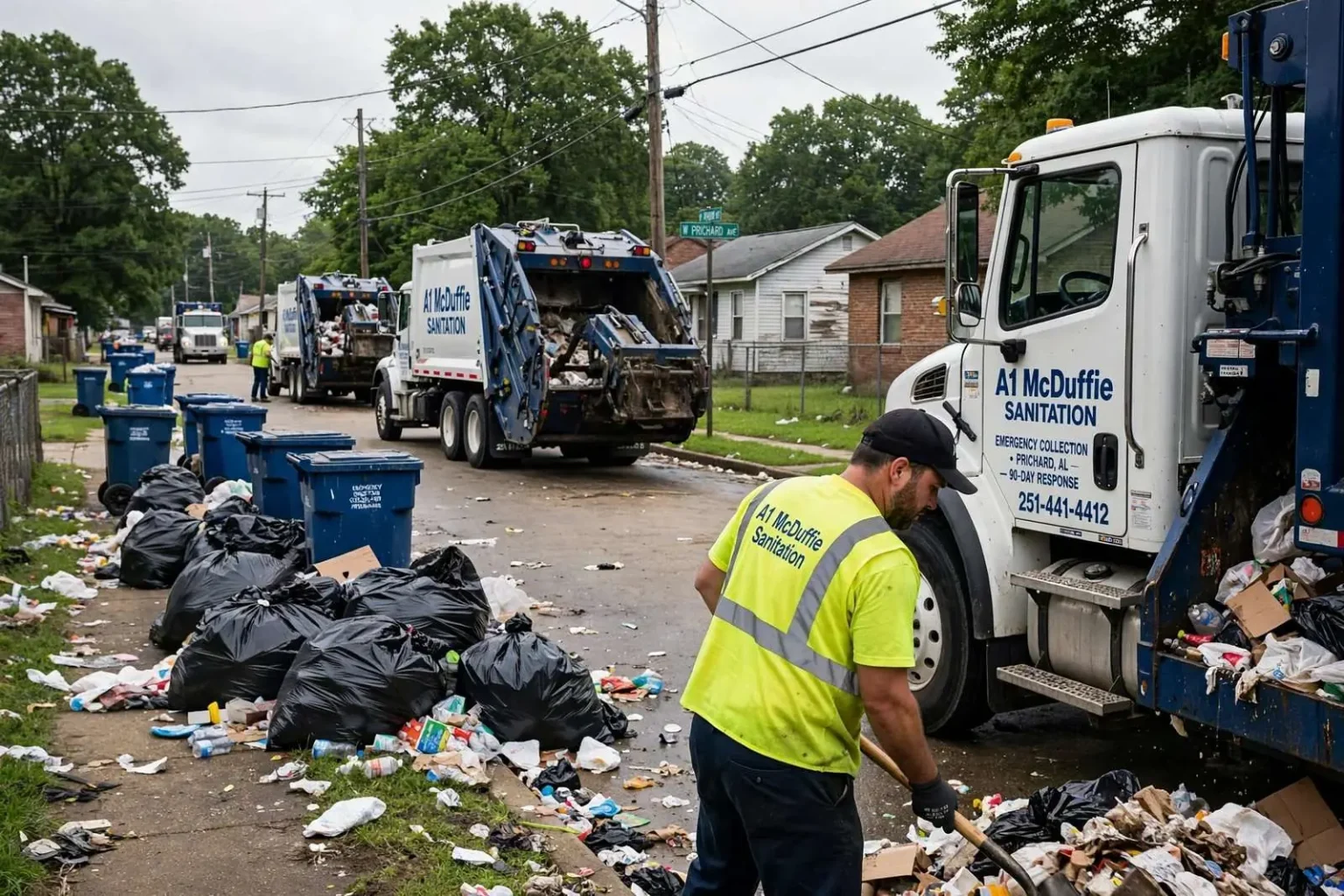
Emergency residential garbage collection services began in Prichard on Saturday, following the City Council’s approval of a 90-day emergency garbage collection contract meant to clear weeks of uncollected trash across the city.
The contract gave the city a contractor of last resort after a sanitation crisis that had left garbage piling up at curbs across Prichard’s neighborhoods through the height of summer — a public-health problem as much as a service failure, in a city where summer heat and rain turn missed collections into odor, pests and overflow.
New contractor deploys multiple trucks
Beginning Saturday, Aug. 8, A1 McDuffie Sanitation launched its residential garbage collection operations throughout Prichard. As part of the initial rollout, the company deployed three automated side-loader garbage trucks and one rear-loader truck to complete the Friday, Aug. 7, collection routes and begin clearing the backlog of uncollected garbage across the community.
The truck mix reflects the challenge. Automated side-loaders — trucks with mechanical arms that grip and empty standardized carts — are the efficient way to cover residential routes, one driver handling hundreds of homes a day. But a backlog cleanup is not a normal route: carts are overflowing, garbage has accumulated on the ground beside them, and some homes have more material than a mechanical arm can handle. The rear-loader supplements the automated trucks, taking a crew aboard to work through the piles that the arms cannot reach.
During the initial cleanup effort, crews are collecting household garbage that has accumulated on the ground, including at locations where residents have more than one garbage cart. City officials say the immediate priority is removing the existing backlog and returning Prichard to a consistent, dependable collection schedule.
Residents are being asked to leave their garbage carts at the roadside until they have been serviced, even if their normal collection day has already passed. Crews will continue working throughout the city until all affected routes have been completed, according to the city’s announcement.
A city utility crisis comes to a head
The emergency contract follows weeks of turmoil over Prichard’s sanitation services after the city’s insurance coverage lapsed, triggering a state of emergency over garbage collection and setting off a dispute between Mayor Carletta Davis and the City Council over how to fund a longer-term fix.
The mechanism behind the crisis illustrates how tightly insurance and municipal services are linked. A city’s garbage trucks and sanitation workers can only legally operate while the city’s insurance — vehicle liability, general liability, workers’ compensation — is in force. When coverage lapses, the contractor serving the city cannot lawfully put its trucks on Prichard’s streets under the city’s contract, and collections stop, regardless of how well the service itself was performing. The result was a sanitation shutdown produced not by broken trucks or missing workers but by paperwork and money.
The Council’s approval of the 90-day emergency deal with A1 McDuffie Sanitation represents the city’s most concrete step yet toward restoring reliable trash pickup for residents who had gone without regular service.
An emergency contract is a stopgap by design. Ninety days buys the city time to restore its insurance coverage, negotiate a regular collection contract, and resolve the underlying budget question — but it also carries a clock. If the longer-term arrangements are not settled by the time the emergency term ends, Prichard risks sliding back into the same crisis, which is why officials have framed the 90 days as a window for a permanent fix rather than a solution in itself.
The dispute behind the deal
The disagreement between the mayor and the council over funding the longer-term fix echoed a structural feature of Prichard’s government: an elected mayor who proposes and administers the budget, and a five-member council that must approve it. Neither side can act alone, and when the two branches disagree over how to pay for a service — through fees, through the general fund, through a new contract structure — the service itself can stall while the argument runs.
The disagreement between the mayor and the council over funding the longer-term fix echoed a structural feature of Prichard’s government: an elected mayor who proposes and administers the budget, and a five-member council that must approve it. Neither side can act alone, and when the two branches disagree over how to pay for a service — through fees, through the general fund, through a new contract structure — the service itself can stall while the argument runs.
Mayor Davis and the council each faced pressure from the same direction: residents asking when the trucks would return. The mayor’s office pressed for the funding and authority it said it needed to secure durable coverage and service; council members pressed for answers about how the money would be raised and whether the terms were sound. Weeks passed with collections suspended while the two branches worked through those questions — a standoff that ended, at least for the next three months, with the council’s approval of the emergency contract.
Emergency contracts also carry legal and procedural weight in Alabama municipal government. State law allows a governing body to act without ordinary bidding procedures when a genuine emergency threatens public health and safety, but the declaration must be justified and the spending documented. The state of emergency over garbage collection provided that basis; the council’s vote put it into effect; and both will be scrutinized as the city moves toward a permanent arrangement.
What residents should watch in the weeks ahead is whether the emergency period produces a regular contract and restored insurance coverage before the 90 days run out. The trucks now rolling through Prichard’s neighborhoods are the visible sign of progress; the invisible sign will be a signed long-term agreement that keeps them running after the emergency term ends.
City officials expressed gratitude to the Prichard City Council for approving the emergency measure, which they said will help restore reliable sanitation services for residents.
The thanks carried a practical edge: the council’s vote was the enabling step for everything that followed on the streets. Without the emergency appropriation, the contractor could not deploy, the backlog would keep growing, and the state of emergency over garbage collection would have remained in place with no end in sight.
What weeks without collection mean
Missed garbage collection is one of the fastest ways for a municipal crisis to reach every doorstep. Households generate waste steadily regardless of what city hall is doing, and in Alabama’s late-summer heat and humidity, a missed route becomes a problem within days — odors, insects, scavenging animals, and bags set out beside overflowing carts until sidewalks and ditches fill. Older residents and families without vehicles have the fewest alternatives for hauling waste elsewhere, so a citywide lapse lands hardest on the people least able to work around it.
Uncollected garbage also carries health and code-enforcement consequences that outlast the backlog. Storm drains clog with windblown debris; rodents and mosquitoes find breeding grounds; and the accumulated piles take longer to clear than they took to accumulate. Crews doing a backlog cleanup work slower routes than normal collection, which is why the city warned residents that crews would keep working until every affected route was completed rather than promising a single-day reset.
Prichard’s broader struggle
The sanitation crisis arrived in a city that has battled fiscal trouble for decades. Prichard, a city of roughly 22,000 in Mobile County, is best known outside its borders for its 2009 municipal pension bankruptcy — a nationally watched case in which the city, unable to meet its pension obligations, cut retiree checks to as little as a few hundred dollars a month. The city’s tax base has never fully recovered from the loss of businesses and residents to surrounding communities, and its budget leaves little margin for surprise expenses such as insurance premiums that rise faster than revenue.
That history shapes how Prichard’s residents read each crisis. A garbage backlog is a service failure, but the question underneath — how a small city funds basic services when its revenue lags its obligations — is the same question that has driven the city’s fiscal episodes for thirty years. The state of emergency and the 90-day contract answer the immediate problem; the budget fight between the mayor and council will answer the durable one.
For residents, the immediate instructions remain the same: leave carts at the roadside until they are serviced, even past the normal collection day, and expect crews to keep working until every route in the city has been cleared and the schedule is whole again.
Households can also help the cleanup move faster by bagging and containing loose garbage where possible, keeping carts accessible at the curb rather than behind fences or parked cars, and separating yard debris and bulk items from household bags where the city’s rules require it. Every stop a truck makes goes faster when the material is ready to load, and a citywide backlog cleanup proceeds route by route in the order crews can complete them.