93rd Alabama Deep Sea Fishing Rodeo Kicks Off on Dauphin Island
The 93rd Alabama Deep Sea Fishing Rodeo opened with its traditional cannon blast Friday morning on Dauphin Island, launching a weekend of fishing, family tradition and more than $500,000 in prizes.
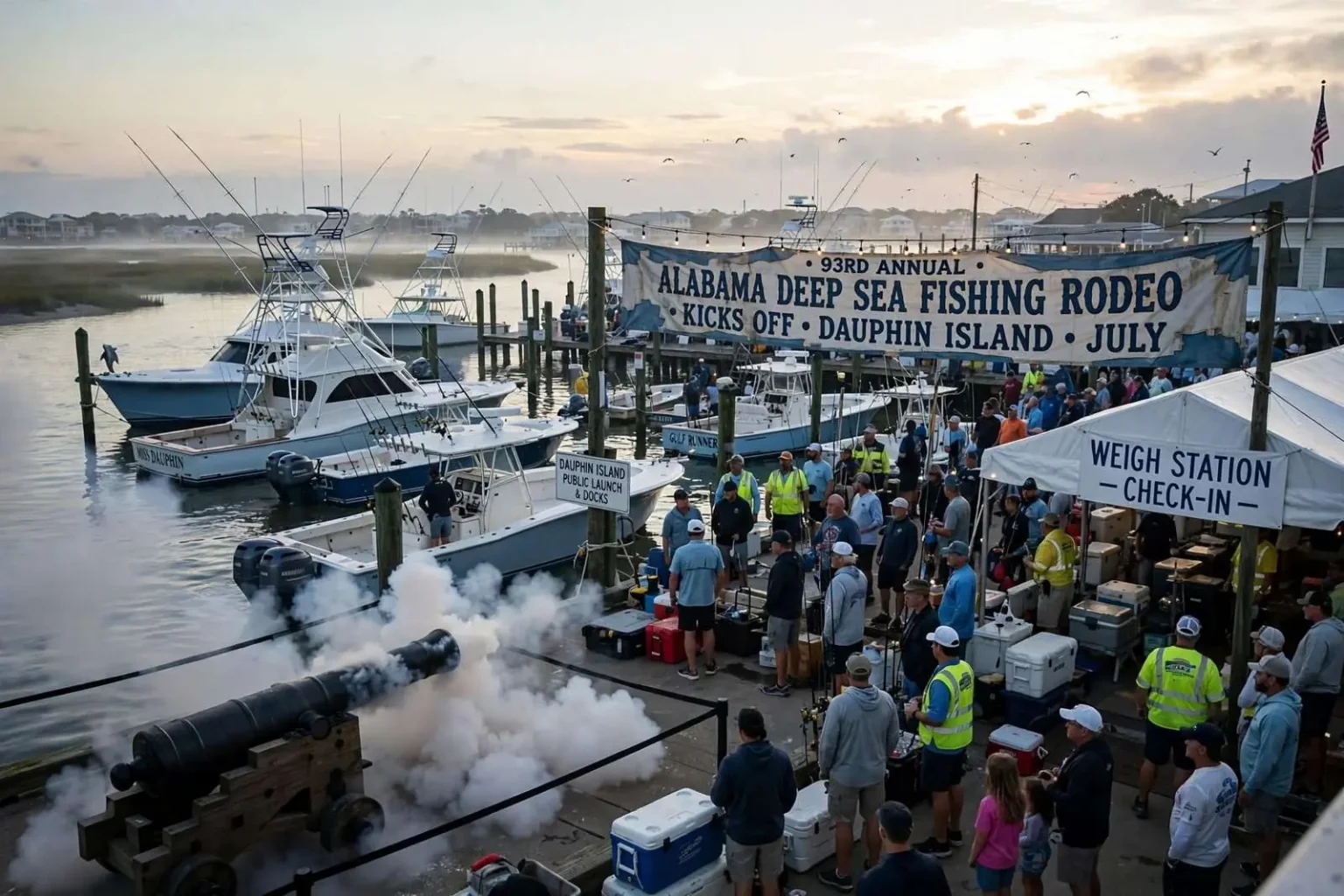
The 93rd annual Alabama Deep Sea Fishing Rodeo opened Friday morning on Dauphin Island with its traditional cannon blast at 5 a.m., signaling the start of one of the Gulf Coast’s longest-running fishing tournaments. Organizers said they expect a strong turnout for the weekend event, which draws anglers and families from across the region every July.
The predatable cannon blast is a tradition as familiar to Gulf Coast anglers as the event itself. In the dark before dawn, the boom rolled across the island’s east end, and lines began going down shortly afterward as boats of every size headed out of Aloe Bay and into open water. By sunrise, the rodeo grounds were humming with the ritual of a tournament weekend: coolers coming ashore, weighmasters calling for the next fish, and families wandering the docks to see what the boats brought back.
“We’re just happy to be here for another great tournament,” said Cody Ward, the rodeo’s vice president of publicity. “We expect a great turnout. We’re excited!”
A Generational Tradition
For many families, the rodeo has become an annual tradition passed down across generations. Twin sisters Allie and Emma Tarver have spent more than a decade attending with their grandfather, helping mark the tournament’s start and finish each year. Now 14 and approaching their 15th birthday, the sisters said the weekend is as much about family time as it is about fishing.
“It gives us a time to hang out with our grandparents and our cousins, and it’s something we bond over,” Emma said, while Allie called it “an amazing experience because we get to do it every year.”
Their story is a common one around the rodeo grounds. The tournament has run for so long that many attendees measure their own lives by it — children who once came out in strollers now fish in junior divisions, and longtime participants bring grandchildren to stand in the same spots their own grandparents did. On an island that draws its identity from the water, the rodeo is less an event than a calendar marker, the way a season opener is for a college town.
Dauphin Island transforms for the weekend. The town’s permanent population swells dramatically as anglers and spectators arrive from across Alabama, Mississippi, Louisiana, and the Florida panhandle. Rental houses fill up, the ferry from Fort Morgan runs heavy with ticketholders, and businesses along the island’s main strip see some of their busiest days of the year. For a town of barely more than a thousand year-round residents, the influx is a summer highlight as reliable as the cannon blast itself.
Big Money and Big Fish
This year’s rodeo features 33 open categories and more than half a million dollars in prizes and cash giveaways, according to organizers. The category list spans the Gulf’s most sought-after species, giving anglers from small skiffs and large sportfish boats alike a shot at the leaderboard. Beyond the open divisions, the event has long included junior and specific-age categories that keep young anglers engaged, reflecting the family-first atmosphere that people like the Tarver sisters describe.
The prize structure is among the most generous in recreational fishing, a scale made possible by the event’s size and longevity. Winning fish are weighed and verified on the island’s public scales, where crowds gather throughout the day to watch leaders change. A heavyweight on the board can hold for hours or be beaten in minutes, and the daily drama at the scales is a spectacle in its own right — part fishing tournament, part theater, all Gulf Coast.
The rodeo’s longevity is nearly unmatched in American sportfishing. Born in the early days of Gulf Coast sportfishing and held on Dauphin Island for generations since, the event has survived hurricanes, oil spills, economic downturns, and wartime to remain the fixture it is today. Organizers and longtime participants describe it as the anchor of the island’s summer calendar, and its record as one of the largest fishing tournaments anywhere has drawn anglers from well beyond the region over the decades.
Its reach extends past the competitive leaderboard. The rodeo has historically supported marine research, with scientists on hand to examine specimens brought to the scales — work that has contributed to the understanding of Gulf fish species over the years. The event’s partnership with the marine science community is one of its quieter traditions, and it means that even fish that never come near a prize still contribute to something larger than the tournament itself.
The Weekend Rhythm
The tournament runs through the weekend and will close Sunday afternoon the same way it began, with another cannon blast on Dauphin Island. The bookend blasts have become the event’s signature, a loud punctuation mark on three days of fishing that participants plan their summers around. Between those two booms, the rhythm of the weekend follows a familiar pattern: early departures from the launch ramps, midday runs to the scales, afternoons of checking the leaderboard, and evenings of camaraderie among crews who may be rivals on the water.
Weather, as always, plays its role. July on the Gulf means heat, afternoon thunderstorms, and long runs offshore for the big-game species at the heart of the rodeo’s history. Anglers check forecasts as closely as they check tackle, and the tournament’s operations staff monitor conditions throughout the weekend to keep the event safe. Rough spells can thin the fleet temporarily, but the rodeo has rarely been slowed for long by summer weather — veterans simply adjust their runs and come back to the scales when the seas calm.
For spectators who never wet a line, the rodeo grounds offer plenty to see. The weigh station draws a constant crowd, food vendors and local organizations line the area, and the people-watching is a sport of its own. Families make an afternoon of it: watch the boats come in, see a shark lifted to the scales, grab something cold to drink, and repeat the next day. The atmosphere is a large part of why the event has outlasted nearly everything else of its kind.
What the Rodeo Means to the Coast
The economic footprint of a rodeo weekend is significant for the island and the surrounding region. Hotels, vacation rentals, restaurants, bait shops, marinas, and fuel docks across Mobile County feel the surge, and many businesses plan staffing and inventory around the event. The tournament’s July slot makes it a midsummer anchor for coastal tourism, landing between the June rush and the late-summer season.
But organizers and regulars alike insist the heart of the rodeo is not the money. It is the experience the Tarver twins describe — grandparents and grandchildren on the same dock, cousins comparing catches, and a community gathering that has repeated itself more than ninety times. When the cannon fires Sunday afternoon to close the 93rd edition, it will end another chapter in a Gulf Coast tradition that, by every indication, will still be going when today’s young anglers bring their own grandchildren to the scales.
Until then, the leaderboard will keep changing, the coolers will keep coming off the boats, and Dauphin Island will spend one more weekend doing what it has done for generations: hosting the Gulf Coast’s great fishing homecoming.
Getting to the rodeo is part of its charm and part of its challenge. Dauphin Island sits at the mouth of Mobile Bay, reachable by a single bridge from the mainland or the mobile-bay ferry that crosses from Fort Morgan on the Baldwin County side. On rodeo weekends the bridge traffic stacks up early, and regulars know to arrive before dawn — which suits the cannon-blast start time just fine. The ferry, for its part, offers arriving anglers a view of the bay’s shipping channel and its islands, a fitting preamble to a weekend built around the water.
Boating logistics shape the fishing as much as anything. Launch ramps on the island and across the bay fill in the dark hours before the scales open, and the mix of vessels ranges from bay boats running nearby reefs to center consoles making long runs to the rigs and deep water beyond. Some crews have fished the rodeo for decades and know exactly which spots to try and when; others are newcomers chasing their first leaderboard entry. The tournament’s open format accommodates both, and that accessibility is a large part of its enduring appeal.
The Scales as Center Stage
Nothing captures the rodeo quite like the moment a big fish comes off a boat. The crowd gathers quickly, kids press toward the front, and the weighmaster’s call goes out as the fish is hoisted. Species that headline the Gulf — snapper, grouper, king mackerel, cobia, amberjack, and the sharks that always draw a roar — each get their moment, and the open categories ensure that everything from a trophy red snapper to an unusual deep-water catch can find a place on the board.
The leaderboard itself is a study in Gulf Coast fishing knowledge. Local anglers who have spent years learning the bay’s contours and the Gulf’s seasonal patterns often hold their own against teams running from far-flung ports. The 33 open categories spread the opportunity across boats and budgets, so the prize money is never concentrated in a single division. For the hundreds of entrants who come up short, the weekend still delivers what most of them came for: time on the water with family and friends, and a place in a tradition bigger than any single catch.
As the 93rd edition settles into its rhythm, the familiar claims hold true. The rodeo remains the island’s summer centerpiece, the Gulf Coast’s longest-running fishing tournament, and — for the families who plan their calendars around it — a homecoming as dependable as the tides. The cannon that opened it Friday morning will sound again Sunday afternoon, and between those two booms lies everything that has kept this tournament alive for nearly a century.