University of South Alabama Spring Hill
Political Notebook: Democrats Seek a Soft Spot in Bob Riley’s Re-election Armor
With Amendment One fading from memory and Gov. Bob Riley courting industry, Alabama Democrats searched for a weakness heading into the fall campaign, while local sidewalks and a federal lawsuit stirred Mobile.
With the ill-fated Amendment One tax measure a fading memory and Gov. Bob Riley rubbing shoulders with titans of international industry, the Republican incumbent entered the summer of 2006 with his re-election prospects looking stronger than ever. Yet the Alabama Democratic Party and its standard-bearer, Lt. Gov. Lucy Baxley, showed no inclination to concede.
The Democratic approach came down to strategy: find a weakness and exploit it. Riley himself appeared a difficult target, so party operatives turned their attention to his grown children, Rob and Minda, whose influence around Montgomery had drawn grumbling since the administration’s earliest days. Some in the capital’s political crowd had taken to disparagingly calling the pair by nicknames borrowed from the headlines of the day. Around Labor Day, observers expected Democrats to try to make the activities of the governor’s children an issue in the race.
The calculation behind the approach was easy to trace. Riley had survived the 2003 tax referendum — the Amendment One package he had staked his first term on, which voters rejected overwhelmingly — by rebuilding his standing around ethics proposals, hurricane recovery and a booming industrial recruitment record that had landed Hyundai’s first American plant and kept Mercedes expanding in Tuscaloosa. By the summer of 2006 he led in every public measure of the race, and Baxley, a former state treasurer widely liked but lightly funded, needed a line of attack that did not depend on matching his advertising budget. Family political activity was the traditional Alabama alternative, and the grumbling around Montgomery’s capital community gave it material.
The tactic carried obvious risk, which is why it waited until fall. Alabama voters have historically reacted badly to campaigns that look like attacks on a candidate’s family rather than his record, and Riley’s children were private citizens. The Democratic operatives expected to raise the question through surrogates and press attention rather than in Baxley’s own voice — a distinction between making an issue and appearing to make one.
A contrast drawn in the lieutenant governor’s race
One notch down the ballot, the Democratic strategy was plainer still. Party messaging cast Jim Folsom as a champion of the common man, while Republican newcomer Luther Strange was portrayed as a country-club figure far removed from everyday Alabamians.
The framing wrote itself in Alabama’s political tradition. Folsom was the son of Gov. Jim Folsom Sr. — “Big Jim” of the hillbilly bands and poor-farmer coalitions — and had inherited the populist brand along with the name, serving as lieutenant governor through the decade’s back-and-forth. Strange, a tall, polished Birmingham lawyer making his first statewide run, had self-funded a campaign and carried an image his opponents were happy to sharpen. The contrast in styles was real; the contest over which man was closer to “everyday Alabamians” would be settled in November, as would the parallel contrast at the top of the ticket.
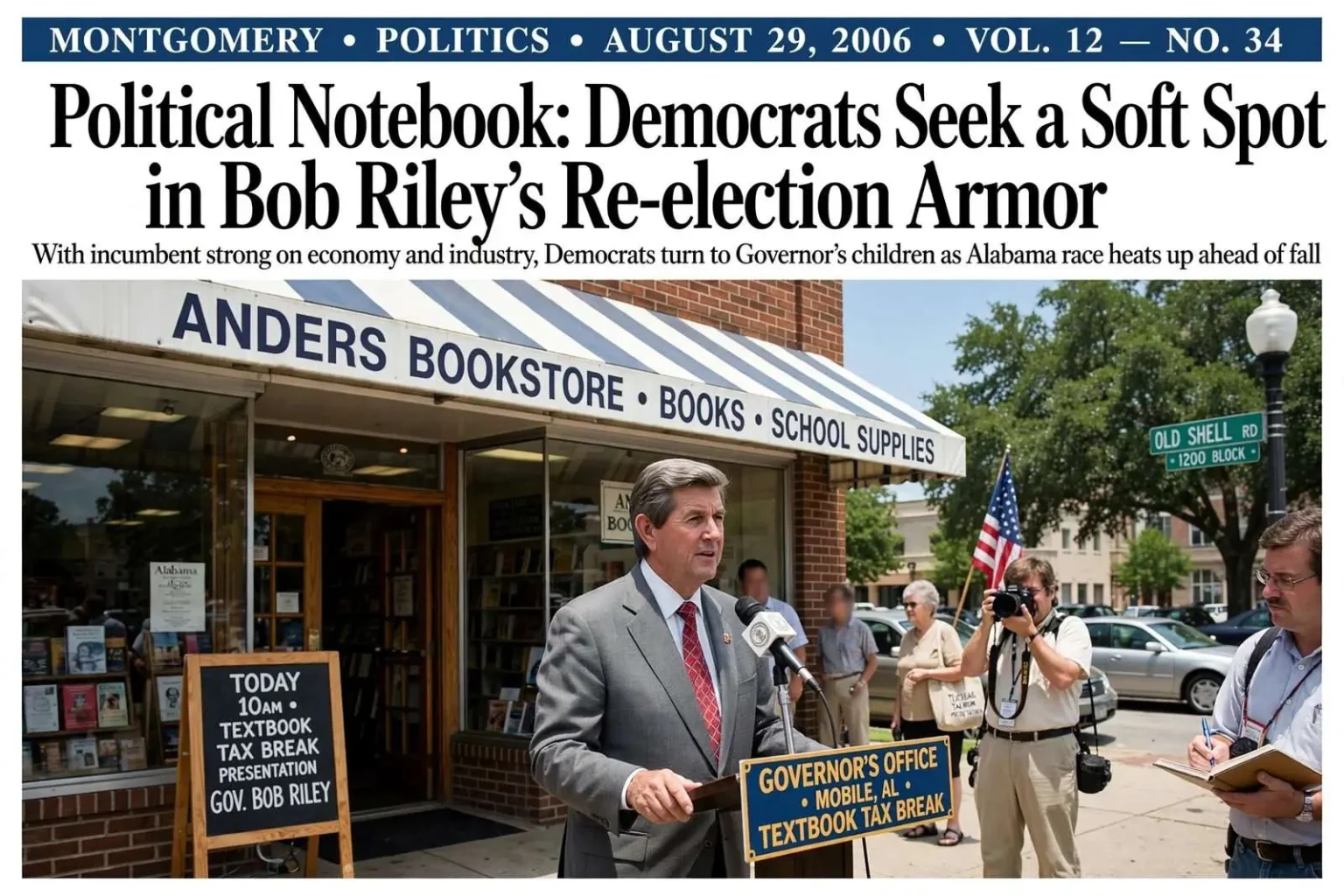
Riley, meanwhile, was scheduled to appear in Mobile at 10 a.m. Tuesday at Anders Bookstore on Old Shell Road to promote a textbook tax break.
The bookstore stop illustrates how Riley governed into his re-election: small, concrete, retail-scale proposals delivered in person across the state’s markets. The Mobile appearance paired the governor with the city’s schoolcommunity around a tax break on school textbooks — a modest measure, but exactly the kind of visible, family-budget-friendly event a front-running incumbent uses to keep his advantage current while his opponent searches for traction.
Alfa plants its crop in the wrong field
The Alabama Farmers Federation, known as Alfa, found itself sowing seeds in the wrong districts during the latest election cycle. A mailing that accused Elberta Mayor Charles “Skip” Gruber, a Republican candidate for the District 4 seat on the Baldwin County Commission, of hiding ties to development and engineering interests was sent instead to residents of state Senate District 34 in west and southwest Mobile County. Gruber went on to win the Republican nomination; his Alfa-backed opponent, Elberta Councilman Steve Kirkpatrick, could have used the help.
The misdirected mailing was more than an embarrassment; it was a window into the reach and the limits of Alfa’s political operation. The federation, headquartered in Montgomery, is Alabama’s largest farm organization and one of its most durable political machines, with county units in all 67 counties and a long habit of mailing attacks on behalf of preferred candidates in local races. Getting the district wrong meant the voters who most needed to see the attack — the Baldwin County electorate deciding the District 4 commission race — never did, while Mobile County Senate voters received an attack on a candidate not even on their ballot. Kirkpatrick’s loss to Gruber completed the waste.
A companion mailing branding Senate District 34 hopeful Chris Pringle a “tax and spend politician” presumably reached south Baldwin voters, though state Rep. Rusty Glover hardly needed the assistance in winning the seat being vacated by retiring Sen. Hap Myers. Pringle, who by his own account spent between $350,000 and $375,000 on the campaign — roughly triple Glover’s outlay — said he was leaving electoral politics. He indicated he planned to obtain a builder’s license so that, in addition to selling hunting land, he could construct camps.
The District 34 episode shows what money could not buy in that cycle. Pringle, a Mobile lawyer and term-limited state representative, poured a sum far beyond anything the district’s legislative races usually see — the bulk of it evidently his own — and still lost to Glover, a high school history teacher whose campaign spent a third as much. The Alfa mailing attacking Pringle, aimed at the wrong geography, did not help his cause any more than its twin had helped Kirkpatrick’s. Pringle’s exit from electoral politics, and his pivot to a builder’s license and a hunting-land business, closed the episode with a shrug that said more about the economics of legislative campaigns than any post-election analysis could.
Linking the university, the park and Spring Hill
A project to connect the University of South Alabama, Municipal Park and the Spring Hill shopping district with a continuous chain of sidewalks was well underway, according to District 7 City Councilwoman Gina Gregory. The University Boulevard section was complete, and work on the Gaillard Drive segment had begun, ultimately tying into existing walkways in the park and along McGregor Avenue. A pedestrian bridge over the park lake was planned to link the park to the museum.
The project’s logic was practical as much as aesthetic. District 7, which covers west Mobile’s university corridor, contains a student population that walks and bicycles daily between campus, the park and the shopping district — and a street grid built for cars, where the absence of continuous sidewalks forces pedestrians onto grass shoulders and roadside ditches. The University Boulevard completion and the Gaillard Drive work knit those destinations together for the first time, with the planned lake bridge adding a pedestrian spine through Municipal Park itself, linking the park’s fields to the museum on its shore.
Gregory said she was working with county and state officials to find money to close the loop with sidewalks along Old Shell Road from McGregor to University. She estimated roughly $2 million would be needed, citing the rising cost of cement, right-of-way acquisition and engineering. “Our traffic engineering department is helping to write the grant application,” she said, adding that the Old Shell stretch would likely run along the south side of the street, where a path already existed.
The funding picture she described was typical of sidewalk projects, which almost never carry dedicated revenue of their own. Federal transportation-enhancement grants funneled through the state, matched by city and county dollars, were the standard vehicle, and a council member who could assemble the application — with traffic engineers doing the technical work — was doing the real work of the job. The south-side routing along Old Shell, following an existing path, would hold down right-of-way costs and spare the street’s historic oak lawns, both of which mattered to the neighborhood’s support.
The $2 million estimate also marked how construction inflation was reshaping even modest municipal ambitions. Concrete prices, land acquisition and engineering fees had all climbed, and a sidewalk project that might have been scoped for less a few years earlier now required a competitive grant to be feasible at all. For a council district absorbing rapid residential growth, the difference between a connected corridor and a patchwork was precisely this kind of application work — unglamorous, unpaid, and decisive.
Will a Mobile lawyer depose the president?
The notebook closed with a striking prospect: could a Mobile attorney one day take the deposition of the president of the United States? The question was raised in a national congressional report examining lawsuits that challenged the constitutionality of the Deficit Reduction Act, among them a case filed that February by Mobile elder-law attorney Jim Zeigler. Attorneys in the suits said they might seek testimony from high-profile figures, and Zeigler added one more name to the list, remarking, “I may have to take the deposition of the president.”
The suits contended that differing versions of the bill had passed the House and Senate, with the signed law never clearing the House because of what Zeigler described as “a $2 billion typo.”
The claim, however unlikely it sounded, went to a genuine constitutional question. The presentment clause requires that a bill pass both chambers in identical form before it becomes law, and the Deficit Reduction Act’s critics argued that a discrepancy between the House and Senate texts — worth roughly $2 billion in the Medicare provisions at issue — meant the document signed by the president was not the bill Congress had passed. Courts weighing the challenge generally held that such clerical discrepancies did not void an enrolled bill signed by the presiding officers of both chambers, and the law survived. But the episode made Zeigler’s name well beyond Mobile, and it gave the political notebook its most improbable image: an elder-law lawyer from Spring Hill Avenue taking the president’s deposition over a typo.
Taken together, the notebook’s items sketched a summer of Alabama politics in miniature — a governor too strong to attack directly, a down-ballot contrast drawn in old populist language, a farm federation mailing to the wrong counties, a sidewalk grant application on Old Shell Road, and a Mobile lawyer threatening the president’s calendar. Campaigns and governments were both at work; only one of them, for the moment, was going anywhere in particular.