University of South Alabama Mobile
St. Luke’s Headmaster Palmer Kennedy Outlined a High School and a $10 Million Campaign
St. Luke's Episcopal School had bought the old Julius T. Wright campus on University Boulevard and was raising $10 million to add an upper school. Headmaster Palmer Kennedy laid out the plan for Mobile's Sunrise Rotary Club.
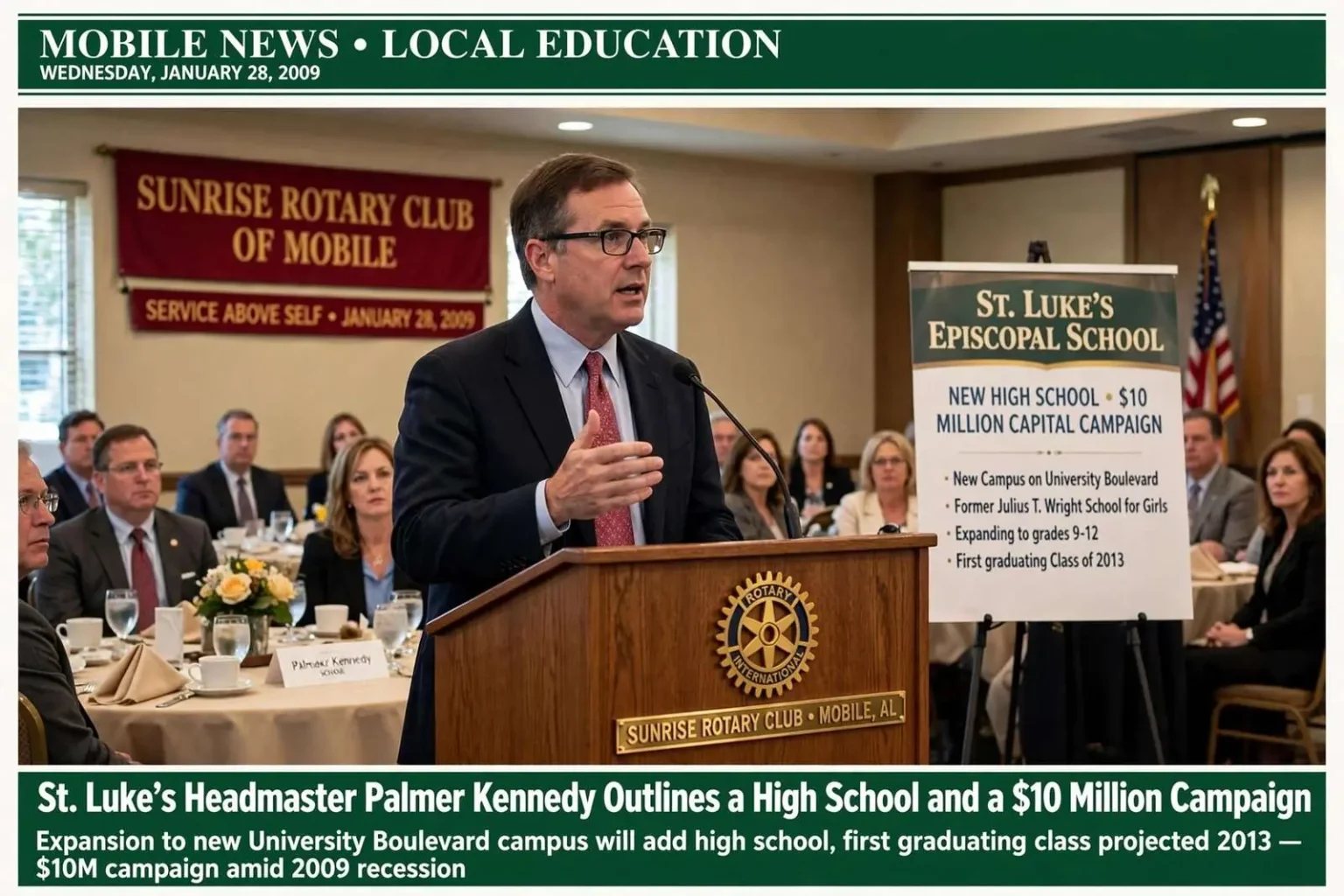
Palmer Kennedy, headmaster of St. Luke’s Episcopal School, addressed the Sunrise Rotary Club of Mobile on Wednesday, Jan. 28, 2009, at a moment when his school was in the middle of the most consequential expansion in its history. The talk doubled as a progress report and a case for confidence, delivered to a room of business leaders in the same winter that national financial news turned grim.
A new campus on University Boulevard
St. Luke’s had purchased the former Julius T. Wright School for Girls campus on University Boulevard with plans to build out a new high school there. The property brought with it roughly 94,000 square feet of facilities on about 32 acres, an unusually large addition for an independent school in Mobile and one that gave St. Luke’s the physical room to grow beyond the grade structure it had operated under for years. For a school that had long made do with a compact footprint, the acquisition amounted to a second campus acquired in a single transaction, complete with athletic space and room to build.
The Wright campus was already a familiar landmark to Mobile families. The Julius T. Wright School for Girls had served the city for decades before its own closing, and its University Boulevard location — near the University of South Alabama and the growing western corridor of the city — placed it where Mobile’s population had been shifting for a generation. Acquiring an existing school campus rather than raw land meant classrooms, offices and athletic facilities that could be adapted rather than raised from the ground, an advantage in both time and money.
At the time of Kennedy’s talk, St. Luke’s served students from PreK3 through the eighth grade, with an enrollment of 565. Kennedy had led the initiative to expand that format to include an upper school, with the first graduating class projected as the Class of 2013. He had also helped launch, and was then in the middle of leading, a $10 million capital campaign that included the purchase of the Wright campus. The addition of an upper school changed St. Luke’s from a feeder into a destination: families who had faced a decision about where to go after eighth grade could now stay through a high school diploma, and a first senior class of 2013 would carry the school’s diploma into college admissions offices for the first time.
The undertaking was ambitious in any year. It was especially so in the winter of 2009, when the national credit crisis had chilled fundraising and construction lending across the Gulf Coast and independent schools everywhere were watching enrollment and pledges nervously. Campaign pledges made in better times came due in a recession, and construction financing had tightened sharply. Kennedy’s pitch to the Rotary club was, in effect, that a school expanding into a decade-long relationship with its families was a different kind of investment than the real estate deals then falling through — one measured in graduating classes rather than quarters.
A Mobile educator’s career
Kennedy is a lifelong resident of Mobile and had been an educator in the city for 24 years by the time he spoke to the club. He attended the University of South Alabama on a four-year track scholarship, earning undergraduate degrees in economics and history as well as a master’s in history, and later earned a master’s in educational leadership from the University of Mobile. He represented Rotary as a member of a Goodwill Exchange Team to Brazil, one of the international exchanges that carry the organization’s name far beyond its weekly luncheons.
He spent 22 years at St. Paul’s Episcopal School, including a stint as upper school director, before moving to St. Luke’s, where he was serving his third year as headmaster. That background gave him an insider’s view of both sides of Mobile’s independent school world — the large established institution and the smaller school betting its future on growth. He and his wife, Karen, had been married 24 years and had two teenagers, the same age bracket the new upper school was being built to serve.
Youth Merit Award
The club presented its Youth Merit Award the previous week to Sarah Bryars, an eighth grader at St. Vincent de Paul Catholic School and the daughter of Richard and Krista Bryars. The award is the club’s way of recognizing students whose service and scholarship stand out before high school even begins, and Bryars’ record made the case on its own.
An honor roll student, she was vice president of the student council and secretary of the National Junior Honor Society, played in the McGill-Toolen elementary band, competed on the St. Vincent robotics team and served as an Oakleigh Junior Belle. The combination — student government, academic honor society, music, robotics and a historic-preservation service role — mapped neatly onto the kinds of well-rounded involvement Rotary’s youth programs are designed to encourage. Her selection also highlighted the way Mobile’s institutions interlock: a Catholic school student honored by a civic club for service that included volunteering with one of the city’s oldest historic house museums.
The Oakleigh Junior Belles, the program Bryars served in, train young volunteers to support events at Historic Oakleigh House Museum, connecting teenage members to the city’s preservation community. The band connection pointed to the McGill-Toolen pipeline that many Catholic school students in Mobile follow into high school. For the club, presenting the award is part of a long-running investment in local students that runs alongside its adult scholarship and exchange programs.
Club business and the polio fight
Members were told that the Bill and Melinda Gates Foundation had awarded $255 million to Rotary International for the global campaign to eradicate polio, bringing the combined commitment from Rotary and the Gates Foundation to $555 million. The announcement, made in late 2008, was the largest single infusion of private money the eradication campaign had received to that point, and it challenged Rotary’s members worldwide to raise matching funds — a responsibility that flowed down to clubs like Mobile’s own.
The polio eradication effort has been Rotary’s signature international cause for decades, dating to the 1985 launch of PolioPlus and the organization’s partnership with national governments and the World Health Organization. By the time of the Gates grant, the disease had been driven out of nearly every country on earth, with stubborn reservoirs remaining in a handful of nations, and the final push required both money and the local volunteers who deliver vaccine drops house to house. The Gates Foundation’s decision to bet $255 million on Rotary’s machinery was widely read as a vote of confidence in the organization’s unmatched grassroots network.
Teeto Graham took over as program chairman for February. The month’s lineup included Russell Ladd on Feb. 4 speaking about the Mobile-Tensaw Delta, Alabama State Port Authority director Jimmy Lyons on Feb. 11 and Estella Dorn on Feb. 18. There would be no meeting on Feb. 25 because of Mardi Gras, the annual pause that Mobile’s civic calendar quietly builds in every year when Carnival week arrives.
The February schedule read like a tour of the region’s defining assets. The Mobile-Tensaw Delta — the vast wetland system north of the Bay that drains into Mobile Bay — has become one of the region’s most discussed conservation subjects, and Ladd’s program promised members a deep look at an ecosystem most had only glimpsed from the interstate. Lyons’ appearance brought the head of the state port to a business audience at a moment when the port’s investments were reshaping Mobile’s economic future, making his program a natural draw for a club built on the city’s commerce.
Leadership awards and membership
Recruiting continued for the 2009 Rotary Youth Leadership Awards conference, set for April 2-5 at Camp ASCCA near Dadeville on Lake Martin, with Donna Ames and Carolyn Akers handling applications from high school juniors and seniors. Camp ASCCA, Alabama’s specialized recreation camp, hosts the annual leadership weekend that gathers rising young leaders from clubs across the state for several days of team-building, service training and contact with Rotary’s adult network.
President Jay Ison and the board again urged members to propose new candidates for membership, noting there was no guest charge for bringing a prospective member to a weekly meeting of the club, which gathers under Rotary’s motto, “Service Above Self.” In a recession winter, civic clubs everywhere faced the same arithmetic: service budgets depend on members, and membership depends on making the first visit easy. The Sunrise club’s answer was to remove the cost barrier and lean on its members’ own networks — the same quiet, person-to-person approach that had filled the room to hear Kennedy talk about his school’s future.
What the morning said about Mobile
A single Rotary breakfast managed to hold together a remarkably complete cross-section of the city at the start of 2009: a private school wagering on growth in a recession, a national health campaign reaching into a local club’s meeting, a middle school student recognized for service to a historic house museum, and a month of programs lined up around the delta, the port and Carnival. Each thread was distinct, but they pointed the same direction — toward the institutions that Mobile relies on to carry it through hard economic seasons.
For Kennedy and St. Luke’s, the months ahead would test whether a $10 million campaign and a new high school could be delivered in the worst fundraising climate in a generation. For the club itself, the challenge was more familiar: keep the programs coming, keep the students coming, and keep filling the room. On the last Wednesday morning of January 2009, at least, both were on track.