Baldwin County School Board Restores Assistant Superintendents in a Return to a Familiar Structure
The Baldwin County school board appointed two assistant superintendents in August 2014, unwinding the executive-principal model and returning the system to a more traditional organization.
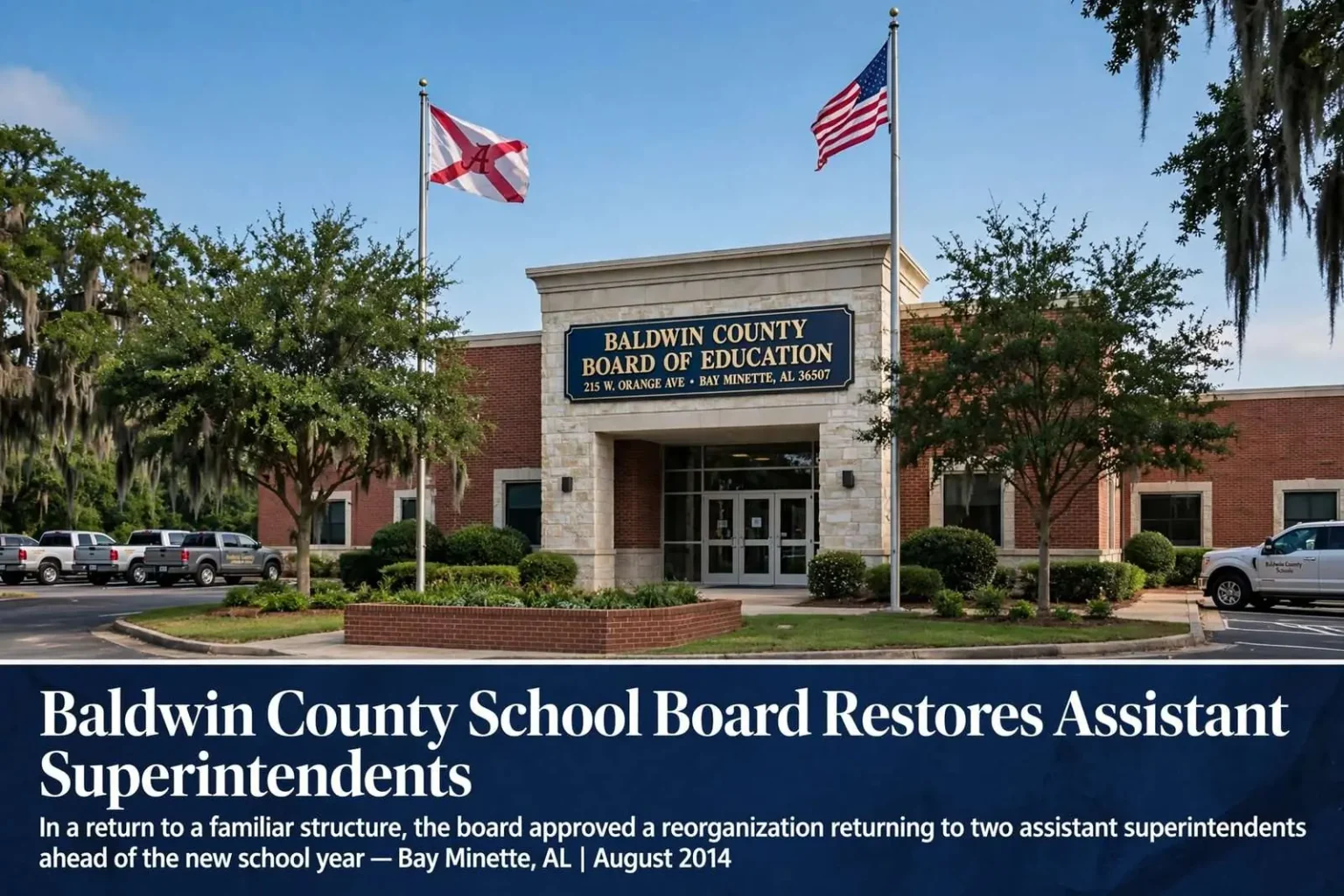
The Baldwin County school board approved a reorganization in August 2014 that returned the school system to the way its staff had been structured before former Superintendent Alan Lee took the helm in 2010.
The vote, coming just weeks before the start of a new school year, marked a clear break with the administrative philosophy of the previous four years and a return to a hierarchy that generations of Alabama educators would recognize on sight. For one of the largest school systems in the state, the decision was as much about confidence as organization.
A more traditional alignment
At a board meeting held on a Tuesday night in Bay Minette, interim Superintendent Robbie Owen presented what was described as “a more traditional alignment.” The change added two assistant superintendents to take over some of the duties that had been handled by “executive principals,” a role designated under Lee.
The restructuring represented “a collaborative effort between the superintendent and the board in the direction of what it will take to move the system forward,” said Terry Wilhite, spokesman for the school system.
Board member Shannon Cauley said the board favored the change because the executive-principal roles had been a source of confusion. “Nobody really understood what they did,” she said.
Under the executive-principal model, experienced school leaders had been pulled out of their buildings to supervise clusters of schools while holding the title of principal — an arrangement that blurred the line between building administration and central office supervision. Parents and staff alike, Cauley’s remark suggested, had never fully understood who was responsible for what.
Lee’s executive-principal experiment had drawn attention beyond Baldwin County when it was introduced, with the system framing it as a leaner way to supervise a sprawling district without adding central office positions. Four years on, the board’s judgment was that the savings in titles had come at the cost of clarity, and that the traditional pyramid — principals answering to assistant superintendents — remained the model Alabama educators, parents and taxpayers understood best.
Baldwin County’s school system spans the entire county, from Bay Minette in the north to Gulf Shores and Orange Beach on the coast, with campuses in Daphne, Fairhope, Foley, Spanish Fort, Robertsdale, Elberta, Silverhill, Summerdale, Loxley and Points Between. Coordinating that geography has always been the central problem of the system’s administration, whoever holds the titles.
Two familiar principals move up
The board appointed Russ Moore, principal of Foley High School, and Becky Comer, principal of Spanish Fort Elementary, as the two assistant superintendents. Both were to start in their new jobs on Sept. 2.
Moore’s responsibilities were to include supervising the middle and high schools, as well as the system’s Facilities and Maintenance and Environmental Services departments. Comer was to oversee the elementary and intermediate schools, along with the Transportation Services and Health Services departments.
The division of labor gave each assistant superintendent a tier of schools plus a set of support operations, pairing academic supervision with the operational departments that keep a countywide system running. Both came to the posts from large schools in fast-growing communities, with Moore leading one of the system’s biggest high schools and Comer one of its largest elementary feeder programs.
Comer’s move to the central office also left Spanish Fort Elementary without its principal, which is why the split-day arrangement at Rockwell and Spanish Fort mattered so much to the eastern corridor’s schedule. The system’s principals’ association and support organizations were notified of the changes in the days that followed, as payroll, evaluation lines and reporting relationships were rebuilt around the new chart.
The Sept. 2 start date meant both new assistant superintendents would begin their duties just as the year’s first attendance counts were taken, the figures on which state education funding is largely based. Timing the appointments for the opening of school, rather than mid-year, was intended to let the new structure settle in from the first day rather than forcing a mid-course reorganization months later.
Owen, who had been appointed interim superintendent on Aug. 11, had been the principal at Rockwell Elementary and was expected to return to that job once a permanent superintendent was hired. In the meantime, the system arranged interim leadership at the schools he and others left behind.
Owen’s appointment itself was a sign of the moment. The board turned to a sitting principal rather than a central office administrator to steady the system, and the former principal’s brief tenure would be judged on how smoothly the transition into the new school year proceeded.
Filling the gaps
Waverly Boutin, an assistant principal at both Rockwell and Spanish Fort elementary schools, was tapped to assist in leadership at both campuses, spending her mornings at Rockwell and her afternoons at Spanish Fort Elementary.
The split-day arrangement put an experienced administrator in both buildings, though at the cost of a schedule that required her to divide her attention each day between two campuses in Spanish Fort. Schools in Baldwin County’s eastern growth corridor had been gaining students for years, and leadership vacancies in that part of the county were among the most consequential the system faced.
Lead teacher Pam Manders was serving as acting principal at Rockwell Elementary, and lead teacher Allison Guy was to step in to assist as needed at Spanish Fort Elementary.
Using lead teachers as acting administrators is a common practice in Alabama systems, offering capable classroom veterans a trial run at school leadership while the system searches for permanent appointments. The approach carries risks — disciplinary decisions and parent relations are different work from teaching — but it also builds a pipeline of future administrators from within.
The board announced several other appointments as part of the restructuring. Shane Tucker was named interim principal at Foley High School. Branton Bailey, formerly the executive principal over middle schools, became principal of Foley Intermediate School.
Foley Intermediate, Bailey’s new post, serves the grades between elementary and high school in a community that has grown quickly enough to require regular campus expansions. Pairing a veteran of the system’s central administration with a growing intermediate school reflected the board’s effort to place experienced hands wherever the transition had opened gaps.
Pat Malisham was appointed assistant principal at Daphne East Elementary. Don Blanchard, who had been the executive principal over high schools, moved to Drop Out Prevention Services. Dana Bottoms, who had been appointed the system’s new elementary executive principal in May — replacing Suellen Brazil, who retired — shifted to Administrative Services.
Dropout prevention, Blanchard’s new assignment, had taken on added importance statewide as graduation standards tightened and systems were held accountable for students who left school early. Baldwin County’s programs in that area coordinated with the system’s alternative school and counselors, work that fit a veteran of high school administration.
The appointments in effect dismantled the executive-principal layer and redistributed its occupants. Some returned to running individual schools, where their experience was most directly useful; others took on targeted roles in dropout prevention and administrative services, preserving their institutional knowledge without the titles that had caused confusion.
Steadying the system
The reshuffling came during a period of transition for Baldwin County schools, with an interim superintendent at the helm and a search for permanent leadership ahead. By retiring the executive-principal titles that had puzzled staff and community members and restoring assistant superintendent positions, the board opted for a structure that many in the system already understood.
For a large county district responsible for schools from Bay Minette to the coast, clarity in the chain of command carried practical weight. The new alignment spelled out who was responsible for the elementary and intermediate schools, who oversaw the middle and high schools, and how support services such as transportation, maintenance and health would be supervised.
The change also responded to a practical reality of Baldwin County’s growth. The system’s enrollment had climbed steadily with the population moving across Mobile Bay, and campuses in Spanish Fort, Daphne and Foley had absorbed wave after wave of new students. A structure whose responsibilities were clearly divided, board members reasoned, would be better positioned to handle the next decade of growth than one whose roles required explanation.
The board’s search for a permanent superintendent was proceeding on a separate track, and members said the reorganization was designed to work under whoever ultimately won the job. A system that had just changed leadership twice in four years, they reasoned, needed stability in its day-to-day structure more than it needed another administrative experiment.
Families and employees following the changes would notice the difference most in who answers the phone. Under the previous arrangement, a parent with a concern about a high school might have been unsure whether to call the school’s principal, the executive principal over high schools, or the central office. Under the restored structure, the lines of authority ran the way they had before 2010 — principal to assistant superintendent to superintendent.
As the new school year opened, the board’s message was one of steadying the organization while it worked to fill its top job on a permanent basis.
Whether the next superintendent would keep the restored structure remained an open question, but the board had made its preference clear: an organization in which every school, department and administrator had a place that needed no explaining.