Stockton Votes Itself a Zoning District as a 4,500-Acre Solar Farm Looms
Residents of Stockton's Planning District 3 voted 215-161 to bring their area under Baldwin County planning and zoning, a grassroots response to a proposed 4,500-acre solar farm they say blindsided them.
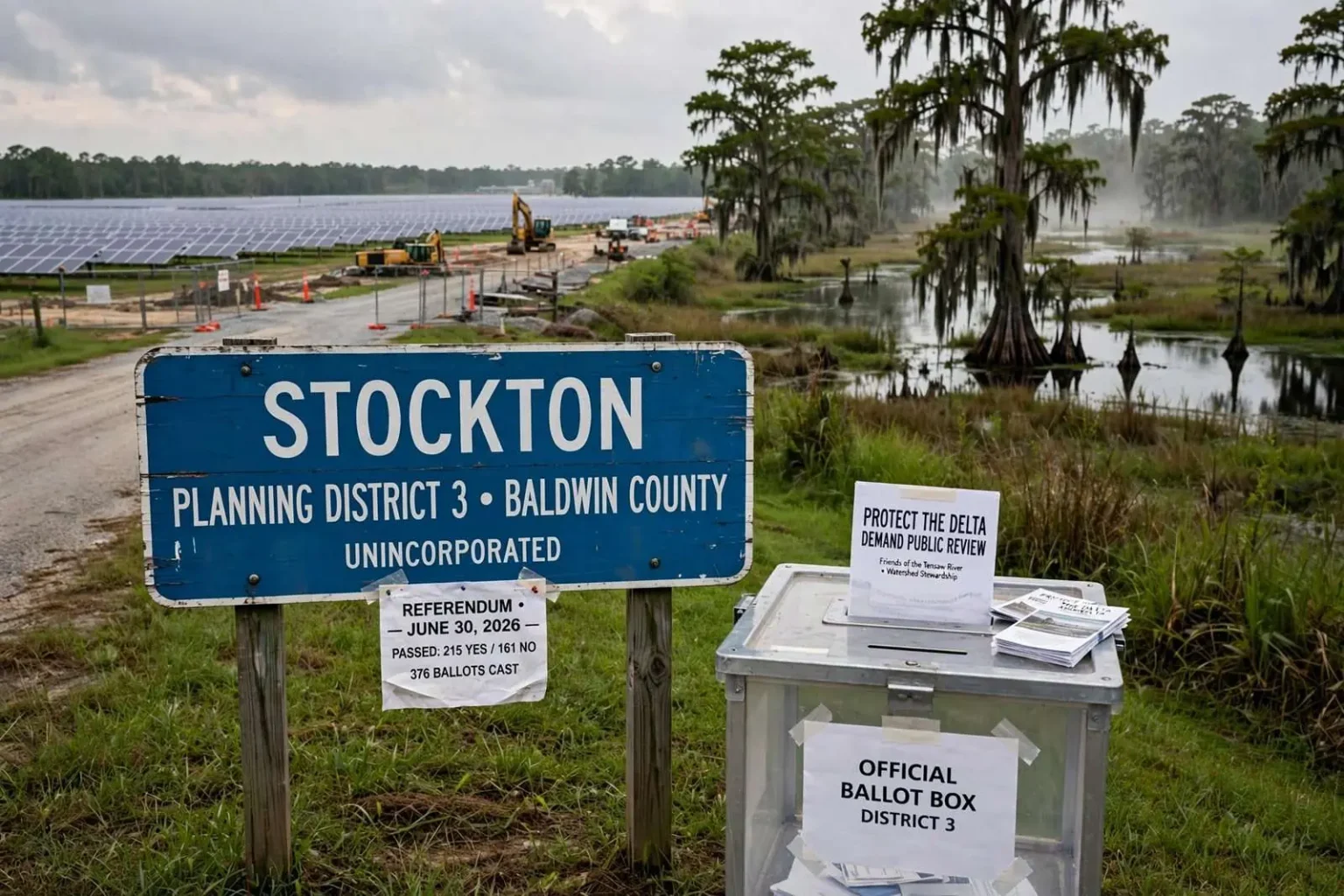
On June 30, 2026, voters in Stockton’s Planning District 3 did something Alabama law rarely gives rural communities the chance to do: they voted to regulate themselves. By a margin of 215 to 161, out of 376 ballots cast, residents approved bringing their district under Baldwin County planning and zoning oversight.
The vote did not happen in a vacuum. It was the direct product of a fight over a proposed 4,500-acre solar farm by Silicon Ranch, a project intended to supply power to a Meta data center in Montgomery.
The Gap in Alabama Law
To understand why residents had to hold an election to get a seat at the table, you have to understand what Alabama counties can and cannot do. Under state law, Baldwin County has no authority to regulate land use in unincorporated, unzoned areas. That is not a policy choice by the county commission. It is a limit written into the statutes.
The practical consequence is severe. In an unzoned area, a company can assemble thousands of acres and develop an industrial-scale project without a single public hearing, because there is no zoning ordinance to trigger one. Residents get no notice, no comment period and no forum. They find out when the equipment arrives.
The only remedy the law provides is the one Stockton just used: a citizen-initiated referendum in which a district votes to place itself under county planning jurisdiction. It is a blunt instrument, and it requires organizing an election from scratch.
What the Community Said It Wanted
Residents who pushed the referendum described being “sold out” and blindsided by the speed of the project’s progress. But supporters were careful to frame the vote as being about process rather than about solar energy as such. The goal, as they described it, was to create a tool to help guide the growth of a community and to guarantee public input, something currently unavailable to them by law.
A successful vote allows the district to appoint an Advisory Committee to recommend zoning designations, and it establishes a framework through which future proposals face public review before they are approved.
The Grandfathering Question
Here is where the victory gets complicated. It is not at all clear the referendum stops the project that prompted it. According to Baldwin County, if a complete development application is received before a zoning vote, the project is generally treated as grandfathered and is not affected by the new zoning. The county commission has previously indicated that Silicon Ranch submitted development applications that may qualify for that status.
A yes vote does trigger a 180-day moratorium on new land uses and structures. But a moratorium looks forward. It may not reach back to halt an application already in the pipeline.
The opposition is not conceding the point. Community groups including Friends of the Tensaw River have signaled they are prepared to challenge the county’s grandfathering determination, arguing that the approval process amounted to an improper exercise of authority. That dispute is headed for a legal fight, and its outcome will determine whether the referendum was a victory or a lesson in timing.
A Contrast on the Coast
Stockton’s situation stands in sharp relief against the Fort Morgan Planning and Zoning District, at the other end of Baldwin County. That district was confirmed and ratified by the Alabama Legislature to manage growth in an environmentally sensitive coastal corridor, following a 2014 Alabama Supreme Court decision concerning de-annexation of property from the City of Gulf Shores. Fort Morgan operates with a pre-existing legal status and a designated advisory committee.
Stockton is building the same machinery from nothing, in a hurry, under pressure from a specific project. One district got its planning authority in advance. The other is scrambling to assemble it after the fact.
The Larger Tension
What happened at the Stockton ballot box is a symptom of a countywide problem. Baldwin County is growing rapidly and attracting large-scale energy and industrial development, while its unincorporated communities remain legally powerless to weigh in on projects that will permanently reshape them. Local leaders and lawmakers have been pushing for legislation that would give counties more oversight of such developments without requiring each community to run its own referendum first.
Until that changes, Stockton’s playbook – organize, petition, vote – is the only one available.
The Delta Next Door
Stockton sits on the eastern edge of the Mobile-Tensaw River Delta, the vast network of rivers, swamps and bottomland forest that forms where the Alabama and Tombigbee rivers come together north of Mobile Bay. Often described as the second-largest river delta in the contiguous United States, it is one of the most biologically diverse landscapes in North America, which is why groups such as Friends of the Tensaw River treat land-use decisions near it as a matter of watershed stewardship as well as local zoning.