Shelby Votes No on Bernanke, Faulting the Fed for the Bubble It Failed to See
Alabama's senior senator broke with the Federal Reserve chairman he once supported, arguing that Ben Bernanke helped inflate the housing bubble that wrecked Gulf Coast home values and bank balance sheets.
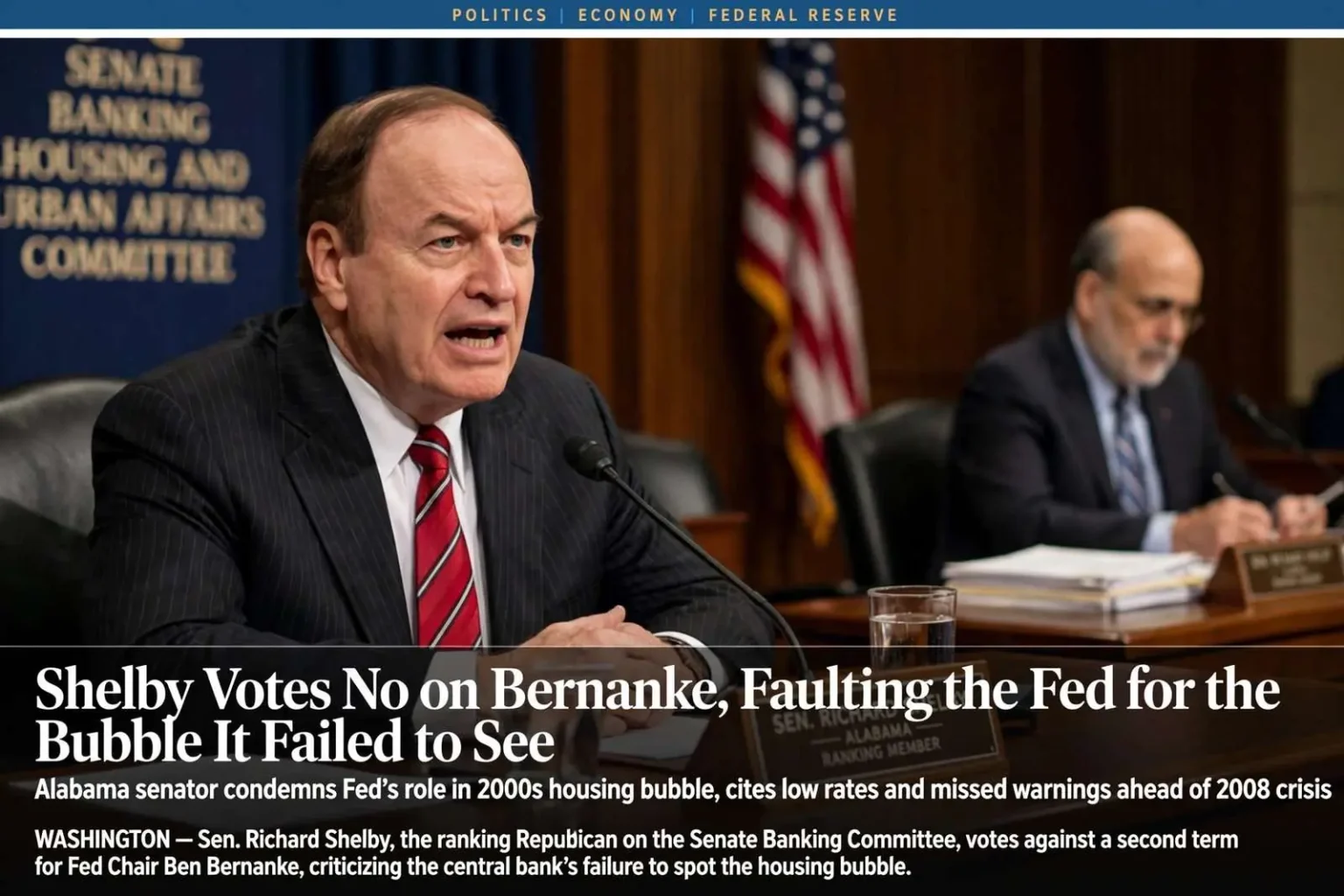
WASHINGTON — U.S. Sen. Richard Shelby, Alabama’s senior senator and the ranking Republican on the Senate Banking, Housing and Urban Affairs Committee, voted this week against a second term for Ben Bernanke as chairman of the Federal Reserve — and delivered a lengthy indictment of the institution he once defended.
“While there may be some agreement on Chairman Bernanke’s handling of the crisis, we must also take into account his role leading up to the crisis,” Shelby said. “We talk a good game when it comes to accountability, but we rarely match our own rhetoric with action.”
The case against Shelby’s argument was that the crisis of 2008 was not weeks or months in the making but years, and that Bernanke — a Fed governor from 2002 to 2005 before becoming chairman — helped make it. He traced the sequence.
After the 2001 recession, the Fed held interest rates remarkably low for an extended period; the effective federal funds rate stayed below 2 percent from December 2001 to November 2004. Bernanke, then a governor, supported that policy and warned repeatedly about the danger of deflation.
But while the Fed leaned hard against deflation, Shelby said, it was “remarkably unconcerned about the possibility of igniting a different financial crisis by inflating a housing price bubble.”
He leaned on the economist Anna Schwartz, who characterized the easy-money environment as a sin of commission and the neglect of accumulating risk as a sin of omission. Schwartz, co-author with Milton Friedman of the landmark monetary history of the United States, brought a rare authority to the criticism: her career had been built on studying how central banks’ choices turn financial stress into catastrophe.
He cited Robert Shiller’s inflation-adjusted home price index: real home prices rose about 85 percent between 1996 and 2006, against a 10 percent rise across the entire period from 1890 to 1996. “In the 106-year period beginning in 1890,” Shelby repeated for emphasis, “home prices only rose 10 percent in real terms.”
The comparison was the analytical heart of the speech. A century of flat real home prices, followed by a decade in which they nearly doubled, is the signature of a bubble rather than a fundamentals-driven market — and Shelby’s point was that the institution charged with financial stability watched the series climb and did nothing about it.
The Banking Committee’s confirmation hearing gave Shelby his forum, but the case he built drew on material that had been accumulating for years — congressional research, academic studies of the housing mania and the Fed’s own published statements. As ranking Republican, he could have treated the nomination as a formality; instead he used the floor statement to conduct something closer to a retrospective audit of the decade.
His sequence was deliberate: low rates, then the bubble, then the blind reassurances, then the rescue. Each stage, in his telling, compounded the one before it. Cheap money inflated the housing market; faith in that market kept regulators quiet; the collapse forced emergency measures that redistributed losses onto the public. The through-line was institutional failure at the Federal Reserve, the one agency with both the mandate and the tools to stand in the way.
The Quotations That Stung
Shelby read Bernanke’s own words back to him. In June 2007 the chairman had said that troubles in the subprime sector seemed “unlikely to seriously spill over to the broader economy or the financial system.” In October 2007 he had said, “The banking system is healthy.”
“In October of 2007,” Shelby said, “the banking system was decidedly not healthy.”
The reassurances had aged badly by the time of the vote. Within months of Bernanke’s comments on the broader economy, the housing collapse had pulled down Bear Stearns, then Lehman Brothers, and the credit markets supporting banks around the world had frozen. For critics, the quotes showed more than optimism; they showed a systemic blind spot at the top of American financial oversight at the precise moment warnings were needed.
He was equally hard on the rescue itself. The Fed’s balance sheet had grown from roughly $800 billion before the crisis to more than $2.2 trillion. Some emergency lending, he allowed, was innovative. Some of it, he said, amounted to bailouts — and in many cases bondholders were made whole though they had no legal entitlement to be.
The result, in his phrase, was “moral hazard on an unprecedented scale.” The argument was the traditional conservative case against crisis intervention: that rescuing institutions from their own risk-taking teaches the next generation of lenders that someone will absorb the losses, guaranteeing a repeat. Supporters of the Fed’s actions countered that the alternative — a cascade of failures through the payments system — would have cost far more.
Why It Mattered on the Gulf Coast
The abstractions had concrete meaning in South Alabama. The housing boom Shelby described had run hard along the coast, particularly in Baldwin County, where condominium towers rose in Orange Beach and Gulf Shores on the strength of speculative pre-construction sales, and where lots changed hands two or three times before a foundation was poured.
When the market turned, it turned violently. Projects stopped mid-construction. Community banks in Mobile and Baldwin counties found themselves holding development loans against collateral worth a fraction of the appraisal.
The coastal condo market became a textbook illustration of the mechanics Shelby described. Pre-construction contracts let buyers flip units before completion, amplifying demand beyond any realistic occupancy, and when the contracts started to collapse, unfinished towers became the region’s most visible monuments to the boom. Local banks that had financed the lending — small institutions whose loan books were concentrated in their own backyards — carried the losses directly.
Shelby’s committee was, at the same time, in the middle of writing the financial regulatory overhaul that would become the Dodd-Frank Act. His vote against Bernanke was in part a statement about that legislation: an argument that the Federal Reserve, which many in Congress wanted to hand expanded regulatory authority, had not earned it.
The vote count told its own story about the Senate. Bernanke’s first confirmation had cleared easily; the second survived by a margin thinner than any Fed chair had endured, with defections on both sides of the aisle. Political observers at the time read it as a referendum on the crisis response generally rather than on one man’s competence — a distinction Shelby himself drew by conceding agreement on the crisis handling while pressing the case for what came before it.
The Outcome
Shelby’s opposition did not prevail. Bernanke was confirmed for a second term the following month, though by the narrowest margin any Fed chairman had ever received — a tally that reflected exactly the accumulated anger, in both parties, that Shelby had spent his committee statement articulating.
The vote itself was a piece of political history. Fed chairs had historically been confirmed with overwhelming bipartisan margins, and the narrow tally — against a chairman widely credited with pulling the financial system back from the edge — showed how thoroughly the crisis had reframed the politics of monetary policy. Legislators who had never before objected to a Fed nomination found themselves answering for bailouts, bank failures and unemployment in their own districts.
For Shelby, the vote was also consistent with a longer record. As the Senate’s most senior Republican on banking matters, he had spent years skeptical of concentrated financial power, of regulatory arrangements that protected the largest institutions, and of the assumption that Wall Street’s stability automatically serves Main Street. The Bernanke speech compressed that worldview into a single argument: accountability begins at the top.
The confirmation fight also previewed the fights to come over the Fed’s post-crisis role. The central bank emerged from 2008 with more authority, a larger balance sheet and a bigger footprint in the financial system than it had ever held — and with a corresponding share of congressional scrutiny. Every subsequent debate over quantitative easing, emergency lending powers and the Fed’s regulatory reach has echoed the terms Shelby laid out in his statement.
“For many years,” Shelby said, “I have held the Federal Reserve in very high regard. I fear now, however, that our trust and confidence were misplaced.”
The line captured the tone of the moment better than any procedural detail. It was not the voice of a senator grandstanding against a nominee but of a committee’s ranking member measuring an institution he had worked with for decades against its own record — and finding the record short. Whatever one makes of the monetary policy debate, the speech stands as one of the fullest congressional articulations of the case that the 2008 crisis was manufactured slowly, in plain sight, by the very officials who expressed surprise when it arrived.
In Alabama, where the collapse of the condo boom and the failures that followed left scars on community banks and coastal economies, that argument found a ready audience. The homes along the Gulf that sold for speculative prices in 2005, the construction loans that soured in 2008 and the banking consolidations that followed were, for local residents, the human ledger of the policy failures Shelby catalogued from the Senate floor.