Crews Scale 160 Feet to Fix Mobile Cathedral Lights After Lightning Damage
Electricians worked 160 feet up to repair lighting on Mobile's Cathedral Basilica domes, a year after a lightning strike.
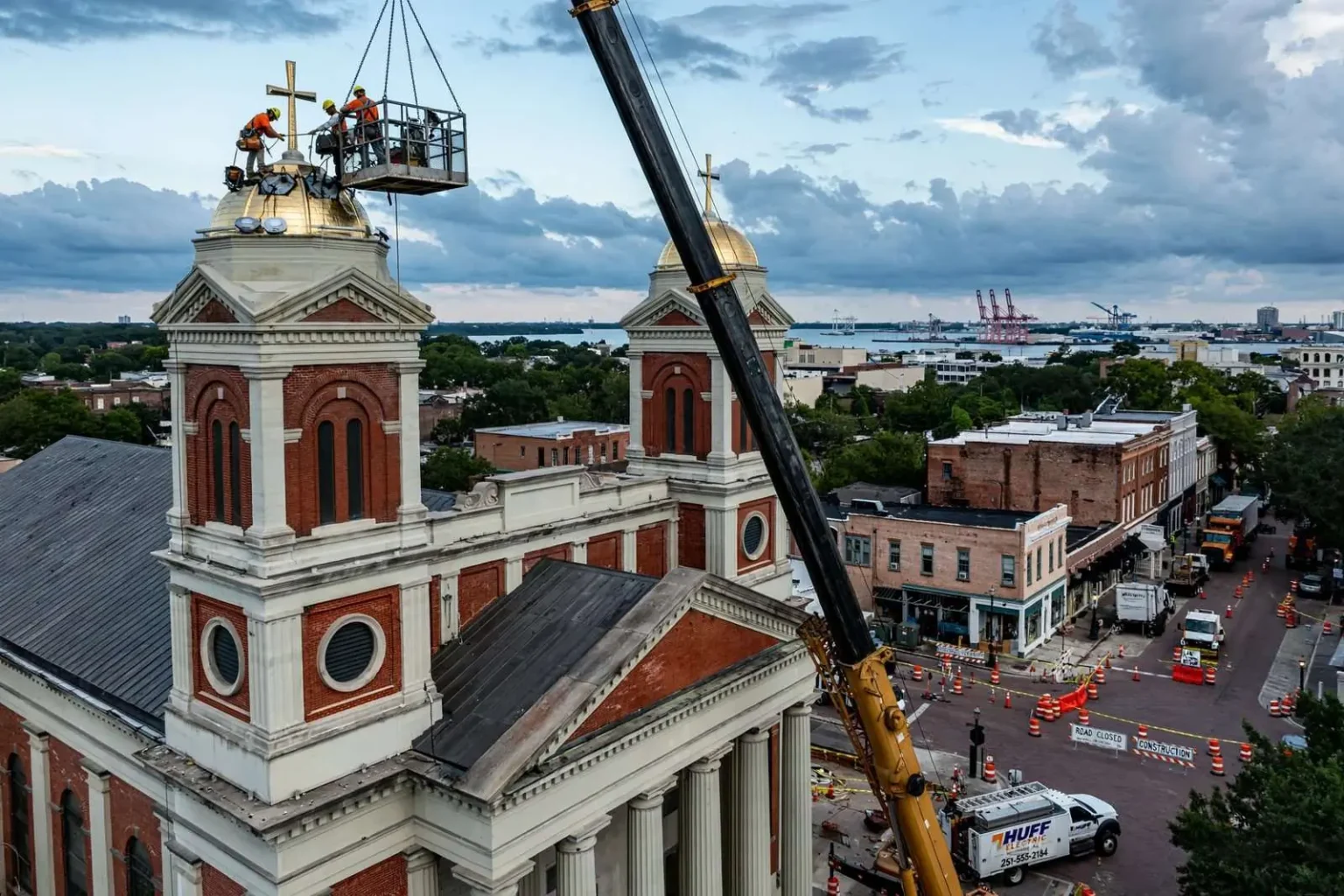
Downtown Mobile drivers may have noticed lane closures near the Cathedral Basilica of the Immaculate Conception this week, as crews worked high above the historic building to replace lighting damaged more than a year earlier by a lightning strike. The work put a crane and a lift basket against one of the city’s most recognizable skylines, drawing glances from commuters passing along the streets that frame Cathedral Square in the heart of the Church Street East historic district.
Repairing damage from a 2013 storm
Lightning struck the 163-year-old cathedral in June 2013, damaging both its electrical system and its organ. A strike on a building of that age is never a small event: the basilica’s masonry, woodwork and wiring predate modern surge protection by more than a century, and a direct hit travels through every conductive path it can find. In this case the damage reached from the structure’s electrical infrastructure all the way into the sanctuary, where the pipe organ — one of the building’s musical centerpieces — absorbed part of the jolt.
According to Facilities Manager David Wilton, the organ has since been repaired, but the exterior lighting on the building’s domes still needed attention. Wilton said the current round of work, which is blocking nearby traffic, was expected to wrap up by the end of the week, weather permitting. The distinction matters to more than aesthetics: the domes’ lighting has long been part of how the cathedral presents itself to downtown Mobile after dark, and fixtures left damaged or dead following the strike had left the building visibly dimmer at night.
A high-wire job at 160 feet
The work has fallen to employees of Huff Electric, a Theodore-based electrical contractor that has serviced the cathedral’s lighting for seven years. Crews are being lifted roughly 160 feet into the air in a metal basket attached to a crane to reach the domes, where they are replacing bulbs and ballasts and addressing damaged interior wiring. At that height, workers are above every surrounding rooftop in the immediate blocks, with a clear view across downtown, the Mobile River and the city’s skyline stretching south toward the water.
The ballast replacement is the unglamorous heart of the job. Ballasts regulate the current to the lighting fixtures, and when a surge like a lightning strike passes through a system, ballasts are frequently the components that fail first or fail subtly — working one week, failing the next. Replacing them in batches, along with roughly 100 bulbs, is more efficient than responding to individual outages, particularly when every repair visit requires closing lanes and lifting a crew 160 feet into the air.
Wilton estimated the job involves swapping out about 100 bulbs and two dozen ballasts, along with removing unused fixtures that had been identified as lightning hazards. Unused fixtures may seem like an odd priority, but dead wiring and abandoned mounts create exactly the kinds of paths a strike seeks out. Clearing them is part of hardening the building against the next storm — a real consideration in a port city where thunderstorms roll in from the Gulf through much of the year.
For electrician Brent Turner, the assignment was something of a long-awaited opportunity. “I’ve been looking forward to this for weeks. I’ve been wanting to do this for five years,” he said of the chance to ride the crane basket up alongside the cathedral’s domes. Few electrical jobs in the region offer a view like it, and the novelty is part of what the crew says makes the uncomfortable work of riding a basket above downtown worthwhile.
Huff Electric owner Pat Huff said the vantage point is a rare one, even for a company that has worked on the building for years. “It’s not often you get an open view,” he said, noting he had only been up in the crane at the cathedral five times over the past seven years. That rarity underscores the specialized nature of the work: most lighting maintenance at the basilica happens on ladders and scaffolding well below the domes, and full access to the uppermost reaches of the building requires the crane, the lane closures and the coordination with the city that go with them.
The logistics also illustrate what maintaining a historic downtown landmark actually costs. A suburban building with a flat roof and room for equipment staging can be serviced with little public impact. The cathedral sits in a dense historic district bounded by active streets and public squares, so reaching its top requires closing lanes on downtown streets and lifting workers past neighbors’ doorsteps — an operation that takes planning, permits and patience from everyone involved.
Services continue despite the work
Despite the ongoing repairs and the lane closures they have caused, worship services have continued uninterrupted at the cathedral, with parishioners directed to enter through a side door on the building’s south side while the exterior work is underway. The workaround is routine for a congregation that has maintained the building through wars, hurricanes and generations of structural upkeep, and it spared the parish the disruption of moving Masses off-site while the exterior work proceeds overhead.
The Cathedral Basilica of the Immaculate Conception has long stood as one of downtown Mobile’s most recognizable landmarks. Its twin towers and domes anchor Cathedral Square, and the building serves both as an active parish and as a piece of the city’s public identity — photographed by visitors, featured in tours of the historic district, and visible in the skyline from the waterfront. Mobile’s Catholic history runs deep; the congregation traces its roots to the earliest days of the city, and the current structure, completed in the 1850s, is among the oldest church buildings in continuous use in the state.
Buildings of that age demand constant care, and the repair work reflects the ongoing maintenance required to keep a structure of its age and historic significance in good condition, particularly after storm damage of the kind sustained during last year’s lightning strike. The basilica’s keepers have long balanced preservation with practicality — repairing rather than replacing wherever possible, matching materials to the original construction, and scheduling intrusive work in ways that keep the building open and in use.
What the work means for downtown
The lane closures should lift by week’s end if the weather holds, restoring normal traffic flow around Cathedral Square and returning the domes’ lighting to full strength. For residents, the practical takeaway is straightforward: expect the restricted streets to clear once the crew finishes, and expect to see the cathedral fully lit at night again for the first time since the 2013 strike left parts of the exterior lighting dark.
The repair also serves as a reminder to other owners of tall, older structures across the Gulf Coast about the cost of lightning damage — both the immediate repairs to wiring, organs and fixtures, and the follow-on work of removing hazards and hardening the building against the next strike. For the cathedral, the week’s work closes out the last significant chapter of the June 2013 damage, leaving the 163-year-old landmark fully repaired, fully lit, and ready for the storm seasons still to come.
Lightning and the Gulf Coast storm season
The June 2013 strike that started all of this was no anomaly for the region. South Alabama sits in one of the more lightning-active corridors of the United States, with thunderstorms building over the Gulf and moving inland through spring, summer and fall. Tall structures — church steeples and domes among them — are natural collection points, and historic buildings present a particular challenge because lightning protection systems installed decades ago often no longer meet modern standards, and retrofitting them has to respect the building’s architecture.
Electrical contractors who work on historic buildings develop a specialty that goes beyond ordinary wiring. Every intervention has to thread through plaster, masonry and woodwork that cannot simply be opened up and closed back the way new construction can. Ballasts and fixtures have to be matched to the look of the building, conduit runs have to be hidden, and the safest modern practice — a fully integrated grounding and surge protection system — has to be added incrementally rather than all at once. Removing the unused fixtures identified as lightning hazards is one piece of that longer-term hardening, and it typically comes with recommendations about grounding paths and surge protection that the cathedral can implement over time.
The people behind the work
For the crew from Huff Electric, the job is the kind that makes a career’s worth of stories. Electricians spend most of their working lives inside walls, on rooftops and in mechanical rooms where nobody sees them; riding a crane basket 160 feet above downtown Mobile alongside the domes of a 163-year-old basilica is the exception. Turner’s five-year wait for the assignment says something about how often this level of access comes around — roughly once in the seven years the company has held the cathedral contract, by his owner’s count — and how much the crew values the days when the work rises above the rooftops.
Contractors like Huff Electric fill an unglamorous but essential role in preserving the Gulf Coast’s historic buildings. The region is full of structures — churches, courthouses, theaters — that predate modern electrical codes and require specialists willing to take on the planning burden, the height work and the paperwork that come with modifying them. When the lane closures around Cathedral Square lift at the end of the week, the visible result will be a fully lit cathedral at night. The less visible result is a building with fewer lightning hazards on its domes, new ballasts and bulbs throughout its exterior lighting, and the last of the June 2013 storm damage behind it — maintenance that keeps one of downtown Mobile’s defining landmarks sound for the generations that will worship in it, photograph it, and pass beneath it on the streets below.