Confidential Informant Helped Bring Down Mobile-Area Man in Nearly 500-Pound Spice Bust
A Mobile-area man faces up to 20 years in federal prison after a tip from a confidential informant led to the seizure of nearly 500 pounds of spice.
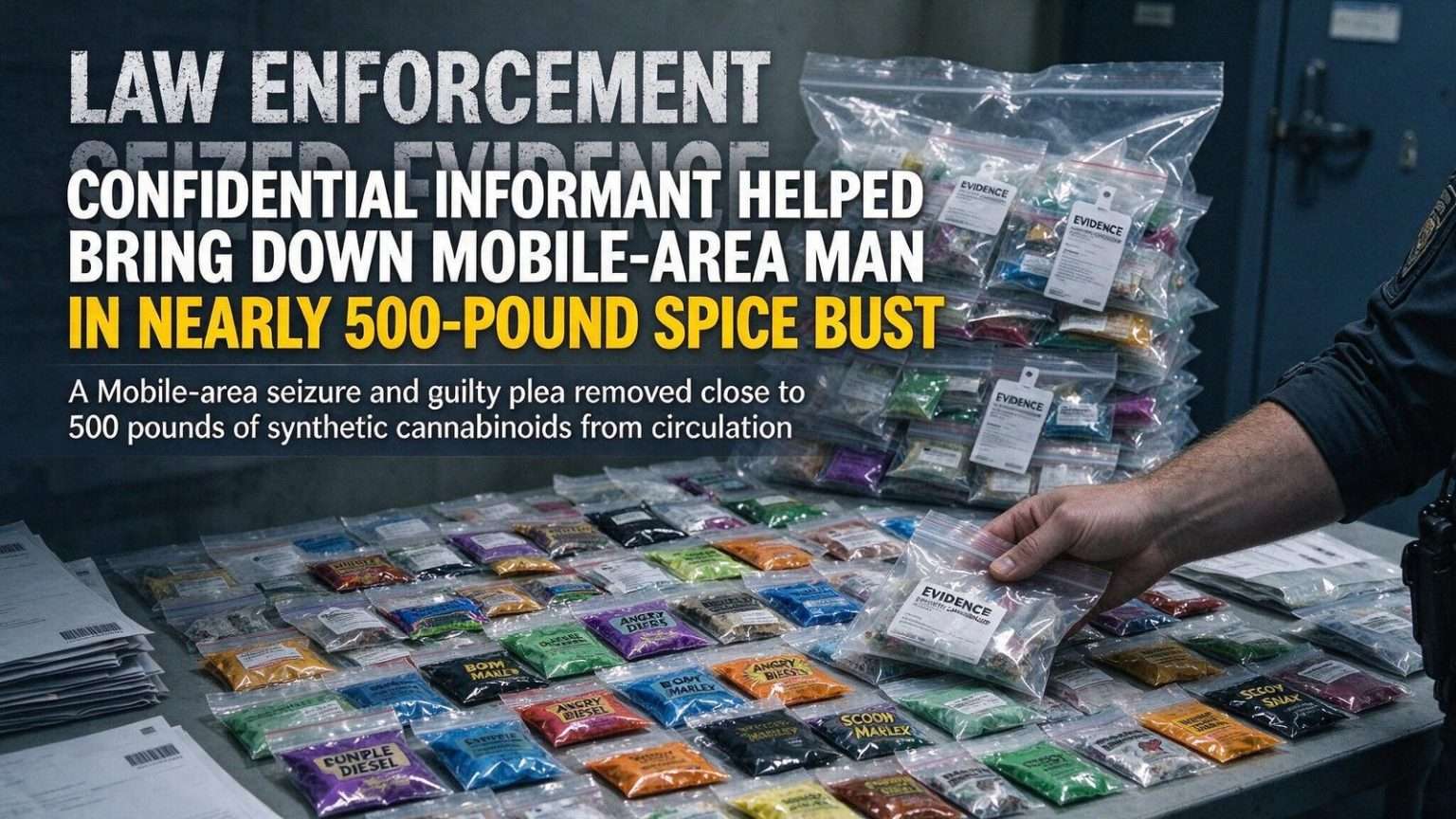
A man caught with tens of thousands of packets of synthetic marijuana known as spice, worth well over a million dollars combined, is facing up to 20 years in federal prison after pleading guilty to a drug conspiracy charge. Tamer Sharer Foqahaa, 33, was arrested in the spring following a series of large-scale busts that together turned up close to 500 pounds of the drug, which authorities say has been tied to a wave of serious health emergencies across the region.
The investigation was carried out by the Mobile County Street Enforcement Narcotics Team, a joint unit that targets drug trafficking across the county by pooling officers and resources from area agencies. The case against Foqahaa, laid out in his plea agreement, traces how a single tip grew into one of the larger synthetic drug seizures the area has seen.
How the case broke open
According to Foqahaa’s plea agreement, the case began after a confidential informant tipped off investigators that he was distributing spice throughout the Mobile area. That informant then arranged to buy the drug directly from Foqahaa at a storage unit in west Mobile, giving investigators a controlled purchase to build the case on.
Narcotics officers monitored the transaction as it happened, then moved in and seized more than 20,000 individually wrapped packets of spice from the unit — a haul authorities valued at upwards of $600,000. The packets had been disguised as ordinary potpourri and sold under street names such as “Purple Diesel,” “Angry Birds,” “Bomb Marley,” and “Scooby Snax,” a common tactic used by spice dealers to skirt drug laws that targeted the substance by name.
The packaging is not an accident. Synthetic cannabinoids have long been sprayed onto dried plant material and sold in colorful foil packets labeled as potpourri, incense or herbal blends, complete with disclaimers claiming the contents were not for human consumption. The labeling was designed to exploit gaps in the law, allowing the product to sit openly on convenience store shelves or move through informal networks while sellers argued that they were merely trading in novelty herbs.
Investigators did not stop with the first unit. A follow-up search of a second storage unit also leased to Foqahaa turned up an additional 235 pounds of the drug, pushing the total seizure toward the 500-pound mark cited in his plea deal. Combined, the seizures represented tens of thousands of individual packets with a combined street value authorities placed well over $1 million.
Why spice drew so much concern
Spice has drawn increasing concern from both law enforcement and medical professionals in recent years. Marketed as a legal alternative to marijuana, the drug is typically smoked and has been linked to a range of severe health effects, including seizures, psychotic episodes and, in some cases, death. Authorities say two deaths earlier in the year in the Mobile area are believed to be connected to spice use, underscoring what health workers describe as a genuinely dangerous product rather than a harmless imitation.
The danger stems from what the drug actually is. Synthetic cannabinoids are laboratory-created chemicals designed to act on the same brain receptors as THC, the active ingredient in marijuana, but they bind to those receptors far more strongly and unpredictably. Users have experienced racing hearts, vomiting, hallucinations, violent behavior and acute psychosis, and because the chemical formulas change constantly, emergency room staff often cannot know which compound they are treating.
The evolving formulas also explain the cat-and-mouse quality of spice enforcement. When lawmakers ban specific chemicals by name, manufacturers tweak a molecule or two and return the product to the market under a new name. Federal authorities responded with broader controlled substance analog laws, which allow prosecutors to charge synthetic versions of banned drugs even when the exact chemical variant is not listed, and Alabama moved to schedule the compounds at the state level as well.
The unit behind the case
The Mobile County Street Enforcement Narcotics Team, the joint narcotics unit that handled the investigation, exists precisely for cases of this kind. By combining detectives from multiple agencies into a single team, the unit can run confidential informants, conduct surveillance and execute coordinated search warrants across jurisdictional lines without the delays that inter-agency handoffs create.
Joint street-level narcotics units like SENT concentrate on mid-level distributors — the sellers who supply retail networks but operate below the trafficking organizations that federal task forces typically target. A single storage unit operation moving hundreds of pounds of product sits squarely in that zone, large enough to supply dozens of smaller sellers and small enough to move under the radar of large-scale federal trafficking investigations.
Storage facilities have become a recurring feature of drug distribution cases across the Gulf Coast. Units offer climate control, drive-up access, a measure of anonymity and a buffer between a distributor and the product — all while requiring nothing more than a leased unit and cash. Investigators in cases like this one routinely ask facility operators for records of rentals, access logs and surveillance footage when building the chain of evidence.
The federal path and what the plea means
Foqahaa’s decision to plead guilty to a drug conspiracy charge moved his case out of the trial phase and into sentencing. In the federal system, conspiracy prosecutions reach agreements and joint activity among participants rather than requiring proof of each individual transaction, which makes them a common vehicle for large distribution cases. The potential sentence of up to 20 years reflects the statutory maximum the charge carries; actual sentences are calculated under federal guidelines that weigh the quantity of drugs involved, the defendant’s role in the scheme and his criminal history.
Quantity matters enormously at sentencing. A seizure approaching 500 pounds places the conduct in the highest ranges of the guideline calculations, and prosecutors often cite the street value of the drugs to convey the scale of the operation. Defendants, for their part, typically receive credit for accepting responsibility, which can reduce the guideline range below what a trial conviction would have produced.
The guilty plea also resolved the evidentiary questions the case would otherwise have taken to trial: the authenticity of the controlled buys, the handling of the seized packets and the connection between Foqahaa and the second storage unit. Sentencing in federal court follows weeks or months after the plea, giving probation officers time to prepare a presentence report that both sides review before arguing for a final term.
What the case means for the community
For residents of the Mobile area, the case illustrated both the scale of the local synthetic drug trade and the way it reaches ordinary settings. The product seized in the case moved under names designed to sound playful or familiar — the kind of branding that authorities warn is aimed squarely at young buyers — and was sold in quantities small enough to change hands informally rather than through any storefront.
Health officials have repeatedly urged parents, teachers and employers to treat spice as a serious threat rather than a legal high. Unlike marijuana, whose potency varies but whose effects are broadly known, synthetic cannabinoids produce effects that differ batch to batch, and even experienced users cannot gauge the strength of a packet from its appearance. The two deaths in the Mobile area connected to spice use that year were cited by authorities as the starkest evidence of that unpredictability.
Sheriff’s deputies, city police and hospital staff across coastal Alabama dealt with the consequences of the drug wave in real time: emergency calls for users suffering seizures or psychotic breaks, schools confronting students in possession of the colorful packets and families trying to intervene with relatives whose use had escalated into paranoia and violence. Public-awareness campaigns in the region warned that the packaging — potpourri, incense, herbal blends — was a marketing fiction.
The removal of close to 500 pounds of the drug from circulation, authorities said, represents more than a single arrest. Every intercepted supply reduces the availability of a product tied to hospitalizations and deaths in the community, and every case that ends in a plea or conviction adds to the record that distributors of synthetic drugs in south Alabama will face prosecution.
Enforcement agencies also stress that the trade adapts quickly. When one distributor is taken off the street, the demand does not disappear, and the same storage units, phones and customer networks that served one operation can be picked up by another within weeks. That is why investigators treat volume cases like this one as opportunities to map the wider network rather than single transactions, working backward from the seized packets to the suppliers and outward to the retail sellers.
For now, the case stood as an example of the full arc of narcotics enforcement: a tip from an informant, a monitored buy at a west Mobile storage unit, coordinated searches that stacked seizure on seizure, and a guilty plea that admitted the scheme. What remained was sentencing, where prosecutors and the defense would argue over how much of the 20-year maximum the man who distributed the drug across Mobile should serve.