Mobile Photo Studio Rebuilds After 2012 Christmas Day Tornado
A longtime Mobile portrait photographer has rebuilt her studio on the same lot destroyed by the 2012 Christmas Day tornado, calling the ordeal a blessing in disguise.
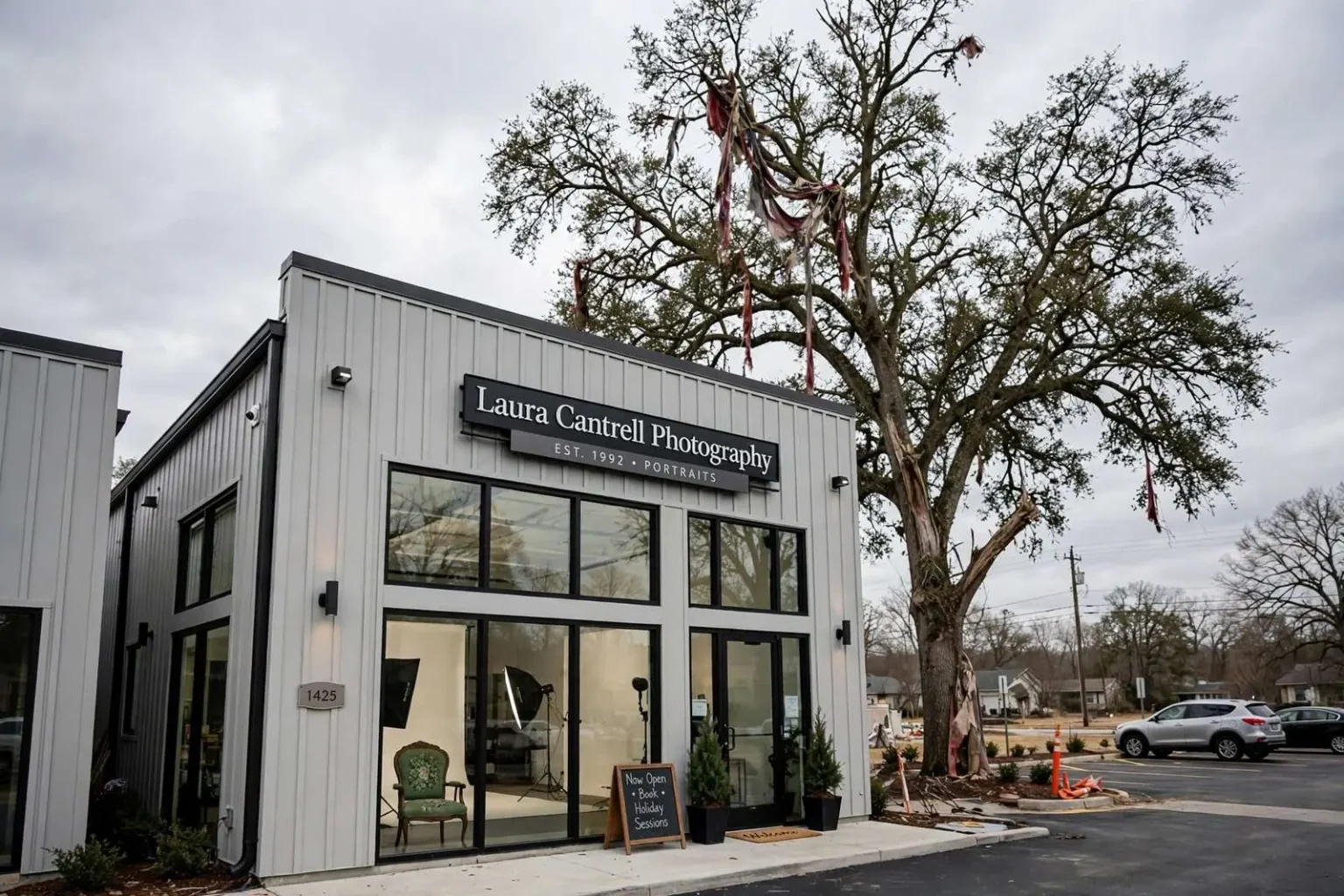
Nearly two years after a Christmas Day tornado tore the roof off her Mobile photography studio, Laura Cantrell Rodgers has rebuilt on the very same lot, determined not to let the storm push her family’s business anywhere else. High in a tree behind the new building, a tattered scrap of fabric remains stuck in the branches, one of the last physical traces of the twister that ripped through the property on December 25, 2012, before continuing its destructive path toward Murphy High School and beyond.
The scrap of fabric has become something of a marker — a reminder, in the shadow of a brand-new building, of the day the storm arrived on a holiday afternoon and upended a business that had operated for decades. Rodgers chose not to remove it, and its persistence in the tree above the parking area tells the story of both the destruction and the decision to rebuild exactly where the studio had always stood.
The Day the Storm Hit
Rodgers, who has run Laura Cantrell Photography since 1992, was out of town with her husband, Clay, when the tornado hit. The couple had opted for a low-key holiday trip to New Orleans that year instead of their usual overseas getaway. They had barely settled in for dinner when the phone calls started. Frank Schottgen, owner of a local alarm company, told Laura there had been multiple glass breakages at the studio and that the roof appeared to be gone.
The couple cut their trip short and drove back through the storm to find the western wall of the building collapsed and the roof, which had only recently been replaced after Hurricane Katrina, caved in entirely. By the time they arrived, Laura’s studio assistant, Angel Alford, along with friends and family, were already pulling salvageable items from the wreckage.
The Christmas Day tornado struck Mobile on an evening when few expected severe weather, cutting a path through midtown neighborhoods and damaging homes, schools and businesses along its track. Murphy High School, one of the city’s oldest campuses, was among the hardest-hit public properties, and the recovery of both the school and the surrounding blocks stretched on for years. For businesses in the path, the timing was especially cruel — the holiday closed banks and insurance offices, and contractors were hard to reach during the days that followed.
Antique clothing used in photo shoots, along with decades of collected props, were destroyed, though a handful of pieces, including a well-loved green needlepoint chair, survived and were eventually reunited at the new studio. For a portrait photographer, such losses are more than inventory. Wardrobes and props accumulated over decades become part of a studio’s character, shaped by the children, families and brides who posed with them across a generation of Mobile portraits.
Keeping the Business Alive From Home
Rather than pause the business, Rodgers had her home deck enclosed and set up a makeshift studio there within weeks, resuming portrait sessions by mid-January. She continued operating out of her house for nearly two years while the new building took shape. She said being raised in a family business, her parents always worked, so the family kept going without excuses, noting that four employees depend on the business for their paychecks.
The turnaround — from a collapsed building on Christmas to shooting sessions three weeks later — reflected both the demand of a working portrait studio and a deliberate refusal to let clients drift away. Portrait photography runs on seasons and relationships; families book holiday portraits, spring sittings and senior photos on annual rhythms, and a studio that goes dark risks losing them to competitors. Operating from an enclosed home deck kept every one of those appointments.
Keeping four employees paid through the disruption carried its own weight. Small studios are tight operations, and a two-year construction gap could easily have meant losing trained staff to other employers. Rodgers credits her upbringing in a family business for the persistence — a philosophy that treats the payroll as the first obligation and the building as secondary to the work.
Rebuilding on the Same Ground
Rebuilding on the same site was never in question for Rodgers, who grew up in the surrounding neighborhood and never seriously considered relocating. She hired architect Tim Spafford to design the new building and Bobby DeMuoy to construct it, a process that took longer than expected because the structure had to meet updated federal energy codes. The result is a roughly 3,000-square-foot, highly energy-efficient building with a ground-floor kitchen and offices, plus an upstairs studio with ceiling heights reaching 14 to 16 feet and a new dressing room the old building never had.
The energy code requirements, adopted nationally after Hurricane Katrina reshaped building standards along the Gulf Coast, added time and complexity to the design process but produced a structure far more efficient than the one it replaced. For a building full of studio lighting, computers and climate control, the efficiency gains promise real savings over the life of the business.
The studio itself was designed around the demands of portrait photography. Ceiling heights of 14 to 16 feet give photographers room for high-key lighting setups and full-length group shots, and the dedicated dressing room adds a client amenity the old building lacked. The ground-floor kitchen and offices support the daily operations of a studio that hosts families for hours at a time, from consultation to final portrait selection.
An Unexpected Upside
An unexpected upside emerged from the disaster. The new building finally has windows facing north, letting in the soft, even light that Rodgers and her staff had wished for in the old studio. North-facing windows are prized in photography for exactly that quality — a steady, diffuse illumination that changes little through the day, flattering faces without harsh shadows.
Rodgers has also expanded her collection of photography backdrops to 68 options and was preparing seasonal displays, including a fall-themed setup and rolling Christmas trees for the holiday season, as she prepared to return to full studio operations after nearly two years working from home. The rebuilt studio, stocked and restaged, positions the business to reclaim the seasonal portrait calendar that defines the industry — school photos in fall, holiday sittings in November and December, and the spring and summer sessions that follow.
For the neighborhood around the studio, the rebuilt building closes one of the most visible wounds left by the 2012 tornado. Where residents had spent two years passing a ruined building on their way toward Murphy High School’s own recovery, they now see a working business in a new energy-efficient structure, back on the lot where it had always been.
What Survives a Storm
The story of the studio’s recovery is ultimately about what a storm can and cannot take. It took a roof that had survived Katrina repairs, a western wall, decades of antique clothing and props, and two years of ordinary operations. It could not take the client relationships, the trained staff, or the owner’s decision that the business would stay where it grew up.
The green needlepoint chair that came through the wreckage now sits in a building designed for the next several decades of portraits, and the scrap of fabric still caught in the tree behind it marks the distance between December 25, 2012, and the day the doors reopened. Nearly two years after the tornado, Laura Cantrell Photography is back on its own lot — rebuilt, restaffed and, in the matter of its north light, better than before the storm arrived.
The Wider Recovery From the Christmas Day Storm
The studio was one piece of a much larger recovery effort that followed the December 25, 2012, tornado through midtown Mobile. The storm damaged hundreds of homes and businesses along its path, and the most prominent public casualty, Murphy High School, required extensive repairs that kept portions of the historic campus out of service well beyond the studio’s two-year rebuilding window. Neighborhood associations, insurers, contractors and city officials spent the months after the storm working through the same sequence Rodgers did — assess, document, rebuild — each property on its own schedule.
Storms along the Gulf Coast tend to leave a split record: the buildings that come back stronger and the character that comes back differently. Mobile’s experience with hurricanes, from Frederic to Katrina to Ivan, has built a local culture of rebuilding that treats recovery as a normal part of doing business on the coast. The Christmas Day tornado tested that culture in a new way, arriving on a holiday when the routines of response — insurance adjusters, supply houses, permits — were paused, and forcing business owners to improvise until the machinery of recovery resumed.
Rodgers’ choice to resume portrait sessions within three weeks, from an enclosed home deck, fit that improvisational tradition. It also kept the studio’s name in front of clients during the exact window when rivals might have absorbed them. By the time the new building opened — with its north light, tall ceilings and 68 backdrops — the business had not merely survived the storm but protected the relationships that made rebuilding worthwhile, on the same lot where the family had worked since 1992.