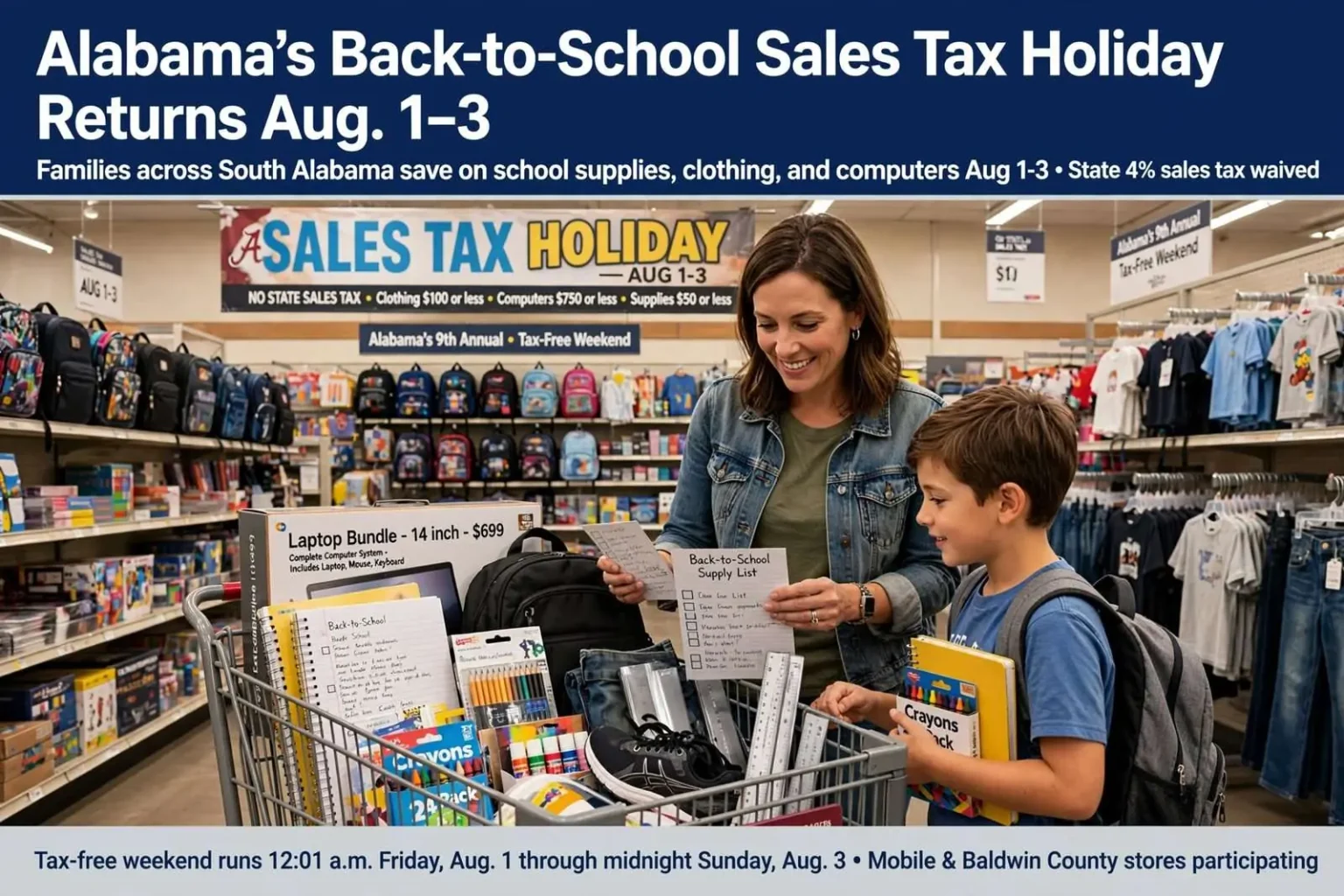
Families across South Alabama can start checking items off their back-to-school lists without paying state sales tax during the first weekend of August. Alabama’s ninth annual back-to-school sales tax holiday begins Friday, Aug. 1, at 12:01 a.m. and runs through midnight Sunday, Aug. 3. The weekend has become a fixture of the state’s retail calendar since it was created by law in 2006, and it arrives each year at the moment when back-to-school spending is peaking — one of the largest shopping periods outside the holiday season — putting the state’s 4 percent sales tax exemption directly on the items families buy most in late summer.
The timing matters for local families because several area school systems open their doors before the month is out. Mobile County public schools are scheduled to start Aug. 7, giving parents just days after the tax-free weekend to finish shopping. Satsuma’s school system follows on Aug. 11, while Saraland and Chickasaw students head back on Aug. 13. Baldwin County schools open later, on Aug. 18, giving families there a bit more breathing room. That compressed schedule makes the Aug. 1-3 weekend the practical last call for stress-free shopping in most of Mobile County, since families who wait past the holiday find themselves buying uniforms and supplies during the first days of school itself.
What qualifies for the exemption
The sales tax holiday, administered through the Alabama Department of Revenue, covers a wide range of everyday back-to-school purchases. Clothing items priced at $100 or less per article are exempt, covering everything from coats, jeans, and school uniforms to shoes, socks, and belts. The per-article limit is the key detail: a $85 jacket and a $60 pair of athletic shoes each qualify, while any single article over $100 is taxed at the full rate, so splitting a purchase into qualifying pieces can matter for families outfitting multiple children.
Computers also get a break under the exemption. A single purchase of a computer package priced at $750 or less qualifies, as long as it’s sold as a complete system with a central processing unit and components such as a monitor, keyboard, mouse, and speakers. Individual parts or peripherals sold separately from a full system don’t qualify. Related computer supplies, including storage media, handheld electronic schedulers, printers, and printer paper and ink, are also included, though cellphones and smartphones are specifically excluded. The exclusion matters more every year, as the line between a phone and a general-purpose computer blurs; the state’s rule keeps the exemption aimed at desktop and laptop setups bought for schoolwork.
Traditional school supplies priced at $50 or less per item are tax-free as well, a list that includes notebooks, binders, backpacks, pencils, pens, crayons, glue, scissors, and rulers, among dozens of other classroom staples. This is the category where nearly every family in the state saves something, since the supply lists distributed by area schools each summer run largely through items on the exempt list. Art supplies such as paints, brushes, sketch pads, and watercolors also fall under the exemption, along with required textbooks priced between $30 and $50 and standalone books priced at $30 or less — a provision that lets students pick up assigned reading and summer catch-up books alongside the notebooks and backpacks.
Shoppers should keep the per-item structure in mind rather than thinking of the weekend as a blanket tax break. A $120 coat is taxable even in an otherwise exempt purchase, and a $900 computer is taxable even though a $700 one is not. Retailers across the state handle the mechanics automatically at checkout, and the Alabama Department of Revenue publishes guidance each year so that both stores and consumers know exactly which items cross the thresholds. The department’s listing is the definitive reference for edge cases, from specialized athletic gear to bundled software.
Where the holiday applies
Not every city and county in Alabama participates in the sales tax holiday, since it’s optional for local governments to opt in. The state exemption applies everywhere, but local sales taxes — which in many municipalities add several percentage points on top of the state’s 4 percent — are only waived in jurisdictions whose governing bodies voted to join. Shoppers in South Alabama are encouraged to check with the Alabama Department of Revenue or their local municipality ahead of time to confirm participation before heading out to shop. For residents of municipalities that do participate, the combined state and local savings can reach roughly 9 to 10 percent on a qualifying purchase, which on a family’s full back-to-school haul translates into real money.
That variation also shapes shopping patterns, with some families timing trips around which nearby jurisdictions are tax-free and retailers along county lines advertising accordingly. Mobile and the Baldwin County beach communities have historically seen heavy holiday-weekend traffic at clothing stores, electronics retailers and office-supply chains, and the weekend doubles as a final summer tourism push that pairs back-to-school shopping with the last stretch of beach season.
The holiday’s design reflects a legislative compromise that has stayed stable for nearly a decade. Lawmakers structured the exemption around categories that are easy for retailers to identify and hard to game, set the dollar thresholds low enough to target ordinary family purchases rather than luxury shopping, and left local participation voluntary so each municipality could weigh its own revenue. The result is a weekend that costs local governments something in sales tax revenue but returns it in retail activity, and that has survived repeated budget cycles without significant amendment.
For the school districts on this year’s calendar, the weekend’s placement before their start dates is straightforward luck of the scheduling, but it shapes real family decisions. Mobile County, the largest district in the affected area, sends its students back Aug. 7 — six days after the holiday ends — which makes the weekend the de facto shopping window for the district’s tens of thousands of students. Families in Saraland, Satsuma and Chickasaw have similar windows, while Baldwin County’s Aug. 18 start gives its families a two-week cushion after the tax-free weekend, useful for the late lists and last-minute supplies that surface once school actually begins.
Practical tips for the weekend
Veterans of the holiday tend to follow the same playbook. Shop early in the weekend rather than Sunday evening, when popular sizes and supply items run thin; bring the school’s supply list and buy the qualifying items on it in one trip; check whether online orders placed during the weekend qualify — under the state’s rules, internet and telephone purchases made during the holiday window are treated the same as in-store purchases; and verify that the municipality where a store sits has opted in before assuming the local portion of the tax is waived.
Families buying electronics face the most detailed rules. A complete desktop or laptop package at or under $750 qualifies, but the same components bought individually do not, so the weekend favors buying a bundled system over piecing one together. Printers, ink, paper and storage media ride along tax-free even when purchased with the computer, which can compound the savings on a student setup. Phones, tablets without the required full-system configuration, and gaming devices fall outside the exemption, and store staff across the area are generally prepared for those questions during the holiday.
The ninth annual holiday ends at midnight Sunday, Aug. 3, and the school calendars that follow it within days make it the most consequential shopping weekend of the summer for South Alabama families. Those who use it stretch their budgets at the exact moment the costs of a new school year land; those who miss it pay full freight on the same list. With Mobile County schools opening Aug. 7, Satsuma on Aug. 11, Saraland and Chickasaw on Aug. 13, and Baldwin County on Aug. 18, the Aug. 1-3 weekend remains the one date on the summer calendar that every back-to-school shopper in the region should have circled.
Behind the shopping mechanics sits the broader question the holiday was designed to answer: who bears the cost of equipping children for school. Supply lists in most area districts run well past the basics, with families supplying everything from classroom tissues and disinfecting wipes to calculators and art materials, and teachers routinely spend their own money to fill gaps. A tax-free weekend does not close that gap, but it lowers the total by the full sales tax rate on every qualifying item at the moment when the list is longest, which is why education advocates have consistently defended the exemption against revenue-side proposals to narrow it.
The retail side plans its year around the weekend as well. Clothing and shoe stores, office-supply chains and electronics retailers treat Aug. 1-3 as a mini Black Friday, staffing up, advertising exempt items and timing back-to-school promotions to land inside the window. Local chambers of commerce have promoted the holiday since its first year as a way to keep consumer spending in-state rather than across the border, and the ninth edition finds the pattern well established: shoppers who once treated the weekend as a novelty now plan major purchases around it.
What happens after the weekend
For families who miss the window, the penalty is modest but real: the same list, bought the following week, carries the full state and local tax. Some strategies soften that. Bulk purchases of non-exempt items can wait for standard sales, teachers’ wish-list requests can be staged across the semester, and Baldwin County families with an Aug. 18 start date have a two-week runway in which regular sales promotions occasionally beat the holiday’s savings on specific items. But for qualifying clothing and complete computer systems, the holiday is the single best pricing event of the year, and no later sale reliably matches the combined state and local exemption.
The state’s ninth annual edition also serves as the annual reminder of what the holiday is for: lowering the cost of school readiness for every family that shops, regardless of income, and doing it through the simplest mechanism government has — taking the tax off at the register. Families across Mobile and Baldwin counties have three days, from 12:01 a.m. Friday, Aug. 1 through midnight Sunday, Aug. 3, to take advantage. The school start dates that follow — Aug. 7 in Mobile County, Aug. 11 in Satsuma, Aug. 13 in Saraland and Chickasaw, Aug. 18 in Baldwin County — mean the timing could hardly be tighter.