University of South Alabama Prichard
Prichard Homeowner Shoots Intruder as Two Juveniles Break Into Thors Avenue Home
A 63-year-old Prichard homeowner shot and wounded one of two juveniles who broke into her home on Thors Avenue, telling officers she realized someone was inside when a light switched on, authorities said.
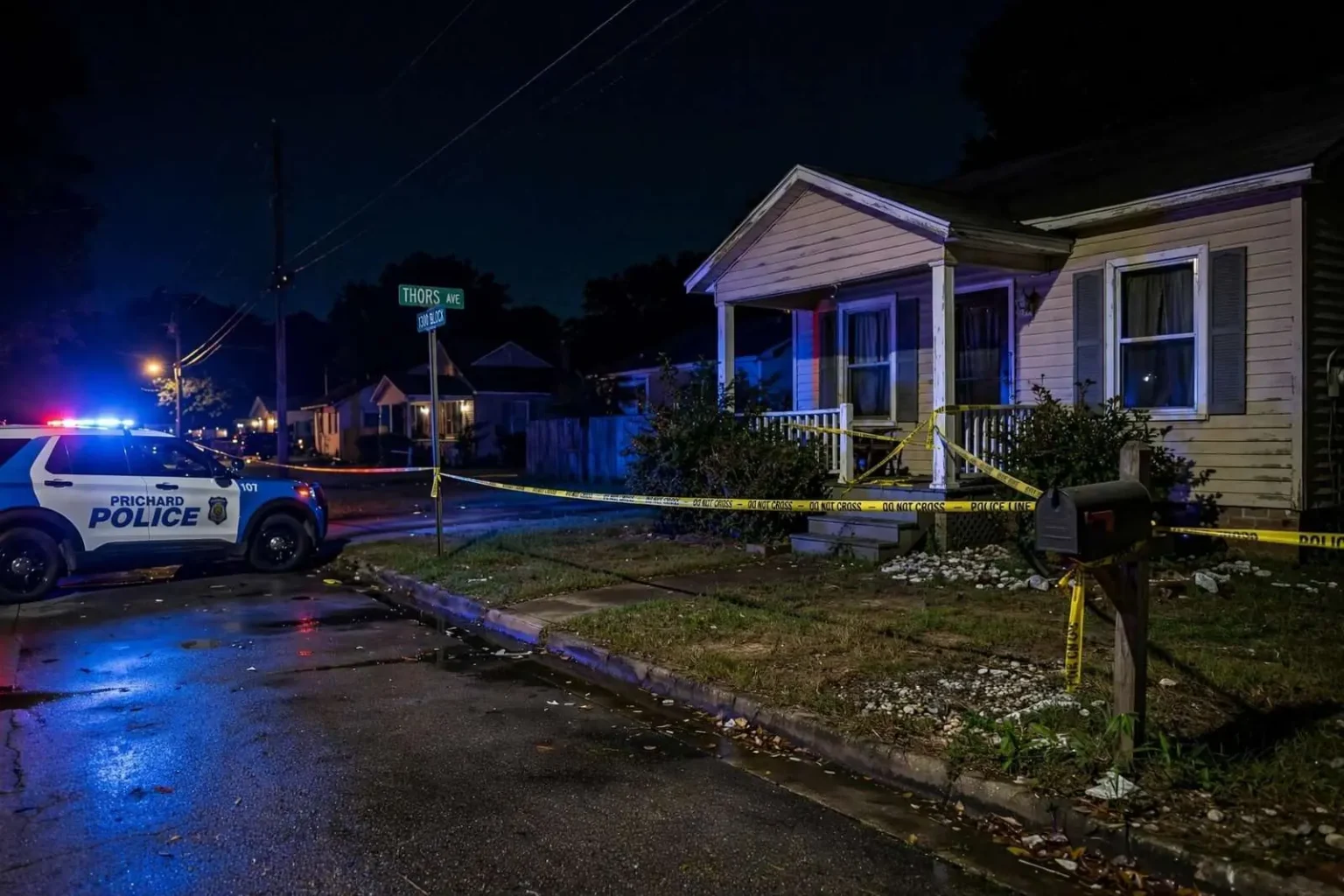
A Prichard homeowner shot and wounded one of two juveniles who broke into her home, according to authorities who responded to a report of gunfire on the city’s Thors Avenue. The incident, which unfolded in the dark hours of a summer night, ended without a fatality but left an elderly resident shaken, two young people in custody, and a neighborhood confronting once again the questions about safety that shadow daily life in parts of the city. Officers were called to the home on Friday, July 18, after a report of shots fired.
When they arrived, the homeowner, 63-year-old Phyllis Law, told them she had shot one of two juveniles who had forced their way inside. According to authorities, Law said she realized someone was in her house when one of the intruders turned on a light. She fired a single shot at the juvenile and then called police. The detail of the light — an ordinary switch flipped in a house that should have been empty — has stayed with neighbors who heard the account, a reminder of how suddenly and how quietly such encounters begin. There was no standoff, no warning exchange; just a noise in the dark, a light where no light should be, and a decision made in a heartbeat.
One of the two juveniles was taken to the Strickland Youth Center, the county’s facility for young offenders. The other was transported to the University of South Alabama Medical Center, where he remained in stable condition, authorities said. The injury, serious enough to require hospitalization, was not immediately life-threatening, and the wounded juvenile’s treatment at the region’s main trauma hospital reflected the standard of care such a gunshot requires — surgical evaluation, imaging and monitoring that smaller facilities are not equipped to provide.
A light in the dark
The account offered by authorities was brief. Law told officers she became aware of the intrusion only when a light came on inside the house, suggesting the encounter unfolded quickly and in the dark. She fired once, striking one of the two juveniles, and then summoned police to the scene. The economy of the sequence — one light, one shot, one call to 911 — matched the way home invasions actually happen, with none of the hours-long standoffs that television dramas imagine. Self-defense experts note that most civilian shootings of intruders are over in seconds, decided by distance, lighting and surprise rather than by any plan.
Authorities did not release the names or ages of the two juveniles, consistent with the way cases involving minors are typically handled. The Strickland Youth Center, where one of the juveniles was taken, serves as the detention and intake point for young people accused of crimes in Mobile County, holding juveniles pending court appearances while their cases move through the family court system. Cases in which a homeowner uses a firearm against an intruder can raise complex legal questions, and authorities gave no immediate indication of whether the homeowner would face any scrutiny.
Alabama law generally provides latitude for residents who use force against people who unlawfully enter their homes, though the specific circumstances of each case shape how it is reviewed. The state’s self-defense framework presumes that a person in his or her own home has a reasonable fear of harm when an intruder forces entry, shifting the legal burden in ways that generally protect homeowners who respond with force. Investigators will still reconstruct the scene — entry points, the position of the shooter, the trajectories of any shots — because every use-of-deadly-force case is eventually reviewed against the facts rather than the headlines.
Prichard’s police department, like the city it serves, operates under persistent strain. The department has worked for years to maintain coverage across a sprawling city with a small force, and response times and patrol visibility are standing concerns in neighborhood association meetings. Officials have encouraged residents to report suspicious activity promptly and to look out for elderly neighbors who live alone — the demographic most often targeted in residential break-ins and least able to recover, financially or emotionally, from the loss. In the aftermath of the Thors Avenue shooting, the department faced the added work of a dual investigation: reconstructing a home invasion while also documenting every element of a shooting by a homeowner, in parallel, with the findings of one matter bearing directly on the review of the other.
The distinction between the two investigations is worth understanding. The burglary case will turn on what the juveniles did — the forced entry, their movements in the house, any theft or damage. The use-of-force review turns on what Law reasonably perceived in the moment: an intruder’s advance, the darkness, the impossibility of knowing whether the person switching on a light in her hallway was armed. Alabama’s legal framework recognizes that a homeowner confronting a forced entry at night cannot wait for certainty, and that recognition is precisely why authorities could describe the shooting factually, in a news release, without announcing any charge. The wounded juvenile’s recovery will add his own account to the file in time, as will forensic work on the entry point and the single spent round.
For Mobile County’s juvenile court, the case adds two more files to a docket that processes hundreds of burglary and trespass cases each year. Judges there work with a toolkit that ranges from detention to diversion programs, counseling and family interventions, on the theory that a fourteen-year-old burglar treated early may never become a twenty-year-old felon. Whether that theory holds for these two young people will depend on what the investigation finds and what their homes and histories look like — questions the public record will likely never answer, but that the court will have to.
A recurring worry in the city
The break-in and shooting touched on a set of concerns familiar to many Prichard residents, where property crime and questions about public safety have long weighed on neighborhoods. The city of roughly 20,000 just north of Mobile has watched population decline and vacancy rates climb over the years, and residents say abandoned structures and dimly lit blocks invite the kind of opportunistic break-ins that ended in gunfire on Thors Avenue. For an older resident confronting intruders in her own home, the episode ended without a fatality, but it underscored the fear that such crimes can provoke — the knowledge, shared by many retirees in the city, that a locked door is not always enough.
Community leaders in Prichard have long pressed for more visible patrols, better street lighting and faster response times, and incidents like this one tend to renew those calls. Older homeowners, in particular, describe keeping firearms in the house as a necessity rather than a choice, and the shooting on Thors Avenue will likely be cited in neighborhood meetings for months — both as an example of why residents feel they must protect themselves and as a warning about how quickly a property crime can become a violent one.
For the two juveniles, the consequences will unfold in the juvenile justice system. Authorities did not say what, if anything, was taken from the home or how the juveniles had entered, and those details will matter when the cases are reviewed: the difference between a probation-track adjudication and a longer detention term often turns on exactly those facts — whether a weapon was carried, whether anyone was hurt beyond the gunshot, and what the pair intended inside the house. The investigation into the break-in and the shooting was expected to continue, with the case involving minors likely to be handled through the juvenile justice system rather than adult court.
The second juvenile was taken into custody and transported to the youth center, where he will await proceedings alongside the county’s other detained juveniles. Family court judges in Mobile County weigh each case individually, considering the minor’s age, record, home situation and the seriousness of the offense, and the availability of the victim’s account — Law’s statement to police — will be a central part of the file. Juvenile proceedings are closed to the public, so the full story of that night may never be told beyond the courtroom.
What the neighborhood knows is simpler. A 63-year-old woman was alone in her home when two young people forced their way in, and by the time the light was switched on and the single shot was fired, the theory of safety she had lived by — locks, caution, the assumption that a house with a light on is left alone — had been tested and found wanting. Neighbors on Thors Avenue spent the following days checking each other’s doors, and Prichard added one more entry to the long ledger of incidents that keeps the city’s conversation about crime, aging and self-protection from ever going quiet.