Environmental and Neighborhood Groups Fault Stimpson Over Mobile Planning Commission Overhaul
A coalition of environmental and historic-neighborhood advocates criticized Mobile Mayor Sandy Stimpson in July 2014 for replacing half of the Planning Commission, calling the reshaped panel pro-industry.
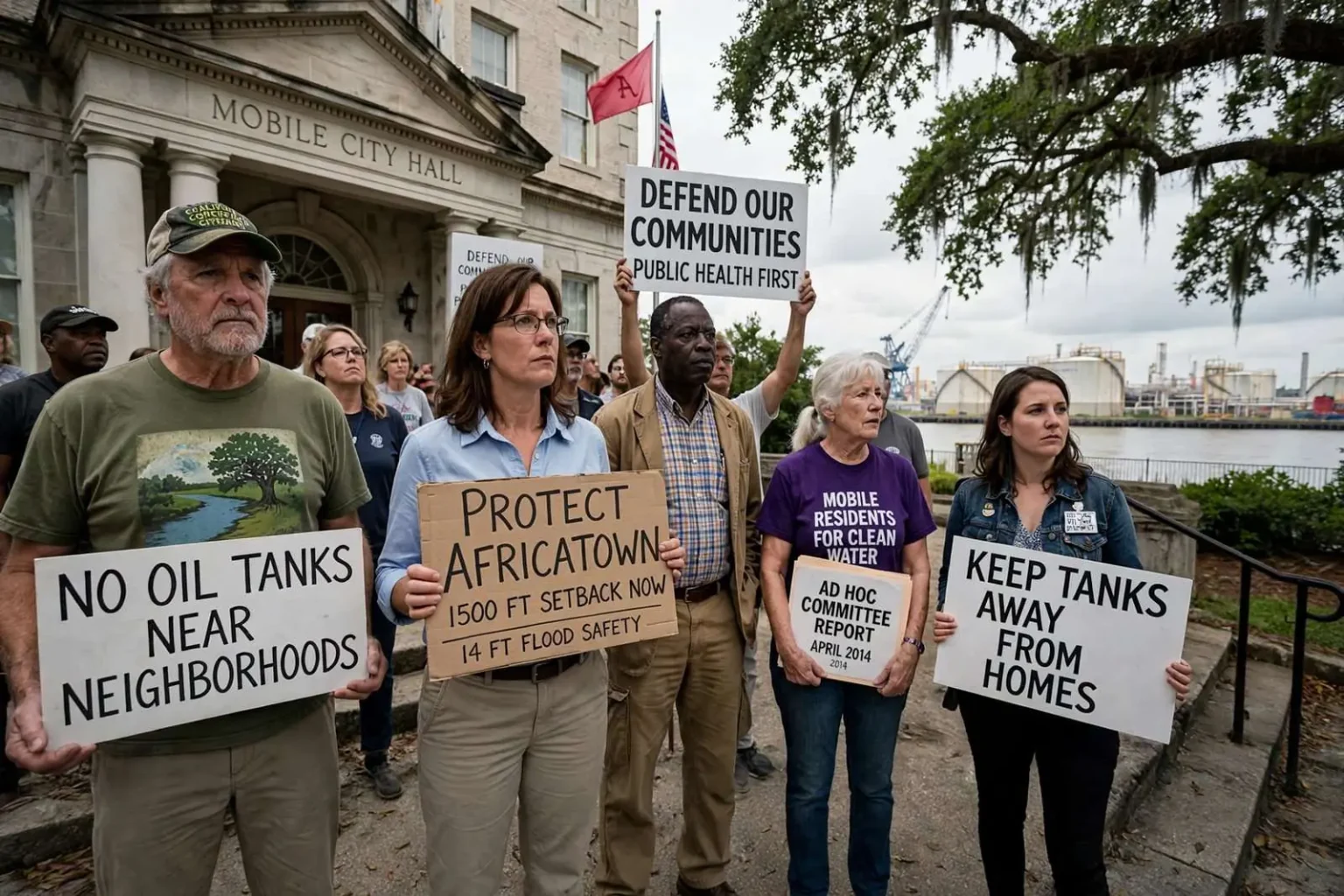
A coalition of environmental advocates and historic-neighborhood residents pressed the Mobile City Council in July 2014 to bypass the city’s Planning Commission and adopt ordinances directly regulating oil storage tanks, arguing that Mayor Sandy Stimpson had reshaped the commission in favor of industry. The push came days after six of the 12 members of the Planning Commission were thanked by the Urban Development Department’s staff, on Thursday, July 17, 2014, for their service. Two of those departing members had served since the 1990s, and their departure marked one of the most significant single-day turnovers the panel had seen in years.
The criticism was outlined in a news release from a group calling itself the Coalition of Concerned Citizens. While the release did not carry the endorsement of any single established organization such as the Sierra Club or the Tar Sands Oil Mobile group, its members were drawn from several of those interests, giving the effort a loose, ad hoc structure rather than the backing of a formal institutional letterhead. That arrangement allowed longtime activists from different campaigns to speak with a common voice without binding the organizations themselves to every statement.
“We don’t feel that Sandy Stimpson used any kind of an open or transparent process to choose these people,” said Thayer Dodd, a representative with the Tar Sands Oil Mobile group. “In some cities, people can apply for open positions. That was not part of this process. What he has ended up with is an unbalanced, pro-industry Planning Commission.”
The coalition also argued that the reshaped commission lacked members affiliated with a local educational or health care institution, which it described as two of the largest industries in Mobile by statistics. Hospitals and universities, the group’s members reasoned, employ thousands of people and anchor entire neighborhoods, yet neither sector had a voice on the panel that would shape where the city’s next industrial facilities could be built. In their view, a commission that reflected one sector of the economy while excluding two others could not fairly weigh proposals that pitted those sectors against each other.
The mayor defends his appointments
Stimpson defended the replacements and described the new commission as well balanced between industry and environmental interests. In his telling, the appointments were not a purge but a refresh intended to bring a wider range of professional expertise to a body whose decisions were growing more consequential by the year. As mayor, he had the authority to appoint all but one of the commission members, while the Mobile City Council held a representative seat on the panel, meaning the turnover he engineered reached nearly every corner of the commission’s membership.
The commission’s responsibilities included ruling on development projects, weighing zoning requests and proposing ordinance changes. Those functions placed it at the center of nearly every fight over land use in Mobile, from subdivision approvals on the city’s expanding western edge to industrial proposals along the waterways. A recommendation from the commission carries weight with the council, and developers spend months preparing cases for the panel’s hearings because an unfavorable first review can derail a project before the public ever weighs in.
Stimpson said he wanted the commission to take a broader approach, particularly as his administration prepared to undertake a long-term plan for the city. A comprehensive plan, he argued, required commissioners who could think beyond individual parcels and consider how growth, transportation, industry and neighborhoods fit together across the whole city. His administration cast the overhaul as preparation for that planning effort rather than a response to any single controversy.
He said the commission would appoint two new members to a subcommittee studying the results of an earlier ad hoc committee’s review of oil storage tanks. That three-member panel had been left short two members — Scott Webster and Tracie Roberson — who were among those replaced. The subcommittee was to be the vehicle through which the ad hoc committee’s findings would be converted, or not, into formal city policy, which is precisely why the coalition was so anxious about who filled its vacant seats.
Oil storage tanks at the center
The dispute unfolded against a backdrop of concern over industrial development near residential and historic areas. Along the Mobile River and its tributaries, tank farms and terminal operations had been multiplying for years, and proposals increasingly reached closer to neighborhoods that had never before shared a fence line with heavy industry. Residents of older communities north of downtown watched new projects advance and worried that each approval set a precedent for the next one to come even closer.
The ad hoc committee’s work, completed in April, followed a proposal by American Tank and Vessel Inc. of Mobile for a 32-tank project near the historic Africatown community. Africatown, the community north of downtown founded by the survivors of the Clotilda, the last known slave ship to reach the United States, had spent generations hemmed in by industry, and residents were deeply wary of anything that would tighten that grip. The prospect of dozens of new storage tanks in view of the community’s churchyards and homes reignited old grievances about the neighborhood bearing burdens the rest of the city never had to carry.
Company chief executive Williams Cutts said American Tank and Vessel had not applied for a permit to build an oil storage facility and had not begun constructing one. He said the property on Paper Mill Road had been covered with broken slabs and foundations left from its former use as a paper mill site, and that clearing the debris was a necessary first step for any development. The company, he said, was waiting for the city to decide whether to amend the zoning ordinance before taking any further steps on the site.
Cutts’s account was meant to calm fears that construction was already underway, but it also underscored how much depended on the city’s pending zoning decisions. If the ordinance were amended to permit the tanks, the site’s existing industrial precedent — a legacy of the paper mill era — would smooth the path for the project. If the city instead tightened its rules, the same debris-strewn parcel could remain an ordinary vacant lot indefinitely. Either outcome would flow directly from choices made by the Planning Commission and the council.
The Arc Terminals fight and the moratorium that failed
The debate traced back further still. In December, the council had pushed for a moratorium on new oil storage tank facilities after Arc Terminals pursued an oil unloading terminal with the Canadian National Railway near the GM&O building, the historic railroad station that anchors the northern gateway to downtown. The project would have tied rail deliveries of crude to tank storage within sight of neighborhoods and public buildings, and it galvanized the coalition of residents who would later take aim at the commission itself.
The moratorium did not pass, but the council adopted a temporary requirement directing new oil storage tank proposals to come before the council rather than the Planning Commission, which normally reviewed such developments first. That workaround was the council’s answer to its own doubts about the reshaped panel: if the commission’s judgment could no longer be trusted on tank matters, the elected council would take the first look itself. The arrangement was meant to be temporary, and its future hinged on the very ordinance question the coalition was pressing.
What the coalition wanted
Dodd said the coalition wanted the council to take control of the issue and adopt ordinances mirroring the ad hoc committee’s recommendations, eliminating the need for the commission’s subcommittee to weigh in. In the coalition’s view, the study work was already done, and a further layer of review through a reconstituted subcommittee would only give industry interests another chance to dilute the findings. Writing the protections directly into the city’s ordinances, the group argued, would take the decision out of the hands of the appointed panel and put it with the elected council.
She said she feared industry groups might press local officials to weaken a recommended 1,500-foot setback between new oil storage tanks and residential neighborhoods, and a recommendation that no new tanks be built below a 14-foot flood elevation. Both numbers had been worked out by the ad hoc committee, and both carried enormous practical consequences. A 1,500-foot buffer would make large swaths of the city’s older industrial corridors unusable for new tank farms, while the flood elevation rule would rule out low-lying sites along the waterways where tank developers most often look.
The flood elevation provision reflected hard lessons from the Gulf Coast. Tanks that sit below storm-surge levels are vulnerable to floating free, rupturing or spilling in hurricanes, and Mobile’s history of tropical storms made the threshold more than an abstraction. For residents near proposed sites, the setback and elevation rules together represented the difference between living beside a routine industrial neighbor and living beside a hazard, and the coalition warned that quiet negotiations could shave those standards down before anyone noticed.
Councilman Levon Manzie, who served on the commission, said he was not certain the council could act on the recommendations without the Planning Commission’s review, and had asked the council’s attorney to research the question. His uncertainty captured the legal tangle at the center of the fight: the council wanted the power to act, but the city’s established procedures, and perhaps its charter, gave the commission the first word on planning matters. Whether the elected body could simply override that structure would determine whether the coalition’s strategy was even possible.
Council attorney Jim Rossler said he was not aware of the concerns. That reply did little to resolve the question, and it left the coalition’s path uncertain as the summer wore on. Without a formal legal opinion clearing the way for council action on the tank rules, the ordinances the group demanded remained a proposal rather than a scheduled item, and the Planning Commission’s subcommittee process stayed in place as the official route for the ad hoc committee’s recommendations.
The members who left, and what the turnover means
The members who were thanked and replaced included Terry Plauche, Victoria Rivizzigno, Scott Webster, Tracie Lee-Roberson, Bill DeMouy, Roosevelt Turner and James Wingfield. Several were fixtures of Mobile’s civic establishment, with decades of service on boards and commissions, and two had been part of the city’s planning apparatus since the 1990s. Their departure ended an era in which long-tenured appointees — many with backgrounds in engineering, development and local institutions — set the tone for how the city evaluated growth.
For residents of the historic neighborhoods closest to the industrial corridor, the outcome of the fight had practical stakes. The rules adopted — or not adopted — in the months ahead would decide whether tank projects could approach Africatown and similar communities, how far they would have to stand from homes and schools, and how high above the flood line they would have to sit. Those questions would be answered by whichever body, the council or the retooled commission, ultimately held the pen.
The July clash also foreshadowed a broader tension that would follow Stimpson’s administration into its long-term planning work. Mobile’s growth in the early 2010s had been driven by industrial expansion along its rivers and railroads, bringing jobs and tax base but also compressing the space between factories and the older neighborhoods that predated them. Every planning decision of that era had to balance those forces, and the composition of the Planning Commission — who sat on it, and what they considered when weighing a tank permit against a historic district — became the battleground on which that balance would be struck.
As the council awaited its attorney’s answer and the commission filled its empty seats, the coalition made clear it would keep pressing. The group’s members had already shown they could turn a technical zoning dispute into a citywide conversation, and they intended to hold both the mayor and the council accountable for whether the ad hoc committee’s setback and flood standards survived contact with the new commission. The 1,500 feet and the 14 feet they were defending had become, in the summer of 2014, the measuring stick of how much Mobile valued the neighborhoods that had grown up first and the industry that had arrived later.