Sheriff’s Office Investigates Apparent Murder-Suicide at Irvington Home
The Mobile County Sheriff's Office said it was investigating an apparent murder-suicide after a couple was found dead in the driveway of a Cook Avenue home in Irvington.
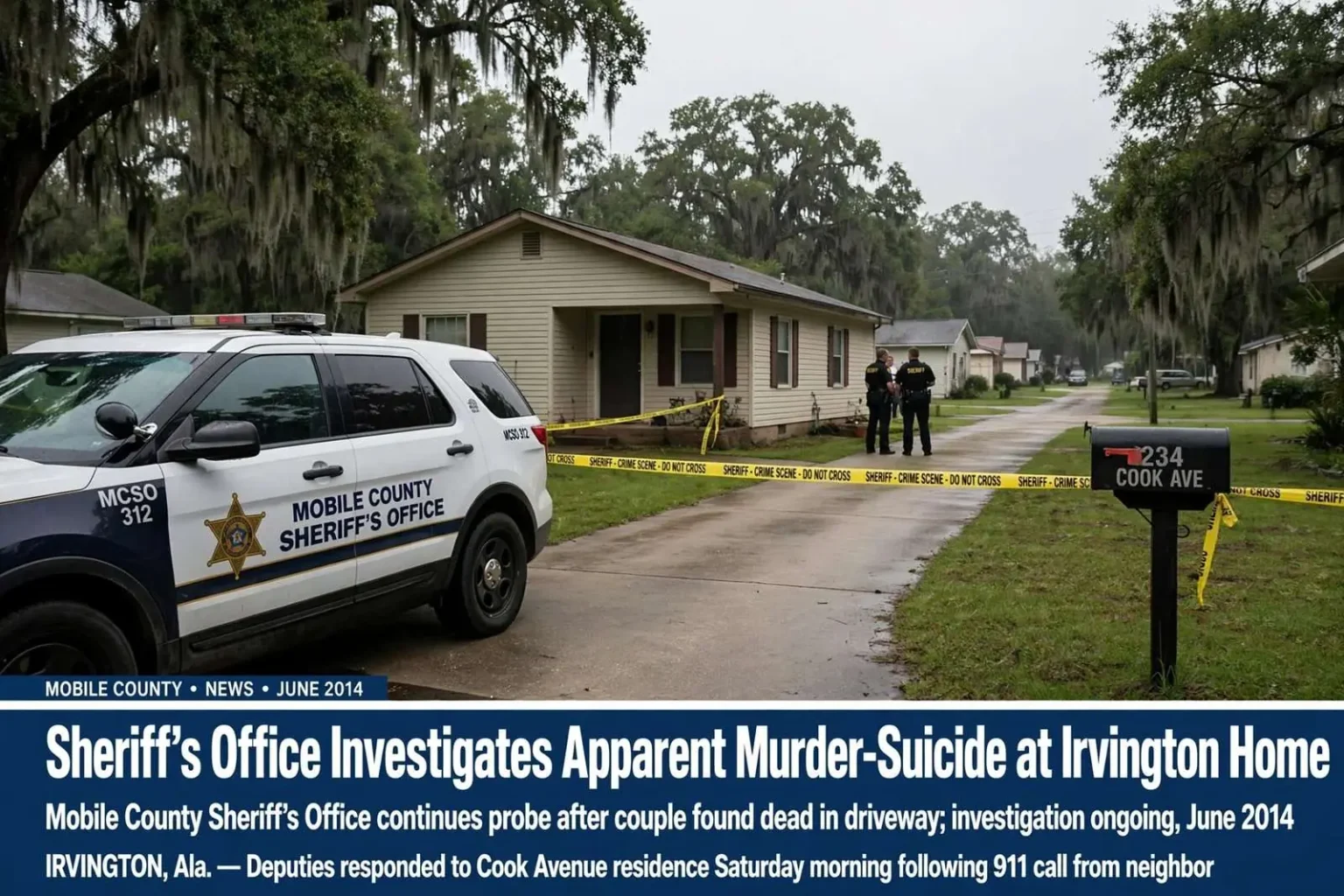
The Mobile County Sheriff’s Office said in June 2014 that it was continuing to investigate an apparent murder-suicide in Irvington, as additional details emerged about the deaths of a couple found in the driveway of their home. The case, which unfolded in the small community in southern Mobile County, drew attention across the region as deputies worked to establish exactly what happened on the quiet residential street where the couple was found.
Sheriff’s Office Public Information Officer Lori Myles said the agency received a call around 9:30 a.m. Saturday reporting a possible homicide-suicide. When deputies arrived at a home on Cook Avenue in Irvington, they found Edward Earl Goodson and Joyce Goodson lying in the driveway, dead. The discovery set in motion the standard machinery of a death investigation in Mobile County, with patrol deputies securing the scene, investigators arriving to document evidence and the county’s medical examiner process taking over the examination of the deceased.
How the couple was found
Myles said a neighbor had walked over to the Goodsons’ home, discovered the bodies and called her husband, who then dialed 911. That sequence — a resident stumbling onto a tragedy during an ordinary morning errand — is among the most traumatic ways such cases come to light, and it left the neighborhood reeling even before deputies arrived. Deputies located the couple between two vehicles parked in the driveway, a positioning that became one of the details investigators worked to understand as they reconstructed the scene.
Investigators believed the shooting had occurred Friday night, Myles said, because reports indicated the bodies had been in the driveway for some time before they were found. The gap between when the deaths are believed to have occurred and when they were discovered — roughly half a day or more — meant investigators had to account for everything that happened at the residence overnight, including whether anyone heard anything during the hours when the couple lay undiscovered.
Based on the early evidence, deputies believed Edward Goodson had shot Joyce Goodson before turning the gun on himself. That preliminary conclusion was described as exactly that — preliminary — with investigators emphasizing that firm findings in cases of this kind depend on the full reconstruction of the scene, autopsy results and the medical examiner’s determinations rather than first impressions at the site.
Investigation ongoing
Myles said the investigation remained active and that she expected to release more information the following Monday. The Sheriff’s Office did not immediately provide additional details about the couple or any possible circumstances leading to the deaths, a restraint that investigators routinely maintain in the early stages of sensitive cases while next-of-kin notifications are completed and evidence is still being processed.
Deputies noted that the timeline itself — the belief that the deaths had occurred the night before they were discovered — was among the details still being confirmed. Establishing that timeline matters in any death investigation, both for the accuracy of the official account and for determining whether anyone else was present or involved. Detectives typically piece together such timelines from physical evidence, weather and lighting conditions, neighbor observations and any records that establish movement in and around the residence.
The Sheriff’s Office said its public information officer would provide further information once the review advanced. In the meantime, authorities offered few additional details, a common approach in the early stages of a sensitive death investigation, when officials aim to verify what happened before releasing more about the people involved or the circumstances.
How such cases are handled
In cases where investigators suspect a murder-suicide, the process typically involves collecting physical evidence at the scene, documenting the position of those who died, and awaiting the findings of medical examiners before authorities reach firm conclusions. The medical examiner’s office determines cause and manner of death, and its findings carry the decisive weight in confirming whether the evidence matches the working theory investigators developed on the scene. Only after those determinations align do officials typically close out the investigative record with a confirmed account.
The burden of proof in such determinations is deliberately high. Investigators must rule out the involvement of any other party before a death is classified as a suicide or a murder-suicide, which is why scenes are treated as open investigations — with canvassing of neighbors, examination of any weapons found, and checks of the couple’s backgrounds and recent history — even when the early evidence points in a single direction. Deputies in the Irvington case followed that pattern, declining to declare final conclusions while the review was underway.
A community reckoning with a quiet tragedy
The case cast a somber shadow over the Irvington community in southern Mobile County, where such incidents are rare and where neighbors were left to reckon with a tragedy that unfolded quietly on a residential street. Irvington, an unincorporated community along the western reaches of the county, is the kind of place where residents know one another, children wait for school buses on the same roads where they ride bicycles, and a handful of churches and storefronts form the center of civic life. Deaths of this nature puncture that familiarity in a way residents of larger cities may find hard to imagine.
For residents of Irvington, the loss underscored how domestic tragedies can touch even the quietest corners of the region, prompting reflection among neighbors who had lived alongside the couple. Cases like this one tend to leave communities asking difficult questions — whether warning signs were visible, whether anyone could have helped, and how to talk with children about what happened at the end of their street. Those questions rarely have clear answers, but they are part of why local agencies and advocates emphasize that support services exist before a crisis reaches its final stage.
Domestic violence advocates have long pointed to cases of apparent murder-suicide as the starkest reminder that threats within a home can escalate beyond what neighbors or family members imagine. On the Gulf Coast, crisis lines, shelters and counseling services operate around the clock for residents who fear violence in their own homes, and authorities routinely encourage anyone in danger to reach out to law enforcement or advocacy organizations before a situation becomes irreversible. The National Domestic Violence Hotline remains available at all hours to connect callers with local resources.
As the Sheriff’s Office continued its work in the days following the discovery, the Goodsons’ neighborhood returned to its ordinary rhythms — school buses, lawn mowers, evening walks — while the empty driveway on Cook Avenue stood as a reminder of how quickly those rhythms can be broken. The investigation’s findings, once released, would give the community an official account of what happened there, but for the neighbors who knew the couple, the fuller story of their lives was already written in the years they had spent on the street.
Law enforcement coverage in unincorporated Mobile County
The case also highlighted the role the Mobile County Sheriff’s Office plays across the county’s unincorporated communities. Irvington, like St. Elmo, Grand Bay, Wilmer and the other communities outside the city limits of Mobile and Prichard, relies on the Sheriff’s Office for primary law enforcement coverage, with deputies responding from district stations spread across the county’s large rural stretches. That geography matters in investigations: when a death occurs in an unincorporated area, the Sheriff’s Office handles the scene, works the case and coordinates with county and state agencies rather than a municipal police department.
The public information function Myles serves is a key part of how those investigations interact with the community. In a small community like Irvington, word of a death spreads within hours through neighbors, phone calls and social media, often faster than official information moves. A designated spokesperson who can confirm what is known, correct what is wrong and explain what remains under investigation helps prevent rumors from filling the vacuum — a challenge that has only grown in the years since, as neighborhood social media groups have become primary news sources in rural communities.
When a neighbor makes the discovery
The fact that a neighbor discovered the bodies adds a dimension that investigators and counselors alike take seriously. People who come upon a death scene unexpectedly can experience acute trauma, and first responders and victim services staff routinely encourage such witnesses to seek counseling in the days that follow. In close-knit communities, the person who made the discovery often carries that burden quietly for years, and neighbors frequently organize informal support around the family and the witness alike.
Those who called 911 that Saturday morning also set in motion a response that involved multiple agencies in quick succession: dispatchers who triaged the call, patrol deputies who secured the scene, investigators who processed it, and the medical examiner’s personnel who took custody of the deceased. Coordinating that chain in a rural driveway, away from the cameras and infrastructure of an urban crime scene, is routine work for a sheriff’s office, but it is demanding work all the same.
For families across Mobile County, the case’s broader lesson — repeated whenever a domestic tragedy makes the news — is that help is available before a crisis becomes a crime scene. Penelope House, Mobile’s long-running domestic violence shelter and advocacy organization, offers a crisis line and support services around the clock, and the National Domestic Violence Hotline at 1-800-799-7233 connects callers nationwide with local resources. Sheriff’s deputies themselves are often the first point of contact for families in crisis in unincorporated communities, and they can connect residents with those services during any welfare check or disturbance call.
The Sheriff’s Office continued to ask anyone with information about the case to come forward as its review progressed, with further updates promised once investigators and the medical examiner had completed their work.