Mobile Retirees Push Back on Proposed Cuts to City Health Benefits
Mobile retirees and city employees packed a public hearing to oppose proposed health benefit cuts in Mayor Sandy Stimpson's 2015 budget plan.
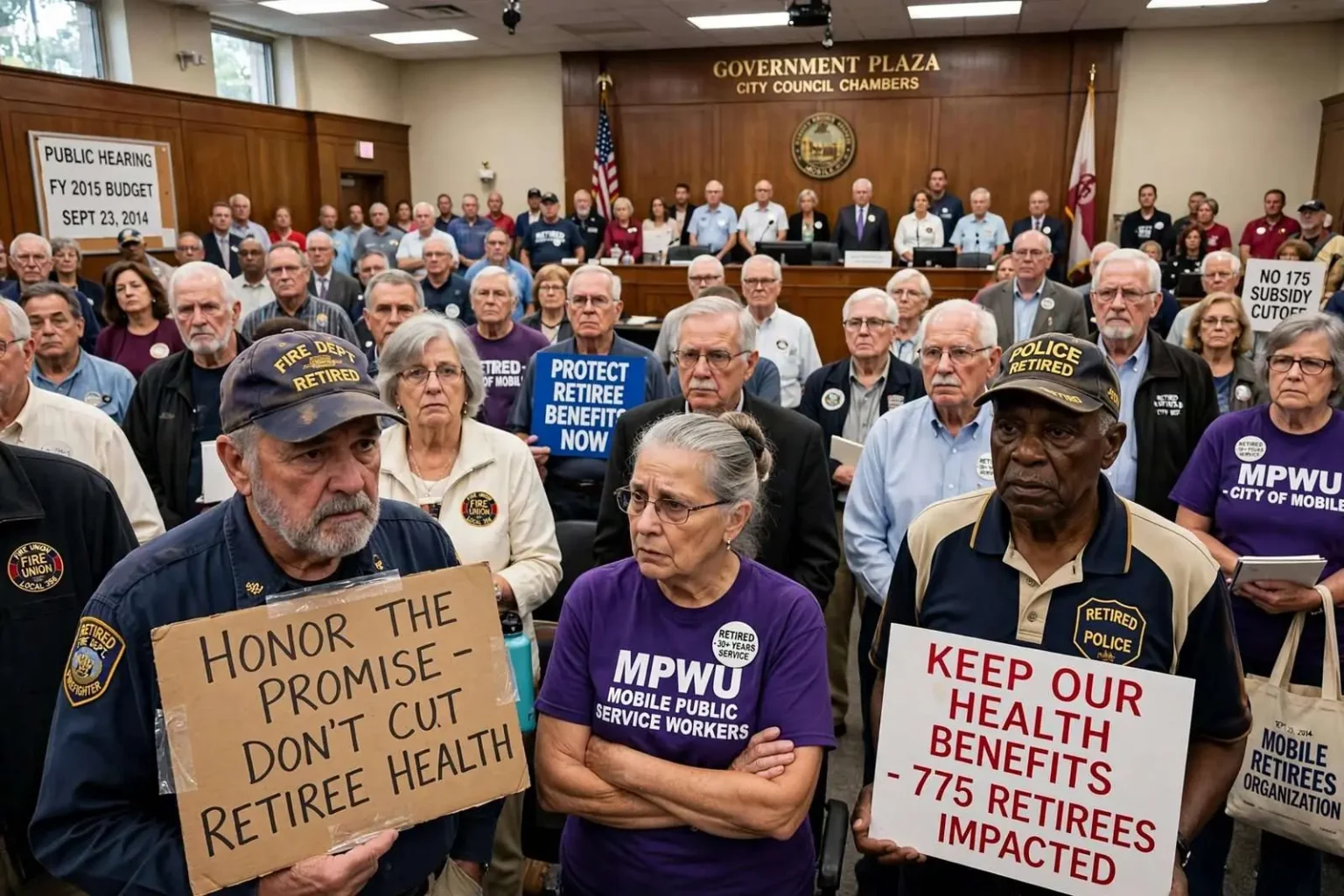
MOBILE, Ala. — A standing-room-only crowd packed Government Plaza for a public hearing on Mobile’s proposed fiscal year 2015 budget, and the people who filled the chamber were not there to talk about potholes or parks. Retired city employees, former police chiefs and union representatives pushed back hard against a plan that would scale back the city’s contribution toward retiree and employee health coverage, turning a routine budget hearing into an emotional referendum on promises the city made to its workforce over decades. Speaker after speaker approached the podium to argue that the men and women who built the city’s departments were being asked to absorb the heaviest burden in the new spending plan.
Retired firefighter Billy Gilchrist recalled a verbal promise made to him decades ago when he was first hired, an assurance he said was echoed for former revenue director Linwood Morrison, former Police Chief Phillip Garrett and Wesley Young, president of the Mobile Public Service Workers. For speakers like Gilchrist, the debate was not an abstract exercise in municipal finance. It was a question of whether the city intended to honor commitments made at the start of public careers that often spanned thirty years or more.
Young told the council that longtime employees stayed with the city for the benefits, not the paycheck, and warned that changing those benefits now would break faith with a generation of retirees. His argument captured the central tension of the evening: municipal wages in Mobile, as in many Southern cities, have historically lagged private-sector pay, and comprehensive health coverage in retirement has long been the counterweight that kept career employees on the job.
The hearing was one of the most heavily attended budget sessions Mobile has seen in recent years, a sign of how directly the proposal touches families across every department. City budget hearings rarely draw more than a handful of regular observers, but retiree benefits mobilize an audience that has both the time to attend and a lifetime of stakes in the outcome. Many in the crowd wore shirts or badges identifying their old departments, and the line of speakers stretched well past the time normally reserved for public comment.
What the Stimpson Administration Proposes
The proposal, put forward by Mayor Sandy Stimpson’s administration, targets what officials describe as the city’s single largest cost center: health coverage, which reached 26.7 million dollars last year, its most expensive year on record. Administration officials have framed the changes as a necessary correction to a benefits structure that has grown faster than the revenue available to fund it. With health costs consuming an ever-larger share of the general fund, they argue, every dollar spent on coverage is a dollar unavailable for public safety, streets and other core services.
Under the plan, new hires would start on a 60/40 cost-sharing structure for health coverage, while current active employees would see monthly premiums rise from 54 dollars to 69 dollars for single coverage and from 140 dollars to 178 dollars for family coverage. Those increases are part of a broader shift toward an 80/20 cost-sharing split that city policy has called for since at least 2004 but has never fully implemented. In other words, the administration is not inventing a new direction so much as trying to finish one that successive councils have endorsed on paper for a decade.
Cost-sharing formulas of this kind determine how a health plan’s total premium is divided between employer and employee. A 60/40 split means the worker pays two of every five premium dollars; an 80/20 split leaves the worker with only one of every five. Moving an entire workforce down that ladder, however gradually, produces the kind of sticker shock that filled the chamber at Government Plaza, particularly for employees whose household budgets were built around the old formula.
Steeper Changes for Retirees
For retirees, the changes are steeper. About 775 Medicare-eligible retirees would receive a 175 dollar monthly subsidy to purchase supplemental coverage, with that subsidy phasing out after four years and a full shift to Medicare-based coverage set for April 2015. The approach reflects a common strategy among public employers trying to wind down legacy retiree plans: rather than continue administering a group plan, the city would help qualifying retirees buy into Medicare Advantage or supplemental policies on their own, then step away entirely once the transition period ends.
For the roughly 381 retirees not yet eligible for Medicare, monthly premiums would climb from 54 dollars to 103 dollars for single coverage and from 140 dollars to 210 dollars for family coverage. Those are the retirees who drew the sharpest objections from the crowd, because they face the largest immediate increases and the least time to plan for them. Many left city service in their fifties under retirement rules that predate modern benefit design, and they are too young for Medicare but too old to easily find affordable coverage on the private market.
The gap between leaving the workforce and reaching Medicare eligibility at 65 has long been one of the most expensive problems in American benefits policy. Public employees who retire early often bridge the gap through their former employer, and when that bridge narrows, the alternatives are rarely cheaper. That reality is what speakers at the hearing said made the proposed timeline feel less like a policy adjustment and more like a door closing.
Public Safety Leaders Warn of Recruitment Fallout
DeWayne Patrick, president of the local firefighters union representing more than 200 retirees and 300 active members, warned that the changes could make it harder to recruit and retain public safety workers at a time when the police and fire departments already face staffing shortages. His argument was straightforward: if the total value of a Mobile public safety career shrinks, the city will compete for qualified candidates against departments that still offer richer retirement health benefits.
Patrick raised concerns that firefighters could be forced to keep working into their sixties simply to hold onto affordable insurance once they turn 55. Firefighting, he noted, is a young person’s job, and asking veterans of the profession to remain on the front lines primarily for health coverage carries its own risks. Critics of the plan made the same point about police work, where the physical demands of the job similarly push officers toward earlier retirement ages than civilian workers face.
Raise or Coverage: A Choice for Employees
Even the administration’s proposed 5 percent employee raise, split between a cost-of-living increase and a later adjustment, did little to soften the objections. One longtime city employee, Julia Dickson, told officials during the hearing that she would rather forgo the raise altogether than accept the tradeoff on health benefits. Her position illustrated the arithmetic that many employees were quietly running at home: a one-time raise, however welcome, can be outweighed within a few years by recurring premium increases and the loss of a retiree subsidy.
The split structure of the raise also shaped the debate. Because the increase is divided between an immediate cost-of-living component and a later adjustment, employees argued that its real value depends on assumptions about future inflation and future premium growth. For workers counting down the years to retirement, the certainty of higher premiums felt heavier than the promise of a phased raise.
The Administration Responds
Mayor Stimpson defended the proposal, saying no plan exists to remove spouses from coverage and noting that retirees on family plans would receive 315 dollars toward supplemental insurance. His comments were aimed at what administration officials viewed as the most alarming rumors circulating among city retirees, and the mayor sought to draw a distinction between the plan as written and the worst-case versions of it that had spread through retirement circles in the weeks before the hearing.
He emphasized that the health plan changes are not directly tied to the budget vote itself, with most changes not taking effect until January 2015 for active employees and April 2015 for retirees, leaving what he called room for continued discussion before implementation. That timeline became a recurring point of contention: the administration presented it as evidence of good faith, while skeptics in the audience treated it as a countdown clock that would start running the moment the council signed off.
Former Police Chief Phillip Garrett compared the situation to national concerns about delayed care for military veterans, arguing that longtime city employees carry the physical and emotional toll of their careers and deserve to be treated accordingly as the council weighs the final shape of next year’s budget. His comparison gave the local dispute a national frame, echoing the period’s debates over whether institutions owe their uniformed personnel more than a market-rate benefits package.
Retiree health benefits occupy a difficult position in municipal accounting because they are promises made today that come due over decades. Unlike salaries, they do not appear as an immediate cost when they are granted, which historically made them an easy way for cities to compensate workers during lean budget years. When the bill eventually arrives in the form of rising premiums and an aging retiree population, the cost lands on whatever council happens to be in office, and trimming benefits becomes the quickest available lever, however painful it may be for the people affected.
What Comes Next
As the hearing closed, council members were left to balance two legitimate claims: the city’s long-term fiscal health and the promises made to the people who served it. The budget process continues through the fall, with the council expected to use the months before the January and April implementation dates to negotiate modifications. For the retirees and union representatives who filled Government Plaza, the measure of those negotiations will be simple — whether the city’s final budget honors what they were told when they signed up, or whether the definition of that promise changes with the times.