Gulf Coast Exploreum Faces Funding Crisis After Losing City Support
The Gulf Coast Exploreum in downtown Mobile faces a funding crisis after losing city support and a BP settlement grant, cutting its budget nearly in half.
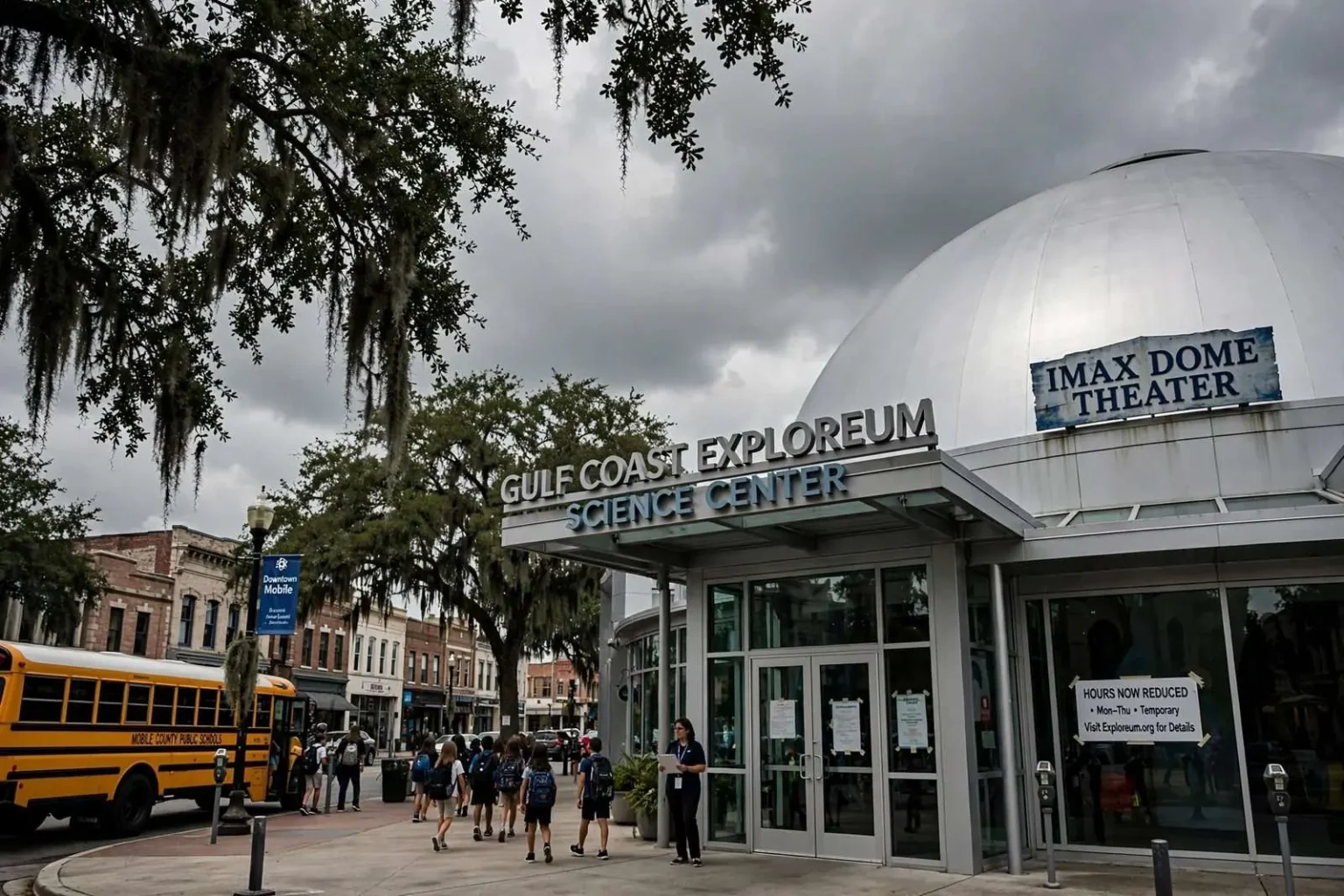
The Gulf Coast Exploreum Science Center in downtown Mobile is confronting one of the most serious financial challenges in its history after losing hundreds of thousands of dollars in city funding within the first week of its new executive director’s tenure.
Jan McKay had barely settled into her new role leading the science center when she learned that the Exploreum’s entire request for $688,000 in performance contract funding from the city of Mobile had been denied. McKay said she found out about the cut just six days into her new job, during what was supposed to be a welcoming celebration for her arrival.
The timing could hardly have been worse. An executive director’s first week is ordinarily spent learning the institution’s rhythms — its staff, its calendar, its donors. McKay’s began with the news that nearly seven hundred thousand dollars of the center’s expected income would not arrive.
The Exploreum had also been receiving $500,000 annually through a BP grant tied to the 2010 Deepwater Horizon oil spill settlement, but that funding disappeared in 2014 as well. Combined with the loss of the city’s performance contract dollars, the science center’s overall budget has been cut by roughly half, according to McKay.
“We are not sure that we will be able to survive,” McKay said, describing the cuts as a blindside that hit an organization with no advance warning and little time to adjust. She noted that few businesses could absorb a 50 percent reduction in income without a serious threat to their operations.
A Broader Shift at City Hall
The funding cut is part of a broader shift under Mobile Mayor Sandy Stimpson’s administration, which has proposed redirecting money once used for performance contracts with nonprofits toward repairing the city’s aging infrastructure. The proposed fiscal year 2015 budget includes cuts of roughly 46 percent to nonprofit and community organizations that have historically relied on city support.
The policy behind the numbers is a philosophy of municipal priorities. Stimpson, elected on a platform of restoring Mobile’s streets, drainage and public buildings, argued that dollars spent fixing a pothole or a broken culvert serve every resident directly, while performance contracts — the payments the city has long made to museums, festivals and social-service organizations — serve particular institutions and audiences. The 2015 proposal put that philosophy into a budget for the first time, and institutions built around those payments felt it immediately.
The Exploreum had been one of the largest beneficiaries of that funding stream, receiving $616,467 in the revised 2014 budget, a figure that included a $212,467 allocation the city had previously covered directly for the facility’s utility costs. That represented a significant increase from the roughly $404,000 the center received in 2013 under former Mayor Sam Jones, when utilities were also covered separately.
The utility piece deserves its own note: nearly a third of the Exploreum’s city money in recent years was not program funding at all but the power bill — the electricity, heating and cooling that a hands-on science center with theaters, exhibits and thousands of weekly visitors consumes. When the city stopped covering utilities directly, that cost landed back inside the center’s own budget.
City officials have expressed confidence that the Exploreum can adapt. A spokesperson for the mayor’s office said McKay’s background could help the organization shift toward a more sustainable model that relies less on taxpayer dollars and more on donors and patrons.
But McKay pointed out that the Exploreum currently has no reserve fund or endowment to fall back on, and financial records show the organization had less than $200,000 in cash on hand against an annual operating budget of about $2.3 million.
That arithmetic is the crisis in miniature. An institution spending $2.3 million a year with less than $200,000 in the bank has no cushion to absorb a bad quarter, let alone a halved income. Museums with endowments can ride out a funding shock by drawing reserves; the Exploreum, like many mid-sized cultural nonprofits, had run year to year on the expectation that its funders would keep funding.
Options on the Table
Options under consideration include reducing the center’s operating days from seven to as few as four per week, though McKay noted that move creates its own financial trap, since reduced hours mean reduced revenue from admissions and the gift shop without proportional savings in fixed costs like staff salaries.
The trap she described is familiar to anyone who has run a visitor attraction. Closing on Mondays and Tuesdays saves little if salaried staff and building costs remain, while the lost days subtract directly from the ticket and merchandise income that keeps the ledger afloat. Cutting hours, in other words, spends the institution’s future to ease its present — a trade a science center with no reserves can afford only briefly.
Despite the financial uncertainty, the Exploreum’s daily operations showed no signs of slowing down. School groups filled the center for tours, and staff were preparing for the opening of a new IMAX exhibit, “Voices of Jerusalem,” expected to draw hundreds of members to an opening event.
The center serves an estimated 160,000 visitors annually and has hosted more than 400,000 schoolchildren on field trips since opening in 1998.
Those two figures explain why the Exploreum’s fate matters beyond its own boardroom. A downtown science center that puts 160,000 people a year through its doors — many of them children on school buses from across the county — is part of the region’s educational infrastructure, not just its entertainment menu. Every cut that narrows its hours narrows the field-trip calendar that teachers plan around.
McKay said she plans to meet with the Exploreum’s board and accountant later this month to map out next steps, including whether new corporate and foundation partnerships could help close the roughly $1 million funding gap left by the combined loss of city and BP settlement money.
Council Moves to Restore Part of the Cut
Late September brought a partial reprieve. The Mobile City Council agreed to reverse a portion of the reduction, directing just under $150,000 back toward the Exploreum for the coming year.
The restoration reflected the council’s own division of opinion about the mayor’s budget philosophy. Council members who had watched the center’s finances unfold argued that an institution anchoring downtown’s cultural district — and carrying the city’s only IMAX dome and its largest family-attraction brand — could not be allowed to fail on the strength of a first-year budget experiment. The restored figure was a fraction of the original request, but it was a signal that the performance-contract debate would not end with the fiscal year’s first draft.
The restored money narrows the real gap considerably. Because the $500,000 BP settlement payment the center received in 2013 was always understood to be a one-time award, it was never a recurring part of the operating budget — meaning the genuine year-over-year reduction is closer to $500,000 than the $1.1 million initially feared.
The distinction between lost income and lost budget matters to how the crisis can be managed. Half of the money that vanished was, in accounting terms, a windfall ending — the BP settlement’s final year, planned for from the start. The other half was recurring: the city money the center had budgeted around for years. A nonprofit can build toward replacing a windfall gradually; it cannot build toward replacing a recurring grant except by the same gradual, year-by-year discipline that donors, memberships and new contracts provide.
With roughly $200,000 in cash on hand against its $2.3 million annual budget, the science center still faces a shortfall in the neighborhood of $300,000 — a serious challenge, but far more manageable than early projections suggested.
The revised math changed the conversation inside the institution. A $300,000 gap on a $2.3 million budget is the kind of shortfall a determined board can attack with sponsorships, membership drives, corporate partnerships and cost discipline. A $1 million gap on the same budget, with no reserves, was the kind that ends institutions. The council’s $150,000 — and the honest recounting of the BP money’s status — moved the Exploreum from the second category toward the first.
What the Center Means to Downtown
Leadership is also pursuing a costly digital projection upgrade for the IMAX dome theater, though that purchase will likely wait until the center’s finances stabilize.
The dome is the Exploreum’s signature — the curved screen that shows films no ordinary theater can carry, and the reason school groups and visitors book trips to the building on Government Street. A digital conversion would eventually free the center from the dwindling supply and high cost of large-format film prints, but in the current climate it is a capital wish shelved behind the operating crisis.
In the meantime, memberships and donations remain a critical lifeline for one of downtown Mobile’s anchor cultural institutions.
The phrase “anchor institution” carries the weight of downtown Mobile’s recent rebuilding. The Exploreum opened in 1998 as the centerpiece of the city’s effort to make Government Street and the historic district a destination — a science center with hands-on exhibits, traveling shows and a dome theater, a block from the History Museum and steps from Dauphin Street’s revival. Since then it has put hundreds of thousands of schoolchildren through its exhibits, pairing the city’s tourism strategy with its science education.
The BP money that sustained it through the early 2010s traced to the 2010 Deepwater Horizon disaster — the spill that touched every Gulf Coast institution’s finances, and whose settlement payments reached museums and community groups across the coast as part of the region’s recovery. That stream’s end, alongside the city’s budget shift, closed the era in which the Exploreum’s operating plan could assume large public and settlement grants would keep arriving.
What comes next depends on the board’s October meeting and the partnerships McKay intends to pursue — corporate sponsors for the exhibits, foundation grants for the education programs, and a membership base large enough to steady the ledger. The center’s visitors, meanwhile, have seen no change: school buses still line Government Street, the IMAX still runs, and the center’s staff are still preparing an opening event expected to draw hundreds. The question the fall will answer is whether downtown Mobile’s science center can convert a near-survival scare into a new operating model — or whether the next budget season brings the argument back to the council floor.