Mobile Weighs Camera Crackdown as ‘Pride and Shame’ Litter Campaign Launches
Mobile city leaders are considering surveillance cameras at litter hot spots as a new 'Pride and Shame' social media campaign targets chronic dumping.
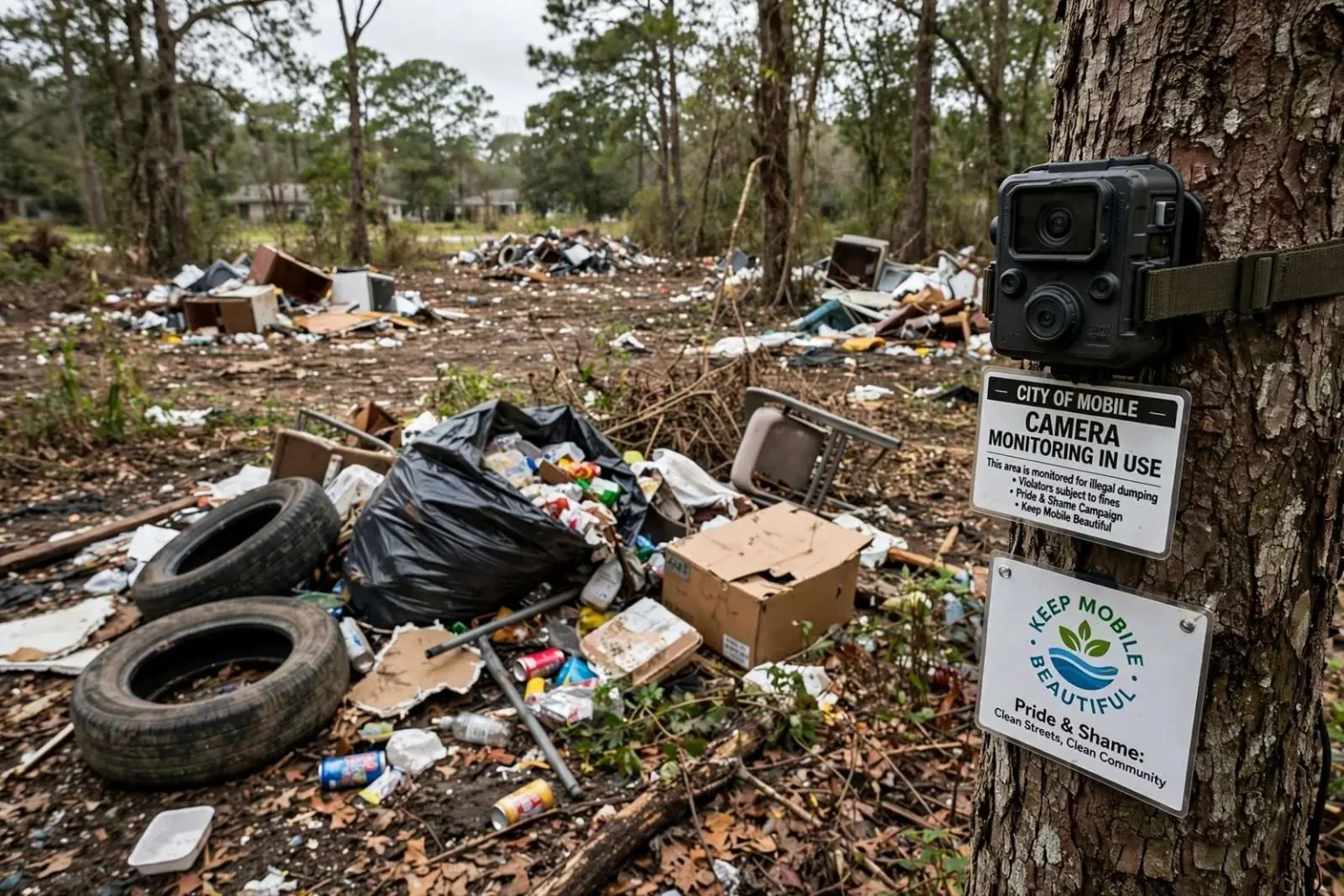
Mobile officials are weighing whether cameras could help solve a problem that fines and warnings haven’t fully fixed: people dumping trash on city streets and vacant lots. The idea surfaced this week as the City Council discussed a new public shaming campaign aimed at litterbugs, one piece of a broader push to clean up chronic dumping spots around town.
The campaign, called “Pride and Shame,” launched on the Keep Mobile Beautiful Facebook page and pairs photos of trashed locations with images of areas that have been kept clean. City officials say the social media push is timed to coincide with stepped-up litter enforcement, which includes larger fines for people caught littering and for businesses that fail to keep their properties clear of debris.
“Unfortunately, we have places that need a lot of help and have become hot spots for trash and debris,” said Shayla Beaco, the city’s senior director of community affairs, describing the goal of highlighting both problem areas and success stories side by side.
During a City Council pre-conference meeting, several council members pushed the conversation further, floating the idea of installing cameras at known dumping grounds. Councilman C.J. Small said he could point to specific spots where a camera would almost certainly catch repeat offenders in the act. “If people can see their faces, you will stop,” he said, arguing that visibility alone might be enough of a deterrent.
Councilman Fred Richardson agreed cameras could be a useful tool at the city’s most persistent litter dumps, while Councilman Joel Daves noted the same technology might help identify who is illegally dumping old tires around Mobile. Tire dumping has been a recurring headache for city crews, who are left to haul the piles away from roadsides and vacant lots at public expense.
Low-cost cameras under consideration
Mayor Sandy Stimpson’s administration is already looking into the idea, according to city officials, and has reportedly priced out consumer-grade game cameras of the kind sold at sporting goods stores as a low-cost option. Those units, often used by hunters to monitor game trails, can be mounted on poles or trees near chronic dump sites and triggered by motion, making them far cheaper than the fixed surveillance systems cities deploy downtown.
Council President Gina Gregory said she’d like to see monitoring extended to heavily traveled roads as well, potentially capturing license plates of people who toss trash from moving vehicles. That kind of roadside litter, from fast-food bags to construction debris, accumulates along major corridors and requires constant sweeping crews to contain.
Council attorney Jim Rossler cautioned, however, that a misdemeanor littering citation likely still requires an officer to be present, meaning camera footage alone may not be enough to issue a ticket under current law. His warning underscored the gap between catching someone on video and actually prosecuting them, a gap that has limited camera enforcement in cities across the country.
City officials say they are still weighing the tradeoffs of expanded camera monitoring, including concerns about government overreach, before committing to any specific rollout. Beaco said the administration is exploring “different avenues” to support the enforcement push that took effect this week, which includes fines for individual litterers and property owners alike.
Lessons from other cities
Cities elsewhere, including Juneau, Alaska, have used similar camera systems to catch and fine people for dumping trash in public spaces, offering a possible model if Mobile decides to move forward. Juneau’s experience showed that cameras placed at chronic sites can produce identifiable footage, but also that the citations that stick tend to be the ones an officer can back up in person.
For now, the Pride and Shame campaign remains the city’s most visible tool, relying on public exposure rather than technology to change behavior at Mobile’s most persistent litter hot spots. Officials say the pairing of blighted and pristine locations is intended to make the stakes visible to neighbors who might not otherwise notice the slow accumulation of trash on their own blocks.
A city’s long fight with illegal dumping
Illegal dumping is hardly unique to Mobile, but the city’s mix of vacant lots, wooded dead-end streets and fast-growing outskirts makes it a persistent drain on public works budgets. Crews sent to clear a dumping site collect household furniture, construction debris, tires and yard waste that someone else chose not to take to a landfill or transfer station. Every load hauled away costs the city twice: once in cleanup labor and equipment, and again in the disposal fees at the landfill gate.
Hot spots tend to repeat. The same lots and street ends attract dumping again and again once word spreads that a site is unwatched, which is exactly the pattern council members described when they argued that a handful of well-placed cameras could cover most of the problem. Small’s claim that he could name specific corners where a camera “would almost certainly” catch repeat offenders reflects how predictable these locations become.
The enforcement push that took effect this week raises the financial stakes for violators. Larger fines now apply both to individuals caught littering and to businesses that allow debris to pile up on their properties. Property owners in particular have long complained that adjacent vacant lots draw trash and that the city’s old penalties were too small to change anyone’s behavior. The new fine structure is meant to make dumping an expensive gamble rather than a minor nuisance.
Keep Mobile Beautiful, the city affiliate that launched the Pride and Shame page, has spent years organizing volunteer cleanups and education efforts across Mobile’s neighborhoods. The shift to posting side-by-side photos of blighted and tidy locations marks a sharper tone for that work, one that officials acknowledge is deliberately uncomfortable for the people responsible for the messes.
The council’s competing instincts
The pre-conference discussion revealed a council drawn to the promise of cameras but wary of what comes with them. Richardson and Daves framed the technology as a force multiplier for a code enforcement and police operation that cannot stake out every wooded lot in the city. Gregory’s interest in highway monitoring pointed toward the other end of the problem, the drivers who treat roadside ditches as bins.
Rossler’s legal caution, though, reframed the debate. A misdemeanor citation built on camera footage alone could collapse in municipal court without an officer who personally observed the violation, which means the city would need to pair any camera program with patrol time at the sites being filmed. That staffing requirement, more than the price of the cameras themselves, may determine whether the idea survives budget season.
Privacy and overreach concerns add another layer. Council officials said any rollout would need to balance the benefit of catching dumpers against the optics of government cameras pointed at ordinary streets. Mobile has watched other cities stumble into backlash over surveillance programs, and no council member proposed a broad network; the talk centered narrowly on known dump sites.
Beaco emphasized that the administration views cameras as one option among several. Additional code enforcement officers, coordinated cleanups of the worst hot spots, and the fines that took effect this week are all part of the same push, and city officials say they intend to measure whether the stiffer penalties alone bend the curve before the city spends on hardware.
For residents living near chronic dumping grounds, the combination of shaming posts, higher fines and possible cameras represents the most serious attention the problem has received in years. Whether any of it changes behavior along Mobile’s most littered corridors will show up first in the same place the campaign lives: the Before photos on the Keep Mobile Beautiful feed, and whether they slowly give way to the After.
What happens next
No formal vote on cameras was taken this week, and city officials stressed that the administration is still in the research phase. The next step, if the idea advances, would likely be a limited pilot at a handful of the worst sites, using the inexpensive game cameras already priced out, paired with enforcement patrols to convert footage into actual citations.
The Pride and Shame campaign, meanwhile, costs the city almost nothing beyond staff time to photograph and post the locations. Officials said the social media effort will continue regardless of what the council decides on cameras, since public awareness is a precondition for any enforcement strategy to work. Residents who see their neighborhoods featured are encouraged to report dumping when it happens, which gives investigators a time window and, sometimes, a description of the vehicle involved.
City leaders say the broader goal is cultural rather than purely punitive. Mobile has invested heavily in downtown revitalization and waterfront improvements in recent years, and officials argue that trash-strewn gateways and vacant lots undercut that work in the eyes of residents, visitors and prospective employers. A city that tolerates dumping on its back streets, the argument goes, will eventually pay for it in perception as well as cleanup costs.
The coming months will test whether the layered approach, stiffer fines, public shaming and possibly cameras, can succeed where years of warnings have not. Council members say they expect to revisit the camera question once the administration reports back on costs, staffing needs and the legal mechanics of citing people caught on tape. Until then, the city’s most persistent litter hot spots remain under watch of a different kind: the phone cameras and Facebook feed of Keep Mobile Beautiful, and the neighbors now paying closer attention to who leaves what behind.