Mobile County Weighed Hurricane and Christmas Sales Tax Holidays After Back-to-School Success
Encouraged by a back-to-school sales tax holiday that appeared to lift rather than dent collections, Mobile County commissioners sketched plans for two more breaks: one for hurricane supplies in June, another for Christmas shopping in December.
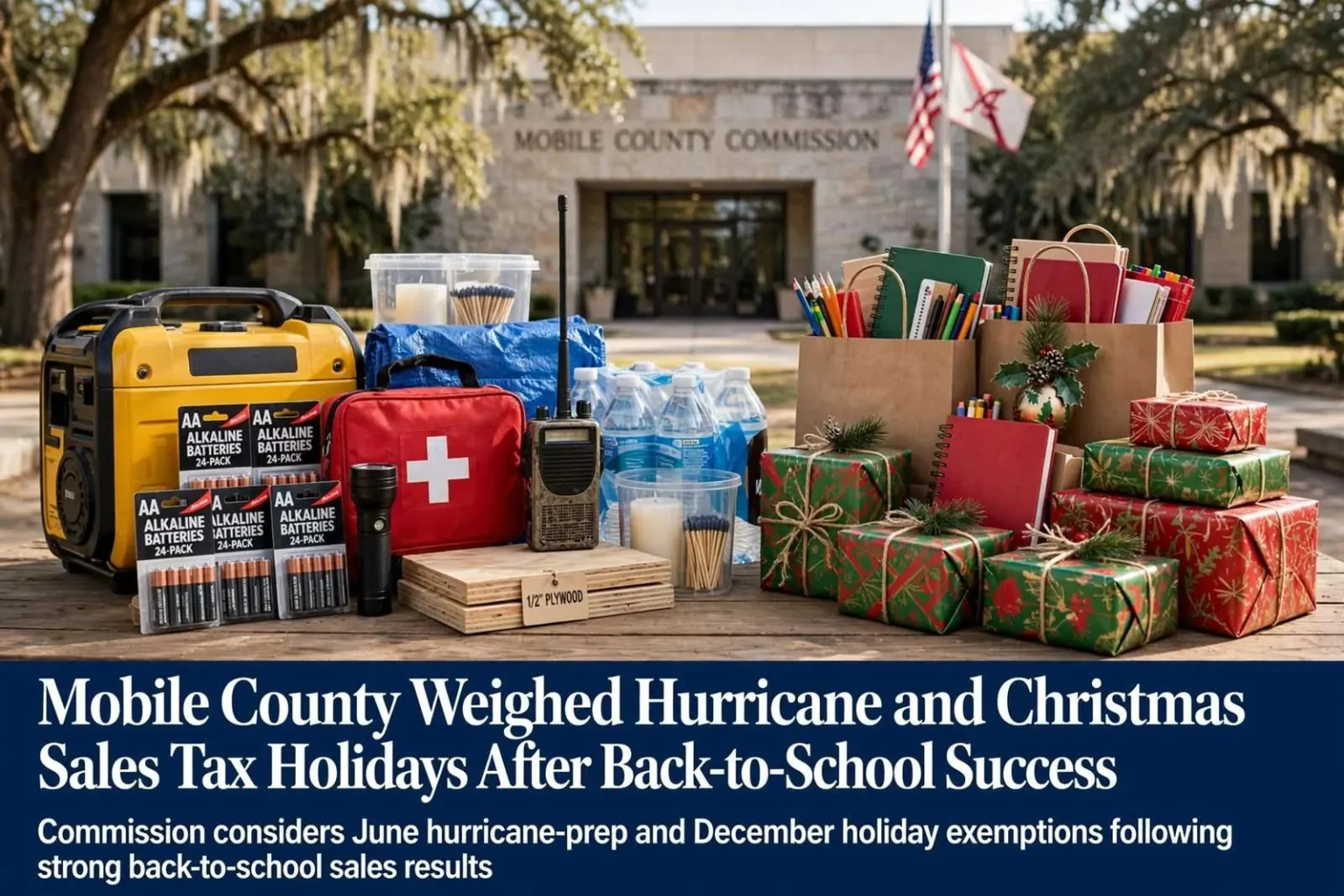
MOBILE — Encouraged by what officials described as a surprisingly profitable experiment, the Mobile County Commission was weighing an expansion of the sales tax holiday concept, with tentative plans for a hurricane preparedness tax holiday in June and a Christmas shopping tax holiday in early December.
The idea grew directly out of the county’s participation in the back-to-school sales tax holiday held the previous August. Rather than draining the treasury, commissioners said, the suspension of the tax appeared to stimulate the local economy so briskly that revenues actually increased over the comparable period.
That result flew in the face of the standard budget officer’s instinct. A tax cut, on paper, is money out the door, and county finance staff had approached the back-to-school weekend expecting to record the forgone revenue as a cost of goodwill. Instead, receipts came in above the prior year, and the experience converted at least some of the commission’s skeptics into students of the experiment — officials now willing to test whether the same mechanics could work twice more in a single year.
How a tax holiday works
A sales tax holiday is a temporary, legally defined window during which shoppers pay no sales tax on a specified list of goods. Alabama’s back-to-school holiday, enacted at the state level, exempted the state’s portion of the tax on items such as clothing, school supplies, books and computers.
Cities and counties, however, levy their own sales taxes on top of the state’s, and those local taxes make up the larger share of the sticker shock at the register in Mobile County. For a shopper to get the full benefit, the county commission and individual municipalities each had to affirmatively vote to waive their own levies for the same weekend. Mobile County chose to participate, and the results, as commissioners read them, undercut the standard objection that a tax holiday is simply revenue given away.
The two-layer structure is the part shoppers most often misunderstand. When the state suspends only its 4-cent share and a city or county keeps its own rate, the customer still pays most of the tax — which is why the holiday’s real effect depends entirely on how many local governments opt in. In a county with a dozen municipalities, each with its own rate, a shopper in one part of the county may get the full break while a shopper a few miles away does not, and merchants on the boundary streets notice which side of the line the savings fall.
The theory advanced at the county’s administrative offices on Government Street was that the holiday did not merely shift purchases from one weekend to another but drew shoppers across county lines, pulled forward purchases that might otherwise have gone unmade, and lifted sales of untaxed and non-exempt merchandise bought on the same trip.
That triple mechanism is what separates a genuine stimulant from a calendar shift. If shoppers simply moved a planned purchase into the exempt weekend, the county would trade revenue for nothing. But an influx of cross-border shoppers brings dollars that would otherwise have been spent elsewhere, and every exempt purchase drags along taxable items — shoes with the bookbag, a phone case with the computer, groceries with the school run — on which the local rate still applies. The same dynamic plays out every year along state lines, where retailers on the Florida side of the Alabama line feel the pull of exemption weekends in both directions.
Why hurricane supplies
Of the two new holidays under discussion, the June proposal carried the most obvious local logic. The Atlantic hurricane season opens June 1 and runs through November 30, and no community in Alabama had a fresher memory of what that meant. Hurricane Ivan came ashore in 2004 near the Alabama-Florida line; Hurricane Katrina followed in August 2005, pushing a devastating surge into coastal Mississippi and flooding low-lying stretches of Mobile County.
Bayou La Batre, Coden, Dauphin Island and the Down the Bay neighborhoods had all learned the difference that a stocked pantry, a working generator and a supply of batteries could make.
Those lessons were written in wreckage. Ivan damaged or destroyed thousands of structures across Baldwin County and the south Mobile County waterfront, and Katrina’s surge, less than a year later, flattened the shrimp docks and canneries of Bayou La Batre and pushed floodwater into the peninsula communities south of the city. Residents who lived through those weeks learned a specific arithmetic: the families who had bought batteries, canned food, water and fuel before the storm ate dinner and lit rooms while the families who had not stood in gas lines that stretched for miles. Preparedness, in coastal Alabama, was not a brochure — it was the difference between weeks.
Alabama had already begun institutionalizing that lesson at the state level with its own hurricane preparedness sales tax holiday, timed to early summer and covering the classic categories of storm gear. The county’s June proposal would have extended the same logic locally, in the same way the back-to-school exemption had been layered on top of the state’s version.
The goods that make up a storm kit are precisely the sort of items a sales tax holiday can make cheaper: Batteries, flashlights and portable radios Tarps, plywood and plastic sheeting Coolers, bottled water and non-perishable food Portable generators and fuel containers First-aid supplies and weather radios.
The list also happens to be the most expensive part of surviving a hurricane season on a working family’s budget. A portable generator can run to several hundred dollars, a chain of tarps and plyboard another hundred, and a stocked kit of radios, coolers and first-aid supplies more still — purchases that get deferred year after year in households stretching to the end of the month. A tax-free weekend does not erase those costs, but on a four-figure kit the savings are real, and the timing pushes the buying to the one moment of the year when the whole Gulf Coast is thinking about the same threat.
A June exemption, supporters argued, would nudge households to buy those supplies before a storm entered the Gulf rather than during the frantic scramble after a watch was posted, when shelves empty and prices climb.
The Christmas question
The proposed December holiday rested on a different rationale. Retailers in Mobile County, as everywhere, booked a disproportionate share of their annual sales in the weeks between Thanksgiving and Christmas. A tax holiday timed to the opening of that stretch would, in the commission’s reasoning, keep dollars from migrating to neighboring counties or across the state line to Mississippi and Florida, while giving local merchants a marketing hook.
The border leakage argument is the serious economics behind the idea. Mobile County sits within a short drive of Mississippi’s tax structure on one side and Baldwin County’s malls on the other, and holiday shopping is precisely when that geography matters most — big-ticket purchases, electronics, toys and clothing where a percentage point or two of sales tax is visible money. A December exemption weekend, timed early in the season, would let local retailers advertise the break before the shopping calendar’s heaviest weekends, converting a tax cut into a reason to stay in county lines.
Skeptics of tax holidays, then as now, raised familiar cautions. Critics contended that merchants sometimes quietly trim discounts during an exemption weekend, capturing part of the savings themselves, and that the benefit flows mainly to households that were going to make the purchase anyway. Local governments that depend heavily on sales taxes to fund sheriff’s patrols, road crews and public health services must also weigh whether a demonstrable bump in volume truly offsets the forgone rate.
Those objections are not academic in Mobile County, where sales tax is a foundational revenue source for a county government that does not levy a property tax rate commensurate with many of its peers. Sales taxes are also the most regressive instrument in the local toolkit — they fall hardest on families that spend nearly everything they earn — and holiday skeptics have long argued that the exemption disproportionately benefits retailers’ marketing calendars rather than the households least able to afford the tax. The counterargument, validated by the August experiment, was that volume itself is revenue: a busier weekend taxed at lower rates can out-earn a quiet weekend taxed fully.
The discount-trimming objection, meanwhile, is the detail that turns a tax policy debate into a consumer-protection one. Officials who design holidays increasingly pair them with publicity reminding shoppers that a tax-exempt price is not automatically a deal — the exemption saves a fixed amount, and a retailer’s own markup determines whether the customer actually keeps it.
What came next
The plans described by the commission at this stage were explicitly tentative. Any county holiday would require a formal vote, and its practical value would depend on whether the cities inside Mobile County, from the city of Mobile itself to Prichard, Saraland, Satsuma, Chickasaw and Semmes, chose to match the exemption within their own limits.
That coordination problem is the recurring headache of Alabama’s local-option holidays. Each municipality decides for itself, and a patchwork of opt-ins blurs the very marketing message the holiday is meant to send. A shopper checking whether a purchase is exempt has to know not only the county’s decision but the city’s, and merchants near municipal boundaries inherit the confusion. The cleanest version of a local holiday — county and all its cities voting on the same weekend — is also the rarest, and commission staff knew that reaching it would require more diplomacy with a dozen city halls than with the state.
What the discussion made plain was that the back-to-school weekend had converted at least some officials at the county level. Having watched a tax cut coincide with a revenue increase, commissioners were prepared to test whether lightning could strike twice, in June for the storm season and again in December for the holidays.