Mobile Police Sergeant Fired After Trial Board Finds Conduct Violations
A 15-year Mobile Police Department sergeant was fired after a trial board found him guilty of multiple conduct violations, including biased profiling.
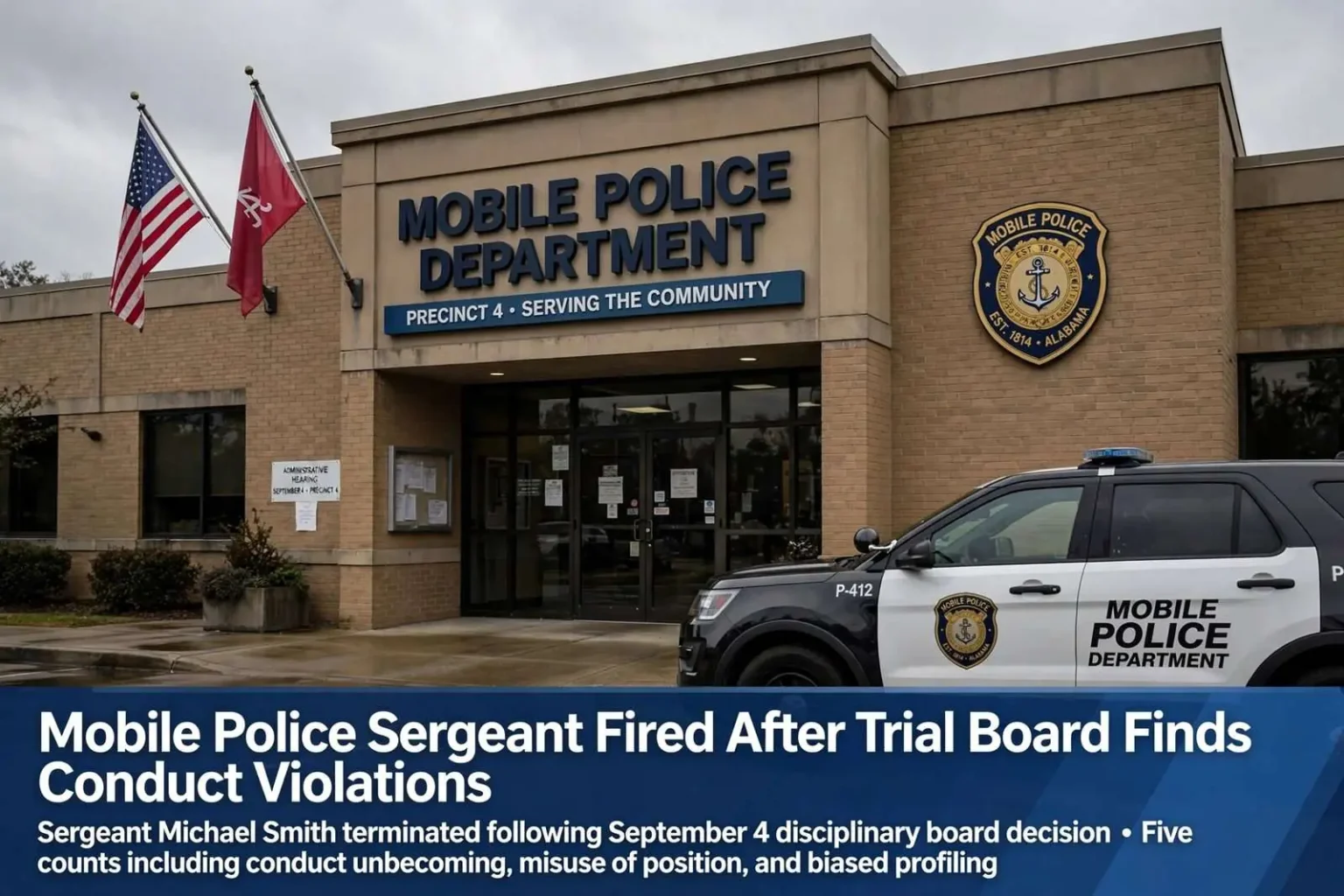
A longtime Mobile Police Department sergeant has been removed from his post after an internal disciplinary board concluded he violated multiple provisions of the department’s code of conduct. Sergeant Michael Smith, who most recently served as a supervisor in Precinct 4, was stripped of his position following an administrative hearing held September 4. Smith had served with the Mobile Police Department for more than 15 years before his termination.
According to department officials, the trial board determined that Smith was guilty on multiple counts, including engaging in conduct unbecoming of an officer, misuse of his position, failure to obey a direct order, biased profiling, and general disobedience of orders. The board reached its decision unanimously, concluding that the combination of violations warranted his dismissal from the force.
Neither Mobile Mayor Sandy Stimpson nor Police Chief James Barber objected to the board’s decision to terminate Smith. In a public statement following the ruling, Barber did not go into detail about the specific circumstances that led to the charges, but he was direct in his assessment of Smith’s conduct, saying the sergeant had violated and tarnished the badge he wore.
What a Trial Board Is, and How It Works
Trial boards of this kind are part of the internal disciplinary process used by police departments to review allegations of officer misconduct outside of the criminal court system. A finding against an officer can result in a range of consequences, from suspension to termination, depending on the severity of the violations identified.
Administrative disciplinary proceedings differ from criminal cases in important ways. The standard of proof is lower, the rules of evidence are looser, and the question before the board is not whether an officer broke a law but whether he or she violated the department’s written standards of conduct. Officers facing a trial board are typically represented, may present evidence and witnesses, and retain appeal rights through civil service channels, but the process is administrative rather than judicial.
Mobile’s department, like most large municipal agencies, maintains a written code of conduct covering everything from obedience to lawful orders to treatment of the public. The five categories the board cited in Smith’s case span a wide swath of that code, from the general, conduct unbecoming, to the specific, biased profiling, which departments treat as among the most serious violations an officer can commit because it strikes at the fairness of policing itself.
The Weight of the Supervisor’s Role
In Smith’s case, the board’s finding on five separate categories of misconduct, including biased profiling, points to a significant breakdown in adherence to department standards for a supervisor with more than a decade and a half of service. Supervisors in the department’s precinct structure carry responsibility not only for their own conduct but for the officers they oversee, reviewing reports, approving arrests, and setting the tone of a shift.
Precinct 4 covers a broad section of the city, and the sergeant’s position within it placed Smith among the department’s working supervisors, the rank most visible to line officers and most responsible for day-to-day field operations. A termination at that level, after a unanimous board finding, removes an officer whose influence extended to the officers under his command.
The case adds to a broader conversation happening in police departments across the country about accountability for supervisory personnel, particularly when allegations involve profiling or misuse of authority. National attention on police accountability has pressed departments to examine not just the conduct of line officers but the officers who lead them, on the theory that a supervisor who violates standards does more damage than one who merely fails, because his example licenses the same behavior in others.
The Signal Sent by the Decision
For a department the size of Mobile’s, the removal of a precinct supervisor after this kind of finding represents a visible signal to both officers and the public about how seriously command staff say they treat conduct violations. Terminations of veteran supervisors are uncommon, and word of them travels fast through a department’s ranks, shaping how officers weigh the risks of misconduct against their careers.
The public dimension matters too. Mobile’s mayor and police chief have both staked credibility on professional standards within the department, and the speed with which the trial board process moved from the September 4 hearing to a confirmed termination was itself a message. Barber’s statement, harsh in tone even while declining detail, left no ambiguity about where command staff stood on the findings.
Departments typically balance transparency in disciplinary cases against privacy rules and the legal exposure that full public disclosure can create. That tension explains the pattern seen here: a detailed list of the violation categories, a clear statement of the outcome, and a pointed public assessment, alongside continued silence about the underlying incidents that prompted the hearing.
What Comes Next
Officials have not indicated whether Smith intends to appeal the trial board’s findings through any further internal or civil service process, nor have further details been released regarding the specific incidents that triggered the September hearing. Alabama’s civil service framework gives terminated municipal employees a path to challenge dismissals, and appeals can take months while the underlying findings are reviewed.
The Mobile Police Department has not announced any additional personnel changes connected to the case. Disciplinary investigations sometimes expand to others involved in the same incidents, but the absence of further announcements suggests the board treated the matter as closed with Smith’s termination.
For Precinct 4, the practical effect is a supervisor vacancy that command staff will fill while the officers assigned there absorb the loss of a colleague of 15 years. Departments manage such transitions routinely, but a termination, as opposed to a retirement or transfer, carries a different weight in a precinct’s culture, and officers take note of the outcome.
The case will also enter the department’s institutional record as a precedent. Trial board findings become reference points for future disciplinary decisions, both for officers weighing conduct and for boards weighing consequences. A unanimous termination, upheld by the mayor and the chief, establishes where the ceiling sits: five violations, including biased profiling and disobedience of orders, by a supervisor, ends a career.
Whether the findings are ever tested on appeal, the department’s public handling of the case has already made its position clear. A sergeant’s badge, in Barber’s telling, is not merely a rank but a trust, and the department judged that Smith had broken it beyond repair.
The biased profiling finding deserves particular attention because of how rarely it appears in formal disciplinary outcomes. Departments define biased profiling as enforcement action based on characteristics such as race, ethnicity, or neighborhood rather than lawful suspicion or observed behavior. Proving it internally requires documentation and testimony, which is why profiling charges in trial board proceedings are less common than their real-world incidence, and why a board finding on that category is significant within a department’s record.
Conduct unbecoming of an officer, the broadest of the charges, functions as a catch-all for behavior that damages the department’s reputation or betrays public trust, even when no specific statute or rule covers it. Misuse of position covers the exploitation of police authority for personal benefit or improper purposes. The remaining charges, failure to obey a direct order and general disobedience of orders, address insubordination, which departments treat as uniquely dangerous in a paramilitary structure where coordinated response depends on the chain of command.
Read together, the five findings describe a supervisor who was not accused of a single lapse but of a pattern, one that touched public trust, misuse of authority, and defiance of the command structure simultaneously. Trial boards weigh combinations as much as individual counts, and the unanimous vote suggests the members concluded the pattern, not any one violation, made termination the only proportionate outcome.
The department’s disciplinary framework distinguishes between officers and supervisors for precisely this reason. A veteran officer is expected to have internalized standards; a supervisor is expected to enforce them. When a supervisor is found to have violated core provisions, the internal logic of discipline treats the breach as more corrosive, because the offending officer is also the one charged with setting expectations for others.
Mobile’s department is among Alabama’s largest municipal forces, with precincts covering neighborhoods that range from the downtown business district to residential corridors in the city’s western and southern sections. Each precinct’s supervisors are the most senior officers most residents of that area will ever deal with directly, and their conduct, for better or worse, shapes public perception of the entire department.
That visibility is why the city’s political leadership was drawn into the case’s resolution. Mayor Sandy Stimpson took office on a platform that included professionalizing city services, and Chief James Barber leads the department under his administration. Neither objected to the termination, and their silence in the face of the board’s findings functioned as assent, closing off any suggestion that political pressure might soften the outcome for a 15-year veteran.
The case now stands as the department’s most recent and most visible demonstration that its internal accountability process can end the career of a senior supervisor, not merely discipline the rank and file. For officers across the city’s precincts, that is the lesson the September 4 hearing left behind.