Three Finalists Emerge in the Search for Mobile’s Next Police Chief
A nine-member screening committee narrowed eight departmental applicants to three finalists for Mobile police chief, leaving the final choice to Mayor Sam Jones.
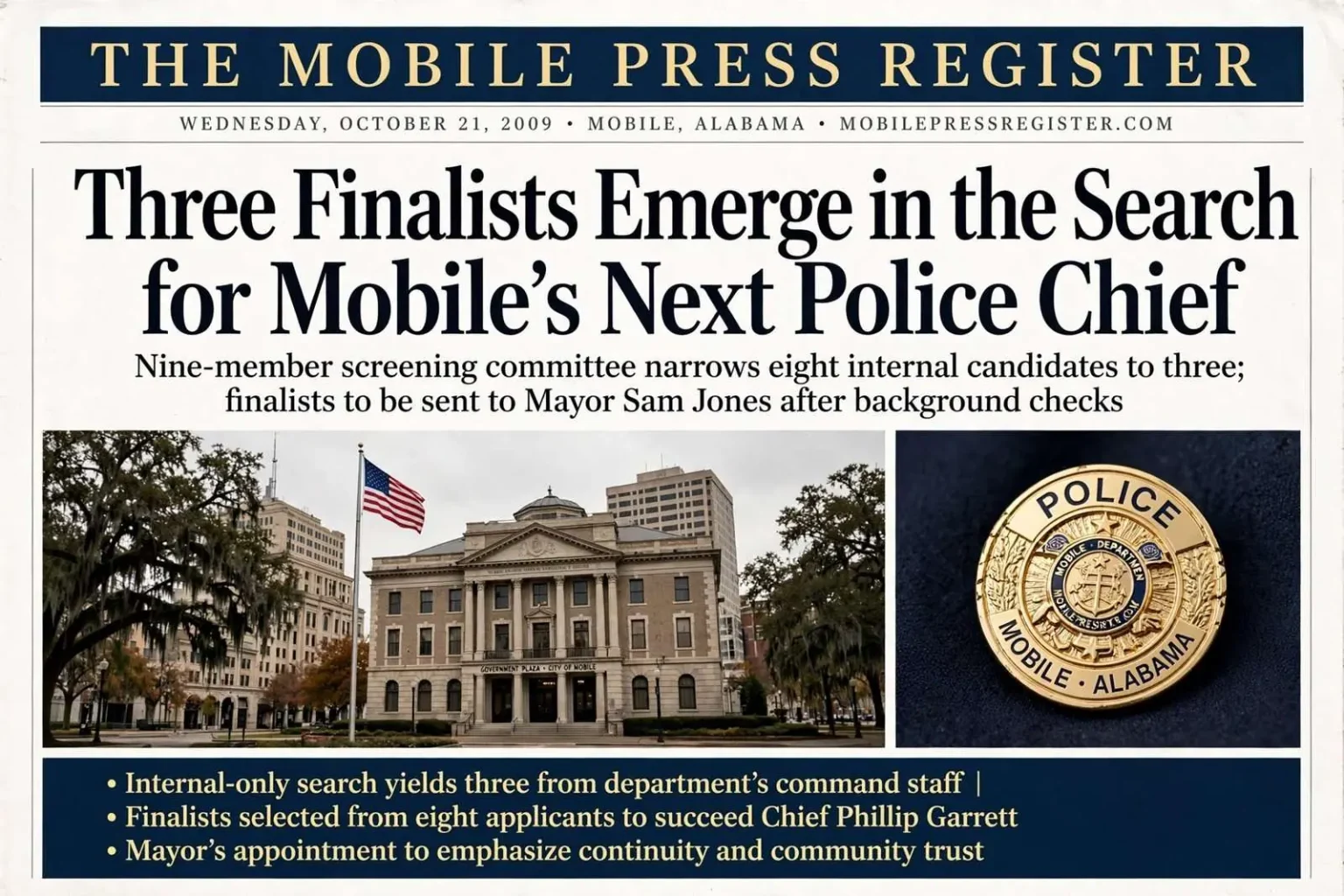
A nine-member screening committee has settled on three finalists to succeed Phillip Garrett as chief of the Mobile Police Department, according to reports, and will send the names to Mayor Sam Jones after background checks are complete. The move marks the transition of a process that began with an unusual public framing — an internal-only search — into its final stage, with the city’s next top cop now certain to come from a shortlist drawn entirely from within the department’s own command structure.
Jones, who will make the appointment, had pledged that his choice would come from within the leadership ranks of the department — a commitment that ruled out a national search and kept the competition among officers who had spent their careers on Mobile streets. The decision was notable at a time when many mid-sized American cities were bringing in outsiders to shake up their departments. Jones’s pledge signaled continuity: whoever took over would be someone who knew the department’s culture, its precincts and its people, and someone the rank and file had watched rise through the ranks.
The applicants
Eight members of the department applied. The list reads like a cross-section of the department’s upper command, and includes both longtime deputy chiefs and bureau-level captains:
Deputy Chief James Barber. Administrative Services Bureau Maj. Mike Barton. Administrative Services Division Capt. Eddie Burrow. Special Operations Section Chief Lester Hargrove. Deputy Chief Joseph Kennedy, of the Field Operations Bureau. Support Services Bureau Capt. Carla Longmire. Community Services Section Capt. William Patrick. 4th Precinct Section Deputy Chief Tyrone Williams.
The applicant pool included a woman and several Black commanders, in a department whose integration had begun decades earlier — a fact that gave the composition of the list historical weight. Longmire’s candidacy marked an important point in the department’s institutional story, as the highest-ranking women in the department moved into serious contention for its top job, and the presence of multiple Black deputy chiefs reflected decades of change in a command structure that once looked nothing like the city it served.
The committee
Local businessman David Cooper chaired the screening committee. Its members were drawn deliberately from across the city’s civic, legal, religious and law enforcement communities — a composition designed to make the selection process look like the city itself rather than a closed deliberation inside Government Plaza or police headquarters.
The members were: Richard Davis, a retired educator and member of the Mobile Airport Authority board. The Rev. Gorman Houston, pastor of Dauphin Way United Methodist Church. Flo Kessler, an attorney for the city of Mobile. Capt. Oscar Kyles, a retired Alabama State Trooper. Caroline C. McCarthy, a managing partner at the Mobile law firm of Lyons, Pipes and Cook. Makeda Nichols, an insurance executive. Tom Purvis, former Mobile County sheriff and a former Mobile police officer. The Rev. Tyree Richburg, pastor of Tabernacle Baptist Church, a former U.S. Marshal and the city of Mobile’s first Black police officer.
The blend was not accidental. A retired educator and airport authority board member brought a neighborhood perspective; two pastors anchored the city’s faith community, long a bridge between City Hall and neighborhoods that view the police department with mixed feelings; a city attorney supplied legal scrutiny; a retired state trooper and a former sheriff and city officer offered professional judgment about policing itself; and an insurance executive and a law firm managing partner connected the process to Mobile’s business and professional establishment. That range mattered in a city where the police chief’s job is as much about community trust as crime statistics.
Why the composition mattered
The makeup of both lists said something about Mobile in 2009. The applicant pool included a woman and several Black commanders, in a department whose integration Richburg himself had begun decades earlier as its first Black officer. Richburg’s own career traced the arc the department had traveled: a man who broke the color line as a young officer went on to serve as a U.S. Marshal, and then, as a pastor, sat in judgment of the generation of commanders who inherited the department he helped integrate.
That arc carries meaning in Mobile, a port city whose racial history is as deep as any in the South. The department that Garrett was leaving had been rebuilt across four decades — from a force that reflected the segregated city of the 1950s and 1960s into one whose command staff included Black officers at the deputy chief level and women leading major bureaus. A selection process that produced a diverse finalist list was, in that context, less a matter of political optics than a straightforward consequence of how far the department had come.
It also mattered practically. Mobile’s neighborhoods differ widely in their relationship with the police — from the historic downtown and midtown districts to the working-class communities of the Plateau, Toulminville and elsewhere — and a chief’s legitimacy in each of them depends on credibility that cannot be issued with a badge. Commanders who grew up in the department’s community policing era, as several of the applicants had, brought that credibility with them.
The stakes of the choice
Phillip Garrett’s tenure left his successor a department with familiar big-city challenges: violent crime concentrated in particular neighborhoods, budget pressures that shaped staffing, and the ongoing work of maintaining the community relationships on which intelligence and cooperation depend. The next chief would also serve at the pleasure of a mayor who had made internal promotion a matter of public commitment, meaning the new chief would be expected to embody the department’s own traditions while still delivering improvement.
The internal-only rule had critics — those who argued that a national search might surface fresh ideas or a high-profile change agent. But its defenders pointed to the opposite risk: an outsider unfamiliar with Mobile’s neighborhoods, its Mardi Gras logistics, its port security responsibilities and its political landscape could take a year or more simply to learn the terrain, and a passed-over internal candidate pool could fracture the command staff. Jones’s pledge effectively bet that the department’s bench was deep enough that the best chief was already wearing a Mobile badge.
How the process worked
The screening committee’s task was to narrow eight applicants to a slate of three, then submit those names to the mayor after background checks are complete. The background check stage is more than a formality in a police chief selection: it typically covers financial disclosures, use-of-force history, internal affairs files, personnel evaluations and, in some cases, interviews with former supervisors and community figures. Only when those reviews are complete do the finalists’ names move forward, and the mayor retains full discretion over the final choice.
That structure puts the committee in the role of gatekeeper rather than decision-maker. Its nine members could exclude no one from consideration who applied, and its deliberations — conducted out of public view — determined which three of the eight would have their careers and records publicly examined in the weeks that followed. For the five candidates who did not make the cut, the process ends without public explanation; for the three who did, the mayor’s decision becomes the defining moment of their careers.
The department the next chief inherits
Whoever gets the job will lead an organization of several hundred sworn officers responsible for Alabama’s third-largest city, a major Gulf Coast port, and a tourism calendar that swells downtown each winter with Mardi Gras crowds. The chief answers to the mayor on policy and to the public on results, and the position demands fluency in everything from federal grant programs and homeland security coordination to the daily rhythm of precinct operations across the city’s four police precincts.
The internal candidates each carried distinct institutional knowledge into the process. Deputy chiefs oversee broad functional commands and have managed the department’s highest-level operations; bureau and section captains have run the administrative machinery — budgeting, records, training, communications and support services — without which a police department cannot function; precinct and community services commanders know the neighborhoods, the crime patterns and the community leaders whose cooperation determines whether policing succeeds. The finalist list, whichever three names it held, represented a depth of experience accumulated across decades of service to a single department.
The emphasis on administrative experience also reflects the era’s fiscal realities. With city budgets under strain in the recession, a chief’s ability to manage overtime, equipment procurement and grant funding mattered as much as street credibility. Mobile’s next chief would inherit not only a crime fight but a ledger, and the presence of multiple administrative-bureau commanders in the applicant pool suggested the department understood that.
What happens next
Once background checks are complete, the committee’s three names go to Mayor Jones, who has said he will interview the finalists before making his selection. The appointment will be one of the most consequential personnel decisions of his administration — a police chief serves at the center of the city’s public life, and the choice will be judged in every neighborhood and on every street corner where a cruiser passes.
For the department’s rank and file, the internal promotion commitment offers its own reassurance: the officer who emerges as chief will be one of their own, someone who rose through the same precincts and worked the same shifts. For the city’s neighborhoods, the hope is that whichever commander takes the oath brings both the institutional memory of a career in Mobile and the vision to lead a department that has, over four decades, transformed itself into something far more representative of the city it serves.
The finalist announcement brings Mobile one step closer to the end of a transition that began when Garrett departed, and the final step now belongs to the mayor. When it comes, the appointment will close one chapter in the department’s history — and open another in which the leaders on this shortlist, whatever their individual paths, will be measured against the standards of professionalism and community trust that the selection process itself was designed to honor.