Mobile Cardiologist’s Retaliation Lawsuit Against Medical Group Settled
A Mobile cardiologist's retaliation lawsuit, tied to a $24.5 million Medicare and Medicaid fraud settlement, has been resolved in federal court.
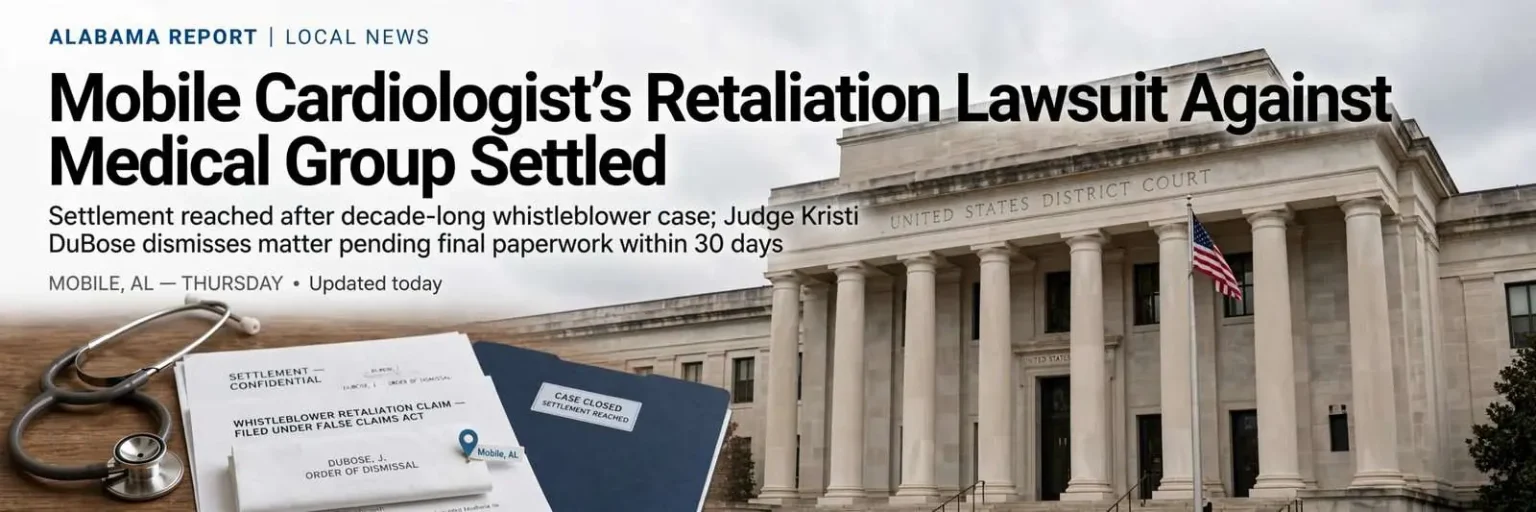
A long-running legal dispute between a Mobile cardiologist and his former medical group has come to a close, with attorneys announcing Thursday that the two sides had reached a settlement in a retaliation lawsuit tied to a broader Medicare and Medicaid fraud case. U.S. District Judge Kristi DuBose dismissed the case shortly after the settlement was announced, though the dismissal is contingent on the parties filing final settlement paperwork within 30 days.
Terms to Remain Sealed
Attorneys representing both the physician, Dr. Christian Heesch, and the defendant, Diagnostic Physicians Group, declined to discuss specifics of the agreement. As is common in these types of settlements, confidentiality provisions are expected to keep the financial terms private. The case had been scheduled to go to trial this month before the settlement was reached, sparing both sides a public proceeding that would have put the dispute’s details before a jury.
The negotiated end avoids years of further appeals that could have followed a trial verdict in either direction. Retaliation cases under federal whistleblower law often hinge on intricate questions about causation — whether an employer’s decision to terminate was truly connected to an employee’s fraud complaints — and juries have leeway in assigning damages. A confidential settlement resolves both the liability question and the money question in a single stroke, which is why the vast majority of such suits end this way rather than in a courtroom.
Origins in a Whistleblower Suit
The dispute traces back to 2011, when Heesch filed suit under a federal whistleblower statute that allows private citizens to bring fraud claims on behalf of the government in exchange for a share of any money recovered. Heesch alleged that Diagnostic Physicians Group had improperly compensated physicians based on the volume of tests they ordered through Infirmary Health Inc., an arrangement he argued ran afoul of federal anti-kickback rules.
That mechanism, known as a qui tam action, is one of the federal government’s most powerful tools against healthcare fraud. Under the False Claims Act, a private whistleblower — formally called a relator — files a complaint under seal while the Justice Department investigates. The government can then intervene and take over the case, or decline and leave the relator to pursue it. Relators who bring successful claims receive a percentage of the recovery, an incentive structure designed to reach fraud that would otherwise stay hidden inside private medical practices and hospital systems.
The federal government later joined the case, pursuing claims under the False Claims Act as well as the Stark Law, which restricts physician referrals tied to financial relationships. Together, the two statutes form the backbone of federal enforcement against financial arrangements in medicine: the Anti-Kickback Statute criminalizes paying for referrals, while the Stark Law prohibits physicians from referring Medicare patients for services in which they have a financial interest.
The $24.5 Million Resolution
Infirmary Health, along with two affiliated clinics and Diagnostic Physicians Group, agreed in July to pay $24.5 million to resolve those fraud allegations. The settlement was among the more significant healthcare fraud recoveries connected to south Alabama, resolving claims that the compensation arrangements had tainted claims submitted to Medicare and Medicaid over a period of years.
As the whistleblower who brought the case forward, Heesch was entitled to roughly $4.41 million of that settlement. The relator’s share is set by statute and depends on factors including whether the government intervenes and the relator’s contribution to the case, and the substantial recovery reflected the fact that his complaint initiated the enforcement action from the inside.
The Retaliation Claim
What remained unresolved after that July settlement was Heesch’s separate retaliation claim. He argued that after eight years working as a cardiologist for the group, he was terminated in 2011 in direct response to his internal questions and documentation of the compensation arrangement — raising concerns within the practice before ever taking them to court.
The Anti-Kickback Statute and the False Claims Act both contain anti-retaliation provisions for exactly this situation, protecting employees who report conduct they believe violates those laws. A retaliation claim requires the employee to show they engaged in protected activity, that the employer knew about it, and that the termination followed because of it — a chain of proof that often turns on timing, internal emails and the employer’s stated reasons for the dismissal.
Because Heesch had first raised questions internally, his retaliation case presented that classic pattern: an employee who worked at the practice for years, flagged the testing compensation arrangements to his superiors, and then lost his position in the same year the whistleblower suit was filed. The defendants, for their part, would have contested any causal connection, arguing the employment decision was made for independent business reasons.
Judge DuBose’s Courtroom Finale
The settlement’s announcement brought the case before U.S. District Judge Kristi DuBose for dismissal, closing a file that had spanned years of litigation. The conditional dismissal — contingent on final settlement paperwork being filed within 30 days — is a standard procedural device that keeps the court’s jurisdiction alive until the agreement is fully executed, protecting both parties while the formal documents are finalized.
With the financial terms sealed, the public record of the case will end with the government’s July recovery and the fact of a negotiated resolution. Neither the medical group nor the cardiologist emerges with a public accounting of the retaliation allegations themselves, the trade-off inherent in confidential settlements of employment disputes.
What the Case Illustrates About Healthcare Fraud Enforcement
The case is a study in how the modern healthcare fraud enforcement system actually works. A physician inside a private practice noticed a compensation structure he believed crossed legal lines; federal law gave him a mechanism and a financial incentive to act; the Justice Department joined and extracted a $24.5 million resolution from the health system and the groups involved; and the whistleblower received a statutory share. Every element of that sequence was designed by Congress to encourage insiders to surface arrangements that auditors rarely see.
For the medical community in Mobile, the resolution was a reminder that referral-based compensation arrangements carry federal exposure that extends beyond the hospital to affiliated clinics and physician groups. Compliance programs, documentation and independent review of physician compensation formulas exist precisely to prevent the pattern alleged in this case, and enforcement actions like this one tend to prompt quiet reviews of similar arrangements across a region’s health systems.
The anti-retaliation protections also carry a message for medical professionals who see questionable arrangements: the law shields those who report in good faith, and the courts take seriously the claim that an employee cannot be fired for triggering a fraud investigation. Heesch’s case, whatever its confidential terms, validated the framework — the whistleblower acted, the government recovered, and the retaliation claim was resolved on the courthouse steps rather than buried.
The Long Timeline of Fraud Litigation
From the 2011 whistleblower filing to the final settlement announcement, the case ran the length of a decade, a span typical of healthcare fraud litigation. Qui tam complaints begin under seal, giving the Justice Department time to investigate without alerting the defendants, and government investigations of complex medical billing arrangements routinely take years. Once claims proceed, defendants fight aggressively, because recoveries of this size carry reputational and financial consequences that far exceed the settlement check.
The July resolution with Infirmary Health, its two affiliated clinics and Diagnostic Physicians Group accounted for the fraud claims, but Heesch’s retaliation suit continued for months afterward, reaching the eve of trial before Thursday’s agreement ended it. For the parties, the final settlement closes litigation that outlasted the employment at its center by many years.
Infirmary Health’s Role in the Region
Infirmary Health stands as one of the largest healthcare systems in south Alabama, operating hospitals, outpatient clinics and physician practices across the region and serving as one of Mobile’s largest employers. Its involvement in the federal settlement — alongside affiliated clinics and the physician group — reflected the reach of the alleged arrangements through a network of related entities, and the system resolved the claims without admitting the findings of a trial.
Large health systems navigate a dense web of federal healthcare law: the False Claims Act, the Anti-Kickback Statute, the Stark Law and their state counterparts. Compensation formulas for physicians who order tests, refer patients or implant devices are reviewed against those statutes because financial incentives tied to referral volume sit at the core of what the laws prohibit. Settlements like this one, resolved for $24.5 million, are the enforcement mechanism that keeps that review honest.
The Whistleblower’s Share and Its Logic
Heesch’s $4.41 million share — roughly 18 percent of the total recovery — illustrates how the qui tam system divides a settlement between the government and the relator. The percentages are set by statute and vary with circumstances such as whether the government intervened and the relator’s role in advancing the case. Congress designed the financial reward deliberately: fraud in medicine is discovered from within far more often than from outside, and without a meaningful incentive, insiders rarely take the professional and personal risk of coming forward.
The retaliation provisions complete that design. A whistleblower who fears losing a career has little reason to report even clear violations, so the law gives the reporting employee a separate claim against an employer who fires them for it. Heesch’s case exercised both halves of the framework — the fraud claim that produced the government’s recovery and the retaliation claim that ended in Thursday’s confidential settlement — making it a full-length demonstration of how the system is built to work.
Closing the File
Judge DuBose’s dismissal, contingent on the parties filing their final settlement papers within 30 days, will formally end one of the region’s longest-running healthcare disputes. The public will know the government’s recovery, the relator’s share and the fact of a settlement; the confidential terms of the retaliation resolution will remain with the parties. What the record shows, though, is a case that ran from a cardiologist’s internal questions in 2011 to a $24.5 million federal recovery and a settled retaliation claim — the full arc of a whistleblower’s decade.