Murphy High School Repairs Advance With $9.7 Million in New Construction Bids
The Mobile County school board has approved $9.7 million in construction bids for Murphy High School renovations, continuing repairs from the 2012 tornado.
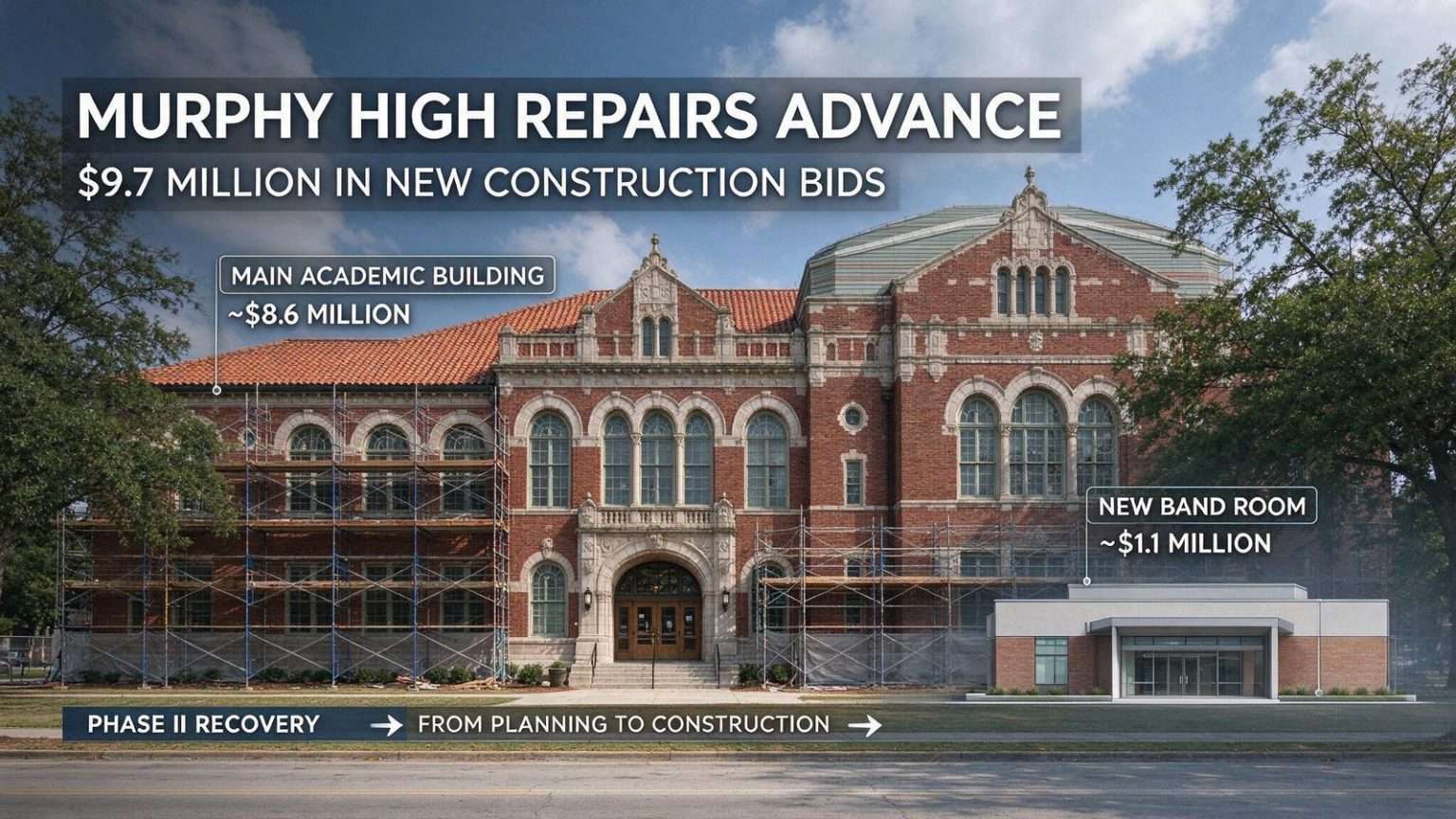
The Mobile County school board has taken a major step forward in the long-running effort to restore Murphy High School, approving nearly $9.7 million in construction contracts for two separate projects at the historic Midtown campus. Board members signed off on the bids during a Monday meeting, awarding the larger contract, worth roughly $8.6 million, to Rod Cooke Construction for renovation of Murphy’s main academic building.
A second contract worth about $1.1 million went to Youngblood-Barrett Construction & Engineering to build a new band room for the school’s music program. Together, the two awards moved the district’s recovery work at Murphy from planning documents into active construction, more than two years after the Christmas Day storm that damaged the campus.
Murphy is one of the largest and most storied high schools in Alabama. Opened in the 1920s on a sprawling Midtown campus, it carries the architectural weight of the era — masonry buildings, a landmark auditorium, terra cotta detailing — and a century of alumni across Mobile. Restoring it has been as much a preservation project as a construction one, because the campus is a fixture of the neighborhood as much as a school plant.
The contracts and their timelines
According to Tommy Sheffield, the school system’s executive facilities manager, work on the main building renovation will not begin immediately. Contractors still need roughly six to eight weeks to secure the necessary permits before construction can start. In the meantime, students attending classes in the main building are expected to be relocated to portable classrooms within the next couple of weeks, well ahead of when heavy construction begins.
Once underway, the main building renovation is expected to take about 18 months to finish. Sheffield noted that the extended timeline partly reflects an effort to minimize disruptions to the school day, since crews will need to work around students and staff still using the campus. An occupied campus changes how construction happens: deliveries, noise, staging areas and demolition all have to be sequenced around bells and bus schedules, which stretches a job that an empty site could absorb more quickly.
The new band room project is on a somewhat faster track, with construction expected to start later in the fall and take between nine and twelve months to complete. The band program has been displaced since the tornado, and a purpose-built room restores one of the school’s signature programs to its home campus rather than whatever temporary space it has been making do with.
Phase II of the storm recovery
Both projects fall under what the school system refers to as its “Phase II” repairs, the next stage of rebuilding following the EF-1 tornado that tore through the Midtown area on December 25, 2012, and left extensive damage across the historic Murphy campus. The Christmas Day storm was an extraordinary event — a tornado touching down in Mobile on a holiday afternoon — and it hit a campus full of buildings designed decades before modern wind codes.
The damage scattered the school across the district for months. Classes resumed in portable buildings and shared space at other campuses while the district assessed what could be repaired and what had to be rebuilt. Phase I addressed the most urgent work — making buildings weather-tight, restoring utilities, getting students back on campus. Phase II is the slower, more expensive stage: full renovations of the buildings themselves, done to modern code inside historic walls.
Sheffield said the broader restoration effort at Murphy is expected to continue for at least three more years. Next up on the list are the Lois Jean Delaney Auditorium and the school’s fine arts building, both of which are moving into the design phase. The auditorium’s exterior has already been patched, but the interior presents a far bigger challenge. The storm damaged the roof structure and the plaster ceiling, and any renovation will require installing new sprinkler systems along with updates to the restrooms and stage area to meet current building codes, including accessibility requirements for individuals with disabilities.
The auditorium is the campus’s ceremonial heart — the room where generations of Mobile students graduated and performed — and its restoration is the most visible measure of whether the recovery is succeeding. Bringing a 1920s auditorium up to current life-safety and accessibility standards means sprinkler piping above a damaged plaster ceiling, accessible seating and restrooms where none existed, and stage rigging and electrical service updated to modern standards, all without stripping out the fabric that makes the room worth saving.
Sheffield explained that some older features may be allowed to remain under grandfather provisions in the code, but others will need to be brought up to modern standards. He said the district is trying to balance those requirements with the need to preserve the auditorium’s historic character while staying within budget. That balance — code compliance against historic fabric, both against a finite appropriation — is the central negotiation of every phase of the Murphy work.
The money
Funding for the ongoing repairs is expected to remain in place through 2016, following a $15 million appropriation approved by the Alabama legislature in May 2013. The state money supplemented the district’s own recovery spending and insurance proceeds, and it came with the political weight of Mobile County’s legislative delegation pushing for a campus that is, by any measure, one of the state’s significant public buildings.
The appropriation’s May 2013 timing mattered: it arrived as the district was deciding what Phase II could include, and it effectively set the ceiling for how far the restoration could go. Multi-year projects like Murphy’s live on a funding calendar as much as a construction calendar; work that outruns the money waits, and money that outruns the work gets redirected.
Theft from a construction site
The restoration hasn’t been without setbacks. In the weeks immediately after the tornado, the campus became a target for scavengers who made off with a number of distinctive terra cotta roof tiles from the damaged buildings. More recently, around 20 copper downspouts, each valued between $500 and $1,000, were reported stolen from the site.
The thefts hit the project twice. The terra cotta tiles are not stock items; matching historic architectural terra cotta means either finding salvage from the era or ordering custom reproductions, either of which costs far more than the original material. The copper downspouts were taken for scrap value, worth a fraction at a recycling yard of the hundreds of dollars each one costs to replace — and replacement means fabricating pieces consistent with the historic detailing of the buildings.
Sheffield expressed frustration over the thefts, noting that restoring the building to meet historic preservation standards is costly enough without added losses from theft. He said the district plans to continue the repairs while working to keep a closer watch over materials and equipment at the construction site going forward. Site security for a damaged school campus is a hard problem: the buildings are exposed, the grounds are large, and the neighborhood surrounds the site on all sides.
What the projects mean for the school
For the students and staff who have spent two years working around the storm’s aftermath, the contract awards mark the point where the recovery becomes visible again. Portable classrooms on a historic campus are a daily reminder of what the tornado did; scaffolding on the main academic building, once the renovation starts, will be the daily reminder that the campus is coming back.
The 18-month renovation of the main building, running concurrently with the band room work, will keep the school operating as a construction site into the following school years, with classes in portables and the campus schedule built around phases of work. The alternative — closing the campus and rebuilding it empty — was never considered, because Murphy’s enrollment and Midtown’s stability both depend on the school functioning.
The band room, at nine to twelve months, should be the first of the new work delivered, giving the music program a permanent home and giving the district an early, completed proof of the Phase II plan. The auditorium and fine arts building follow in design, with construction to come as the funding calendar allows through 2016.
The school board’s nearly $9.7 million in awards also represent a commitment beyond Murphy itself. A restored Murphy anchors Midtown: home values, neighborhood investment and the city’s sense of its historic core all track with what happens on the campus. That is why the Christmas 2012 tornado’s damage to the school registered far beyond the school system, and why the state legislature’s $15 million appropriation passed with broad local support.
The work ahead remains long — at least three more years of restoration, a full design and construction cycle for the auditorium, and a campus that will be under construction well into the future. But with the two largest Phase II contracts signed and permits moving, the Murphy recovery has crossed from assessment and planning into the rebuilding that the Midtown community has been waiting for since the night after Christmas 2012.