University of South Alabama Bayou La Batre
West Mobile Principal Enters School Board Race, Pledging to Give His Salary Away
Hutchens Elementary principal William Foster confirmed a run for the Mobile County school board's District 5 seat, saying he would turn his board salary into scholarships and field trip money for students.
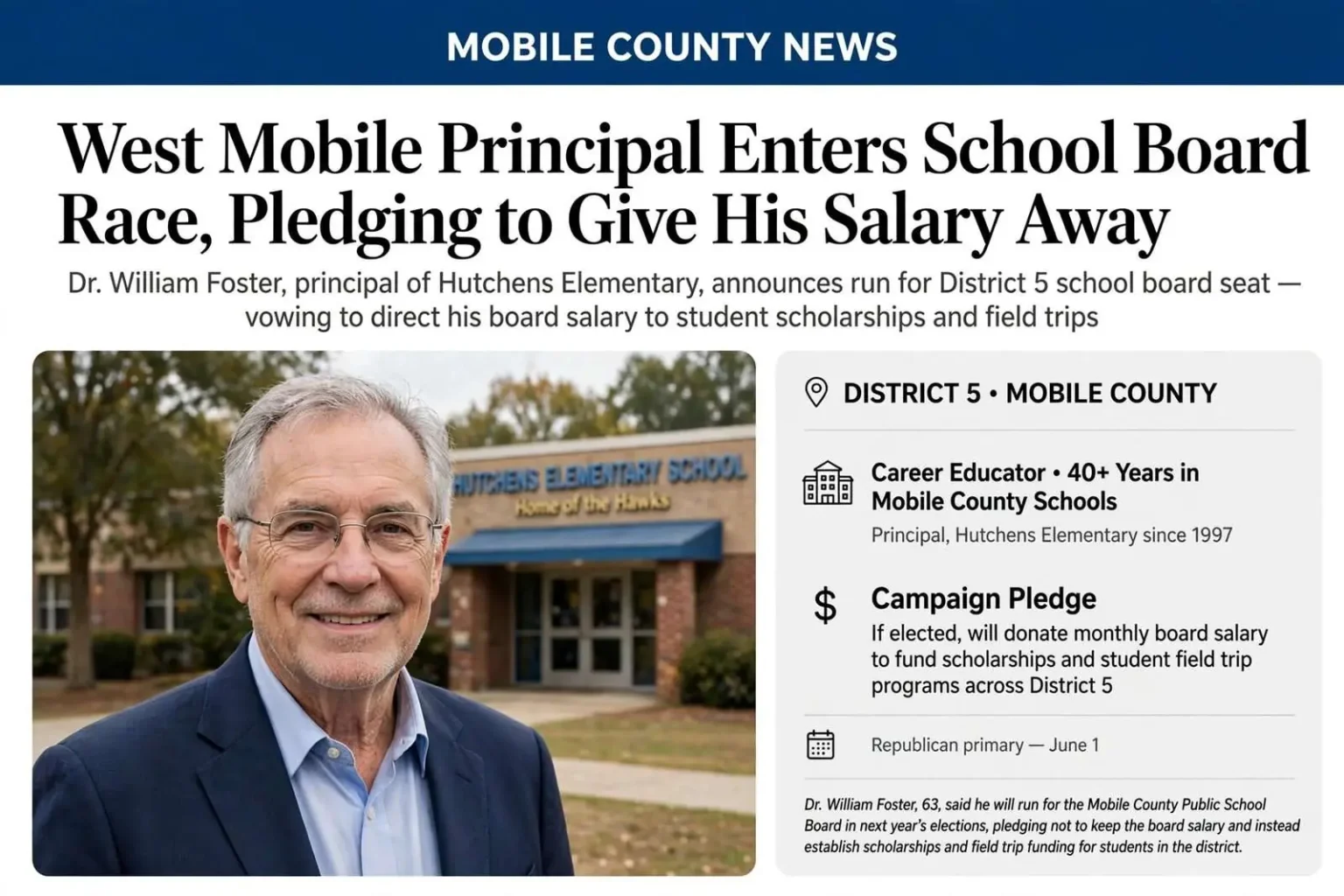
Dr. William Foster, the principal of Hutchens Elementary School in west Mobile, confirmed this week that he will run for the Mobile County Public School Board in next year’s elections, entering the contest for the District 5 seat with a promise that drew immediate attention: he does not intend to keep the pay.
Foster, 63, said he would run as a Republican in the June 1 primary. The District 5 seat, which takes in much of south and west Mobile County, is held by school board President William S. Meredith, also a Republican. Meredith had not formally declared for a second six-year term, though he had repeatedly spoken of “unfinished business” when asked about his plans.
A contested Republican primary in a district that spans some of the county’s fastest-growing suburbs would put two of the area’s best-known education figures on the same ballot — a veteran board president weighing a third term against a four-decade schoolman making his first run for elected office.
A career in the system he wants to govern
Foster began his career in the Mobile County Public School System in 1972 and has spent more than four decades in education. He came out of retirement in 1997 to open Hutchens Elementary, then a new school of roughly 400 pupils, and said he plans to retire a second time at the end of the current school year.
“The reason I’m running is I think it would be beneficial to have someone on the board who is as thoroughly familiar with the school system as I am,” Foster said. “I understand what’s needed relative to the local school children, the teachers and the administrators of the local schools. I’ve been very immersed in this system. I’ve seen it in good times and bad times. I have been here when we have lost teachers. I’ve seen tough times. I realize we have tough times ahead of us.”
Tough times were not a rhetorical flourish. The 2009-10 school year had arrived in the middle of a recession that had forced proration of Alabama’s education budget, and districts across the state were cutting positions and deferring maintenance. Mobile County, the largest school system in Alabama, felt every percentage point.
Proration — the state’s mechanism for cutting already-appropriated school funding mid-year when tax collections fall short — has been a recurring wound for Alabama districts, and no system absorbs it more deeply than Mobile County’s, with its roughly 60,000 students and its payroll of thousands of teachers. Each round of cuts forces choices between classroom positions, transportation, supplies and deferred building repair.
Foster’s pitch to District 5 voters is precisely that lived experience: a candidate who has signed the payroll, opened a new school, absorbed budget cuts and hired through the same personnel system the board oversees.
His confidence in his school is unreserved. “I will match the top 25 percent of our students against the top 25 percent of any private or parochial school anywhere,” Foster wrote on the Hutchens website.
The boast is pointed in a district where private and parochial schools — UMS-Wright, McGill-Toolen, St. Luke’s and others — have long competed with the public system for Mobile families. Foster’s argument is that a public school serving a west Mobile attendance zone can hold its own against any private campus when measured student for student at the top of the class.
The salary pledge
Foster said that if elected he would convert his board salary into scholarships and field trip funds for students in the district.
“It has occurred to me over the years what the meaning of service is,” he said. “The salary is not that much, but I’m not inclined to keep it. I intend to establish scholarships from that salary for students in this district so that students who may need those scholarships can have an opportunity to go to college.”
He estimated that after minor expenses he would have roughly $600 a month to devote to the fund. “I’ve already been paid to be a principal, so I don’t intend to double-dip,” he said. “I’m not in it for the money. It has to do with a commitment to the students, the teachers and the community. I’ve derived significant benefits from having those people in my life. This is an opportunity to give back.”
The pledge is the kind of campaign promise that is easy to say and harder to administer, and Foster has sketched its mechanics himself: a monthly stream of roughly $600, converted into scholarships for college-bound students and field trip money for campuses across the district. Over a six-year board term, that would amount to several tens of thousands of dollars redirected from his own pay into student opportunities.
Foster also said he would not play favorites among the schools in the district, a standing complaint in a county whose schools range from prosperous suburban campuses to struggling inner-city ones.
That equity pledge speaks to a familiar tension on the Mobile County board, where nine districts cover everything from affluent west Mobile subdivisions to neighborhoods in the city’s core where school buildings are older and family needs are heavier. Board members have historically been accused — fairly or not — of steering resources toward their own districts, and Foster is promising the opposite.
Keeping the campaign out of the school
Because he would be a sitting principal through the primary, Foster said he would build what he called an inviolable wall between his duties at Hutchens and his political activity, confining all campaigning to evenings and weekends.
The arrangement matters in a system of the county’s size. A principal who campaigns during school hours, or who leans on staff and parents at his own campus, would create exactly the kind of conflict the school board exists to police. Foster’s pledge to wall the two roles apart — and to leave his Hutchens post at the school year’s end — is designed to answer that question before opponents raise it.
Bayou La Batre roots
Foster was born and raised in Bayou La Batre, where his father worked as a shrimper. He attended St. Margaret’s in the Bayou and McGill Institute in Mobile, studied at St. Bernard College in Cullman, earned a master’s degree at the University of South Alabama and a doctorate at the University of Alabama.
His biography traces a path familiar to generations of south Alabamians: a seafood-town childhood on the Alabama Gulf Coast, parochial schooling in Mobile, then a climb through Alabama’s colleges that ended with a doctorate and a career running schools in the same county where he started as a shrimper’s son.
Bayou La Batre itself — the small fishing village on the western edge of Mobile County celebrated in “Forrest Gump” and repeatedly tested by hurricanes — sits inside the county school system Foster now hopes to help govern, giving his story a full-circle quality that voters in south Mobile County will recognize.
He lives in Mobile with his wife, the former Laura Cammack, herself a former principal at Hamilton Elementary School, to whom he has been married nearly 40 years. Their children, Leslie Gaston and Chuck Foster, attended Mobile public schools, as do the Fosters’ grandchildren.
Three generations of Fosters moving through the same public school system — as student, teacher, principal, parent and now grandparent — is the underlying claim of his candidacy: that he knows the system not as an outsider studying it but as a family that has lived inside it for decades.
Asked why he had returned to work after his first retirement, Foster gave an answer that had little to do with policy. “I really missed being around children,” he said. “I still enjoy that most about the job, associating with kids. I still enjoy it even now that I’m in my early-, mid-60s. It’s a little more tiring.”
That answer — affection for children rather than ambition for office — is the note he has struck in explaining the run. A man who twice chose the schoolhouse over retirement is now proposing to spend the last years of a long education career on the board that sets policy for the system that shaped him, at a salary he says he will not keep.
Whether the June 1 primary draws additional Republican contenders remains to be seen, but Foster’s early entry gives him months to build name recognition beyond the Hutchens campus and the west Mobile neighborhoods where his school sits — time a first-time candidate rarely gets against an incumbent president.
The June 1 primary will decide whether that pitch wins over Republican voters in a district stretching from west Mobile’s suburbs deep into the county’s southern reaches — and whether the board’s next president-seat holder is the man who has held it for six years or the Hutchens principal who wants to hand his paycheck to the students.