The Gonzo Journalist Who Wrote a Book in a Mobile Apartment
After Hunter S. Thompson's death in February 2005, Mobile friends recalled the months the gonzo journalist spent writing a book in a borrowed apartment on Government Street.
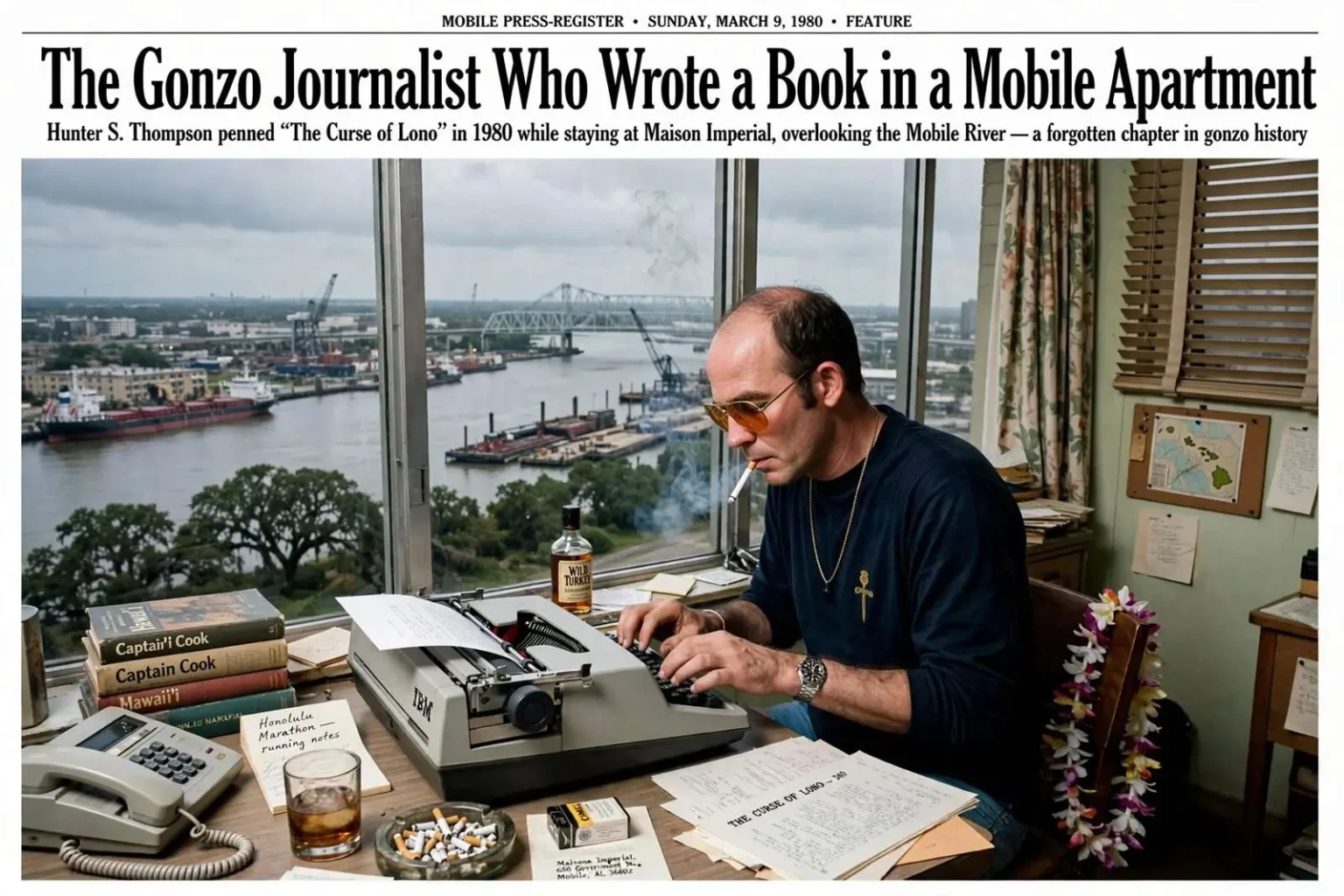
MOBILE — Hunter S. Thompson, the writer who invented gonzo journalism and spent a career blurring the line between reporter and subject, died by suicide at his Colorado home on Sunday, Feb. 20, 2005, according to authorities and a statement released by his family. He was 67.
What most of his readers never knew — and what struck even devoted admirers as improbable — is that one of his books was written in Mobile. Around 1980, Thompson spent two or three months in the Maison Imperial apartment of Pierre Pelham, a Mobile attorney and former state legislator, and Pelham’s wife, Eva, while the couple wintered at Spanish Wells in the Bahamas. Thompson stayed with his girlfriend Laila, who remained a close friend and confidante for the rest of his life, and used the borrowed rooms to get The Curse of Lono down on paper — a lesser-known work than Fear and Loathing in Las Vegas, Hell’s Angels, Fear and Loathing on the Campaign Trail ’72 or The Great Shark Hunt, but a book with a genuine Mobile provenance nonetheless.
A friendship forged across borders
Other than that stay, Pelham said, Thompson never came back to Mobile. “He was life magnified,” Pelham said. Pelham and Thompson had been close friends, though they had not spoken much in recent years. Each had tried to reach the other by telephone in recent months, Pelham said, without ever connecting. News of the death left him with “a terribly empty feeling.”
“Hunter was an eminently decent guy,” Pelham said. “We spent a lot of time together from the Florida Keys to the Canadian border.” He added, dryly: “He damn near got us arrested by Canadian Customs.” The two had been driving back from a prizefight in Montreal when border police began randomly searching vehicles; Thompson’s restless hopping around in the back seat caught their eye. He was, Pelham said, a master at concealment. They crossed without incident.
Pelham’s son, Marc, then marketing director for the Mobile Airport Authority, also became a friend of the writer and spent time at Owl Farm, Thompson’s Woody Creek, Colorado compound. The younger Pelham recalled Thompson as a generous host who would cook breakfast for guests at dawn after late nights of conversation and drinking, a ritual that bewildered visitors expecting the cartoon version of gonzo excess.
The Curse of Lono and its Mobile origins
The Curse of Lono, published in 1983, emerged from Thompson’s assignment to cover the 1980 Honolulu Marathon for Running magazine. The piece sprawled into a book-length meditation on Hawaii, Captain Cook, and the author’s own mythologizing, illustrated by Ralph Steadman’s distinctive ink-splatter drawings. That the manuscript took shape in a Mobile apartment on Government Street adds an unlikely geographical footnote to a work steeped in Pacific island lore.
Maison Imperial, the building at 650 Government Street where Pelham kept his apartment, was one of Mobile’s early mid-rise residential towers, completed in the 1960s. Its units overlooked the Mobile River and the working waterfront, a view that would have placed Thompson within sight of the channel where tankers and barges still queue for the turning basin. The building’s name, a nod to imperial aspirations, would not have been lost on a writer who made a career of puncturing American self-mythology.
Thompson’s Mobile sojourn came at a pivotal moment in his career. By 1980, the gonzo heyday of the early 1970s had passed. Fear and Loathing in Las Vegas (1971) and Fear and Loathing on the Campaign Trail ’72 (1973) had cemented his reputation, but the Rolling Stone assignments that fueled his visibility were drying up. The Curse of Lono received mixed reviews on publication, with some critics dismissing it as self-parody. In retrospect, the book reads as a transitional work — Thompson grappling with the limits of the persona he had created.
Pierre Pelham: Mobile lawyer, legislator, friend
Pierre Pelham, who died in 2006 at age 86, was a fixture of Mobile’s mid-century political and legal establishment. A graduate of the University of Alabama School of Law, he served in the Alabama House of Representatives from 1954 to 1958 and in the State Senate from 1958 to 1966, representing Mobile County during a period of profound social change. He was known as a moderate voice on race relations during the civil rights era, advocating for peaceful compliance with federal court orders at a time when massive resistance dominated Alabama politics.
Pelham’s friendship with Thompson began in the 1960s, when both men moved in overlapping circles that included writers, politicians, and the kind of boundary-pushing characters who gravitated toward each other across the South’s cultural fault lines. Thompson, who attended but did not graduate from Florida State University before his Air Force service and subsequent newspaper career, found in Pelham a Southerner who defied easy categorization — educated, traveled, and unbothered by convention.
A Southern literary footnote
Mobile has long occupied a peculiar place in Southern literary geography. The port city produced or attracted writers including Eugene Walter, whose flamboyant presence in Mobile and Rome, Italy, made him a kind of American expatriate before the term applied; Albert Murray, the critic and novelist who graduated from Mobile County Training School and Tuskegee Institute before shaping postwar African American letters; and Winston Groom, whose Forrest Gump began as a Mobile story before becoming a global phenomenon. Thompson’s brief residency adds a gonzo gloss to this lineage — the only major American writer to compose a book in a borrowed Mobile apartment while his friend wintered in the Bahamas.
The Maison Imperial apartment itself no longer exists as Pelham knew it. The building was converted to condominiums in the early 2000s, part of the downtown residential wave that saw Mobile’s historic core repopulated after decades of suburban flight. Unit 1402, where Thompson typed on a rented IBM Selectric, now bears no plaque, no marker. The view across the river remains: the Alabama State Docks, the Cochrane-Africatown USA Bridge, the delta’s green fringe where the Mobile and Tensaw rivers braid before meeting the bay.
Laila, the girlfriend who accompanied Thompson to Mobile, remained a presence in his life long after the Mobile months ended. She was among the small circle at Owl Farm in the final years, when Thompson’s health declined and the public appearances grew rarer. Pelham, in his later interviews, spoke of her with the same respect he afforded Thompson — a loyalty that survived the chaos.
The view from Government Street
Thompson’s Mobile stay coincided with a quiet period in the city’s modern history. The 1980 census recorded a population of 200,452, a slight decline from the 1970 peak. The downtown commercial district was hollowing out; Springdale Mall and Bel Air Mall had siphoned retail from Dauphin and Royal streets. The Mobile Area Chamber of Commerce was beginning to tout “quality of life” metrics to attract industry, a phrase that would define the city’s economic development language for decades.
For Thompson, Mobile was a way station, not a destination. He wrote in a 1981 letter to a friend that the city struck him as “a place where time pools rather than flows,” a line that echoes the gothic sensibility of native writers like Walter and Murray. He left when the Pelhams returned from Spanish Wells, and by his own account never revisited. The Curse of Lono bears no dedication to Mobile, no acknowledgment of the Government Street apartment. The connection survives only in Pelham’s recollections and in the unlikely fact that a book about Hawaii was born on the Mobile River.
When Thompson died in 2005, the obituaries mentioned Aspen, Woody Creek, San Francisco, Big Sur. None mentioned Mobile. Pierre Pelham, reading the coverage from his law office on Dauphin Street, recognized the omission. He called a reporter. “They forgot the part about the apartment,” he said. “But then, Hunter always did prefer the legend to the address.”
The gonzo method in a Southern port
Thompson’s approach to journalism — the immersion, the subjective lens, the refusal of objectivity as a shield — found an unlikely laboratory in Mobile. The city’s layered history, its French, Spanish, British, and American colonial strata, its Creole and Cajun and African American neighborhoods, its shipyard unions and country club conservatives, offered the kind of cultural density that gonzo journalism feeds on. Thompson, who had covered the Hell’s Angels in Oakland and the 1972 campaign across the national map, understood that every place contains its own absurdities if you stay long enough to watch them surface.
In Mobile, those absurdities included a Mardi Gras tradition older than New Orleans’, with mystic societies that traced their charters to the 1830s and maintained debutante presentations alongside parades that shut down downtown for weeks. They included a political machine that had governed through patronage and paternalism since Reconstruction, and a business elite that managed the transition from cotton to chemicals to aerospace with a pragmatism that baffled ideological purists. Thompson, always drawn to power’s theater, would have recognized the players.
The Maison Imperial apartment placed him blocks from the Battle House Hotel, where the city’s power brokers had lunched for generations, and from the federal courthouse on St. Joseph Street, where civil rights cases and environmental suits and organized crime trials moved through dockets that read like Southern Gothic novels. He could walk to the Mobile Press-Register building on Government Street, where the afternoon edition still landed on porches across two counties, and imagine the newsroom rhythms that had shaped a different kind of Southern journalist.
Legacy and the long view
Thompson’s Mobile chapter remains a footnote in a biography crowded with louder episodes. But footnotes matter in literary history — they mark the places where a writer paused, observed, and converted experience into text. The Curse of Lono, whatever its critical reception, stands as the only major American book composed in a Mobile high-rise overlooking a working river port. That fact alone anchors Thompson, however briefly, in the city’s cultural record.
Pelham, who lived to see the downtown renaissance he had advocated as a legislator, never wrote his own account of the friendship. He preferred the role of witness, the man who lent the apartment and watched the writer work. In his later years, when visitors asked about Thompson, Pelham would smile and gesture toward the window, toward the river where the ships still turn. “He wrote about Hawaii right there,” he would say. “Never wrote about us. That was the joke, I suppose. The gonzo journalist came to Mobile and wrote about somewhere else entirely.”
The apartment is gone, the building converted, the view much the same. Mobile continues its slow reinvention — Airbus assembly lines at Brookley Field, a cruise terminal at the former grain elevator site, a medical corridor expanding along Spring Hill Avenue. Thompson’s ghost, if such a thing exists in a city that has hosted everyone from Bernardo de Gálvez to Jimmy Buffett, would probably approve of the chaos. He understood, better than most, that places are not what they claim to be. They are what happens in them while nobody is looking.