Mobile Postpones Dumpster Enclosure Requirement for Businesses
Mobile Mayor Sandy Stimpson says the city will hold off four months on requiring businesses to build enclosures around trash dumpsters citywide.
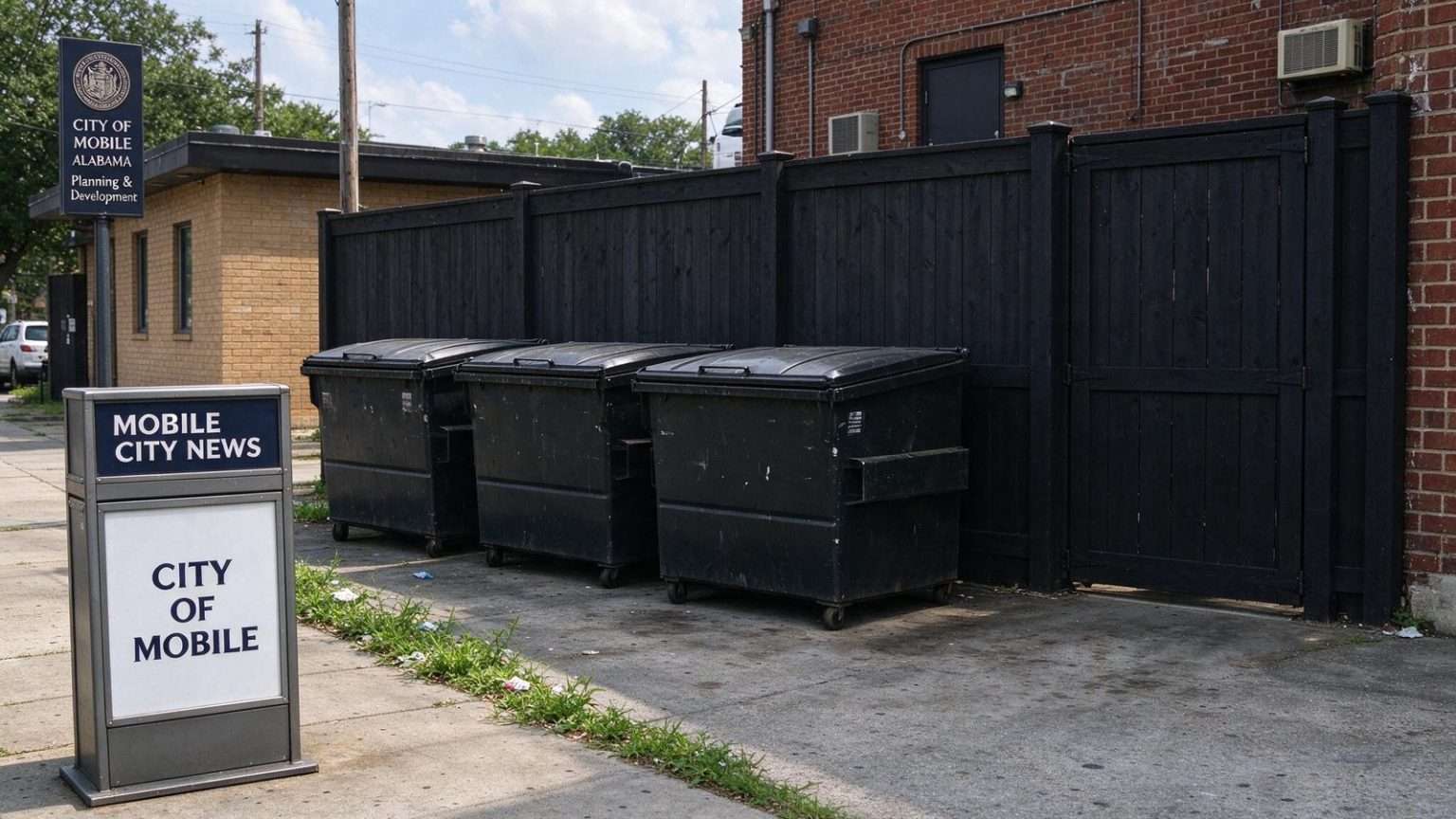
Mobile business owners bracing for a costly new requirement to fence in their dumpsters are getting a reprieve, at least temporarily. Mayor Sandy Stimpson’s administration has pushed back enforcement of a dumpster enclosure mandate by roughly four months while officials study whether the rule is truly necessary.
The delay covers only the enclosure piece of the city’s new litter rules, but for the businesses it affects the pause is material: owners of restaurants, retail shops, and commercial properties across the city had been looking at a construction bill between them and compliance, on a timeline that would have made the expense unavoidable within the year. Instead, the mandate now sits in a review period while the administration tests a proposition that sounds obvious and rarely gets tested — that the litter problem the rule was written to solve might be better addressed by pickup schedules than by construction.
Stimpson addressed the delay during a local radio appearance, saying the city’s priority remains making sure trash gets picked up regularly rather than mandating a specific fix like enclosures.
“The initial idea is what we wanted, a clean city,” Stimpson said, describing the goal as keeping garbage from piling up or scattering around dumpster sites rather than forcing every property owner into new construction.
The mayor’s framing drew a line between ends and means that the enclosure debate had blurred. A clean city — no trash heaped behind shopping centers, no debris blowing from overloaded bins into streets and ditches — was always the ordinance’s stated purpose; the eight-foot enclosure was one engineering answer to it. The administration’s review asks whether that answer fits every property, or whether some fraction of the problem can be eliminated by the simpler instrument of a functioning pickup schedule.
Where the Enclosure Rule Came From
The enclosure requirement was originally folded into a broader litter ordinance the Mobile City Council approved earlier in the year, part of a citywide push to crack down on illegal dumping and unsightly trash accumulation. The ordinance bundled several enforcement tools into one package — rules aimed at illegal dumpers, requirements for property owners, and the enclosure mandate that has now become the package’s most controversial piece.
Under the ordinance as first written, businesses and property owners would have been required to build enclosures as tall as eight feet around their dumpsters, with construction costs falling on individual owners. City estimates put the cost of a typical enclosure between $300 and $1,000, depending on size and materials.
Those figures, modest as construction projects go, multiply quickly across a city’s commercial inventory. Mobile’s restaurant strips, shopping centers, churches, day cares, offices, and industrial properties all maintain dumpster service, and each would have faced its own version of the mandate — a masonry or wood screen, a gate, and in many cases the redesign of a service alley or parking layout to fit it. The city’s $300-to-$1,000 estimate covers a straightforward build; corners of the requirement where access, slope, or existing pavement complicated construction would run higher, and none of it was budgeted by the owners it would fall on.
Dianne Irby, the city’s director of Planning and Development, defended the requirement when it was first proposed, arguing it was a one-time expense that would help keep trash contained rather than spilling into streets, parking lots, and drainage areas.
“I don’t want to minimize the hardship to some, but it’s a one-time expense and it does not have to break the bank,” Irby said at the time.
Irby’s defense captured the case that put the mandate in the ordinance in the first place: enclosures work. A screened, gated dumpster corral contains what an open bin scatters — wind, scavenging animals, and overloaded service all produce less litter behind an enclosure than without one — and once built, it performs that function for the life of the property at no further public cost. The administration’s review does not concede that case; it asks whether the same containment can be achieved for less.
The Council’s Skeptics
Not everyone on the council was convinced the enclosure mandate made sense. Some members raised concerns about the added financial burden on small business owners already dealing with other city regulations, questioning whether a fencing requirement was the most effective way to address litter complaints tied to overflowing dumpsters.
That skepticism reflected a constituency calculation as much as a policy one. The mandate’s costs would land hardest on exactly the operators the city least wants to burden — the neighborhood restaurant on a thin margin, the small strip center whose owner maintains it out of its rents, the family business whose alley offers nowhere to build without losing parking. The council members who questioned the rule were representing owners who could afford the $300-to-$1,000 estimate but not the version their particular property would actually cost.
The effectiveness question ran alongside the fairness one. If a dumpster overflows because it is not emptied often enough, an enclosure hides the overflow but does not empty the bin; the litter migrates to whoever’s property adjoins it. Mandating construction before verifying that pickup practices — the hauler’s schedules, the bin sizes, the service frequency written into commercial contracts — are adequate inverts the order of operations, and it was that inversion the review is now designed to check.
What Still Takes Effect Oct. 1
Stepped-up enforcement of the broader litter ordinance, including rules aimed at keeping dumpsters regularly emptied, is still expected to begin Oct. 1. The distinction is the review’s central fact: the city is not pausing its litter enforcement, only its construction mandate. Owners will still be accountable for the condition of their dumpster sites — for bins that overflow, for service that lapses, for the debris that follows — under rules that take effect on schedule.
For most property owners, those operative rules are also the cheaper compliance path. A pickup schedule that matches a business’s actual waste volume costs a fraction of construction, and the enforcement aimed at emptied bins reaches the offenders the enclosure rule was drafted against without taxing the owners whose sites were never the problem.
But the enclosure piece specifically will remain on hold while the administration reviews complaint data and weighs whether regular pickup schedules alone can solve the litter problem without forcing businesses into new construction costs.
City officials said the delay gives the administration time to gather more information on where litter complaints are concentrated and whether enforcement resources would be better spent on dumpster pickup compliance rather than structural requirements. That evidence-gathering is the review’s substance: mapping where the city’s litter complaints actually originate, and checking whether the clusters track unenclosed dumpsters or missed pickups. The two hypotheses lead to different policies, and the four-month runway exists to let the data choose between them.
No new timeline for revisiting the enclosure rule was announced, though officials indicated the issue would return to City Council discussion once the review is complete.
That open-endedness is the piece business owners will watch. The mandate is postponed, not repealed — four months of review followed by a council discussion that could reinstate the requirement, revise it to exempt compliant properties, or shelve it in favor of the pickup-based enforcement that began Oct. 1. What the administration has promised in the meantime is the review itself: complaint data gathered, pickup compliance tested, and the clean city the mayor described pursued by whichever means the evidence supports.
Why the Ordinance Mattered in the First Place
The litter ordinance grew out of a complaint stream that city departments track across every district: illegal dumps in vacant lots and along roadsides, trash scattered from commercial bins, and the drainage problems that follow when debris washes into storm inlets. Mobile’s stormwater system makes litter a public-works issue as much as an appearance issue — material that gets past a dumpster site ends up in ditches, canals, and eventually the bay, where the cost of removal lands on the city rather than on the source.
The enclosure mandate was the ordinance’s most visible piece precisely because it was the one residents could see being built. The rules that take effect Oct. 1 work through inspection and citation; the enclosure rule would have worked through concrete and lumber, changing the look of the commercial alleys behind the city’s businesses one property at a time.
That visibility cut both ways. To supporters, a screened dumpster site was a visible commitment to the clean-city standard, the kind of requirement that makes a corridor’s upkeep obvious to visitors and investors. To the council’s skeptics, it was the ordinance’s one piece that charged the city’s small businesses for a problem many of them did not have — and the four-month review is the administration’s chance to determine which of those readings the data supports.
What Owners Should Watch
For commercial property owners, the practical guidance from the delay is to hold off on enclosure construction and focus on service. The enforcement that begins Oct. 1 will measure outcomes — bins emptied on schedule, sites kept clean — rather than structures, and an owner whose dumpster service is adequate to the business’s volume is already positioned to comply.
Owners whose sites generate recurring complaints are the population the review is most likely to reach, and the cheapest response available now is a conversation with their hauler about bin size and pickup frequency rather than a contractor bid for fencing. If the review ends with the enclosure rule reinstated in some form, the record of compliant service will matter; if it ends with the rule shelved, the money never spent on construction is the win.
The council discussion that follows the review will settle the question publicly, with the administration’s data in hand and a season of enforcement experience behind it. Until then, the mandate is on hold, the clean-city goal is not, and Mobile’s business owners have a four-month window in which the city’s litter policy runs on schedules rather than construction.