Historic Magee Farm Treasures Find New Home in Downtown Mobile Shop
A downtown Mobile antique dealer is selling roughly 1,000 pieces from the historic Magee Farm homestead in Kushla, including a $3,800 painting.
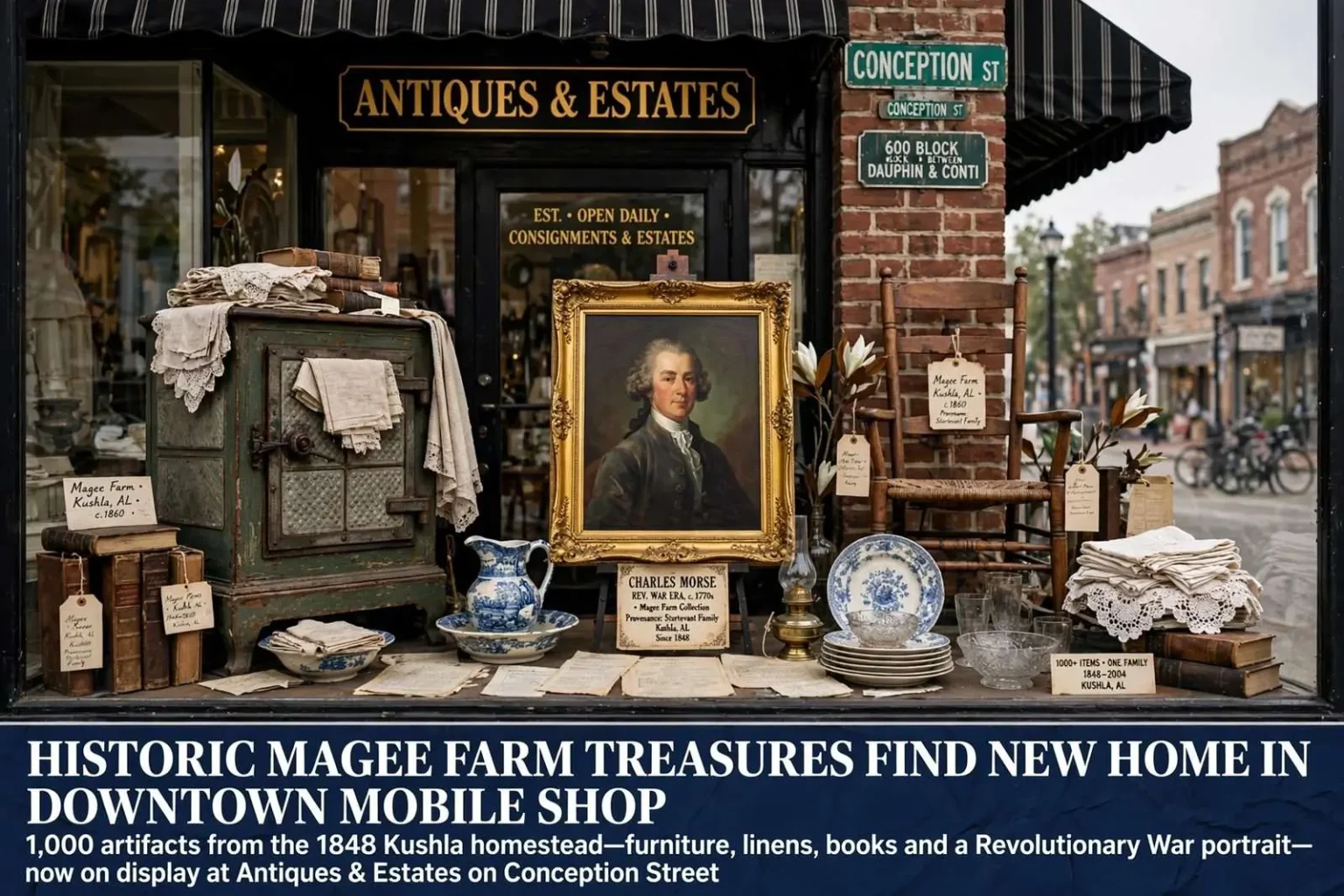
Tucked into a storefront on Conception Street in downtown Mobile, between Dauphin and Conti, a shop called Antiques and Estates has become the temporary resting place for a slice of north Mobile County history. Owner Bill Appling is working through roughly 1,000 items pulled from the historic Magee Farm homestead in Kushla, a project he calls one of the more meaningful undertakings of his career in the antiques business — less a standard inventory of consignments than the dispersal of a household that held together for a century and a half.
The scale alone sets the collection apart. A thousand objects from a single property, most of them acquired by one family over successive generations, represent the kind of documented continuity that dealers rarely encounter; most estates arrive with pieces from a dozen different households and no memory attached to any of them. Here, nearly everything on the shop’s shelves and floors can be traced to one farmhouse and the people who lived in it.
The Creole cottage-style farmhouse sits at the intersection of U.S. 45 and Alabama 158 and has stood since 1848, when it was built by Jacob Magee. The form — a raised cottage with a broad gallery and rooms arranged around a central hallway — is the signature domestic architecture of the Gulf Coast, developed to move air through a house long before electricity and to lift the living floor above the wet ground of a subtropical climate. Examples survive across Mobile’s older districts, but the Kushla farmhouse is among the rural survivors, standing at what was once a quiet crossroads far from the city it supplied.
A century of one family
Ownership passed to the Sturtevant family in 1898, and generations of that family filled the home with furniture, china, artwork and everyday keepsakes that stayed largely untouched for more than a century. Houses that pass through a single family without a clearing-out tend to become time capsules: the parlor furniture stays where the previous generation placed it, the books keep their bookplates, and the linens stay folded in chests exactly as they were put away. Collectors prize such unbroken accumulations precisely because nothing in them was bought for show.
The last surviving member of the family, Margaret Sturtevant, died in 2004 at age 93, closing out a direct family connection to the property that had lasted well over 100 years. Her death marked the end of a line of residence that had begun before the automobile, the rural mail route or electrification reached the Kushla crossroads, and it left the farm’s contents without an heir whose task it would have been to simply keep them.
Saraland veterinarian Ben George purchased the farm in 2005 and spent several years, from 2007 to 2010, operating it as a small history museum open to the public. The experiment fit the property’s significance — the farmhouse had long drawn the attention of local historians — but sustaining a rural museum requires a visitor volume that even significant sites in out-of-the-way locations rarely achieve, particularly when the area’s growth spreads outward from the interstate corridor rather than toward its historic crossroads.
Appling said George eventually decided it was time to part with the collection after the museum concept never quite caught on with visitors the way he had hoped. Rather than run a standard estate sale, George asked Appling to handle the pieces individually, given their historical significance to Mobile County. The distinction matters: an estate sale disperses a house in a weekend, priced for volume, while a dealer working pieces one at a time can match objects to buyers who understand what they are getting — museums, collectors with ties to the area, families researching their own histories in the same county.
The care reflects the collection’s particular value. Objects with a documented chain of ownership back to a specific 19th-century farmhouse carry a provenance that gives them meaning beyond their categories; a pie safe from the Magee farm is not simply a pie safe, but a record of how one Mobile County household ate, stored and lived across six or seven generations. Once scattered without record, that meaning is unrecoverable.
What the collection holds
Among the items now on display are roughly 35 pieces of furniture, boxes of china and glassware, a couple hundred books, and stacks of linens and doilies that Appling says rarely surface in the antiques trade because families tend to hold onto them. Household textiles are among the most fragile links to domestic history — made by hand, used daily, worn out and discarded — so a collection that preserved generations of them intact offers an unusually complete record of ordinary life rather than the parade-room furniture that dominates the market.
Many of the objects date to the Civil War era and belonged directly to the Sturtevants, giving each piece a documented tie back to the farmhouse rather than an anonymous history. For dealers and collectors, the difference between “circa 1860” and “bought by this family in 1860 and never left this house” is the difference between an antique and an artifact, and it is the reason the shop has drawn visitors interested in the story as much as the objects.
The books alone constitute a small library of 19th-century rural Alabama — family Bibles, school texts, agricultural manuals and literature of the sort a literate farm family accumulated over decades. Book collectors search out such volumes for their inscriptions and ownership marks as much as their content, and a library that stayed on one farm’s shelves since the 19th century preserves marginalia and gift inscriptions that map the family’s marriages, friendships and migrations.
The centerpiece of the collection is a Revolutionary War-era oil painting of Charles Morse, the great-grandfather of a Sturtevant ancestor, giving the farmhouse’s contents a documented line back to the founding of the nation itself. A portrait like that, handed down in one family from the 18th century to the 21st, is the sort of object that museum registrars describe as a collection anchor: whatever else the dispersal scatters, the painting’s provenance ties every generation of the family’s story — Revolution, cotton frontier, Civil War, modern Mobile County — into a single record.
The Magee farm’s historical significance extends well beyond its furnishings. The property is remembered in Mobile County history as the setting for events at the close of the Civil War, when commanders met at the Kushla farmhouse in the final days of the conflict to arrange the surrender of Confederate forces in the region — a chapter that has made the plain Creole cottage at the U.S. 45 and Alabama 158 crossroads one of the most historically consequential rural houses in south Alabama.
Collectors who have visited the shop describe the experience as reading someone’s household, not shopping in one. The everyday character of so much of the collection — the workaday furniture, the well-used kitchen pieces, the books with their spines cracked at favorite chapters — offers a plainer picture of 19th and early 20th century life in Mobile County than any furnished museum room, precisely because none of it was ever arranged for public viewing.
Why provenance matters
For historians, the dispersal of a collection like this one cuts both ways. The objects will be preserved — dealers in documented material are meticulous about recording what they sell — but they will be preserved separately, their collective meaning as one household’s record surviving mainly in the shop’s inventory lists and in whatever cataloguing the new owners maintain. Every private collection eventually disperses; the question is whether the paper trail travels with the objects.
Appling’s shop sits in the middle of that process, on a block of Conception Street where the antiques trade has clustered among downtown’s older commercial buildings. Dealers along the corridor handle everything from Gulf Coast estates to imported European pieces, and a walk through their shops amounts to an education in the region’s material culture — but even in that company, a thousand objects from one documented farmhouse occupies rare ground.
The project is also a reminder of how much of Alabama’s material history lives in private hands. The state’s archives preserve its official records, and its museums display its curated highlights, but the furniture, linens, books and portraits of ordinary families — the objects that show how people actually lived — survive in farmhouses, attics and estate inventories, moving into the market only when a family line ends or a property changes hands. Each dispersal is a last chance for the record to be kept.
For now, the Magee Farm collection fills a storefront between Dauphin and Conti, where visitors can see the accumulation of a century and a half laid out piece by piece: the furniture of a rural parlor, the china of a holiday table, the doilies folded by hands three generations gone, and a portrait from the Revolution watching over all of it. Bit by bit, the collection is finding new homes — and carrying the story of the Kushla crossroads with it.