Battleship Memorial Park to Honor Late Senator Jeremiah Denton on His Birthday
Battleship Memorial Park is hosting a celebration of the life of Mobile native and former U.S. Senator Jeremiah Denton on his 90th birthday.
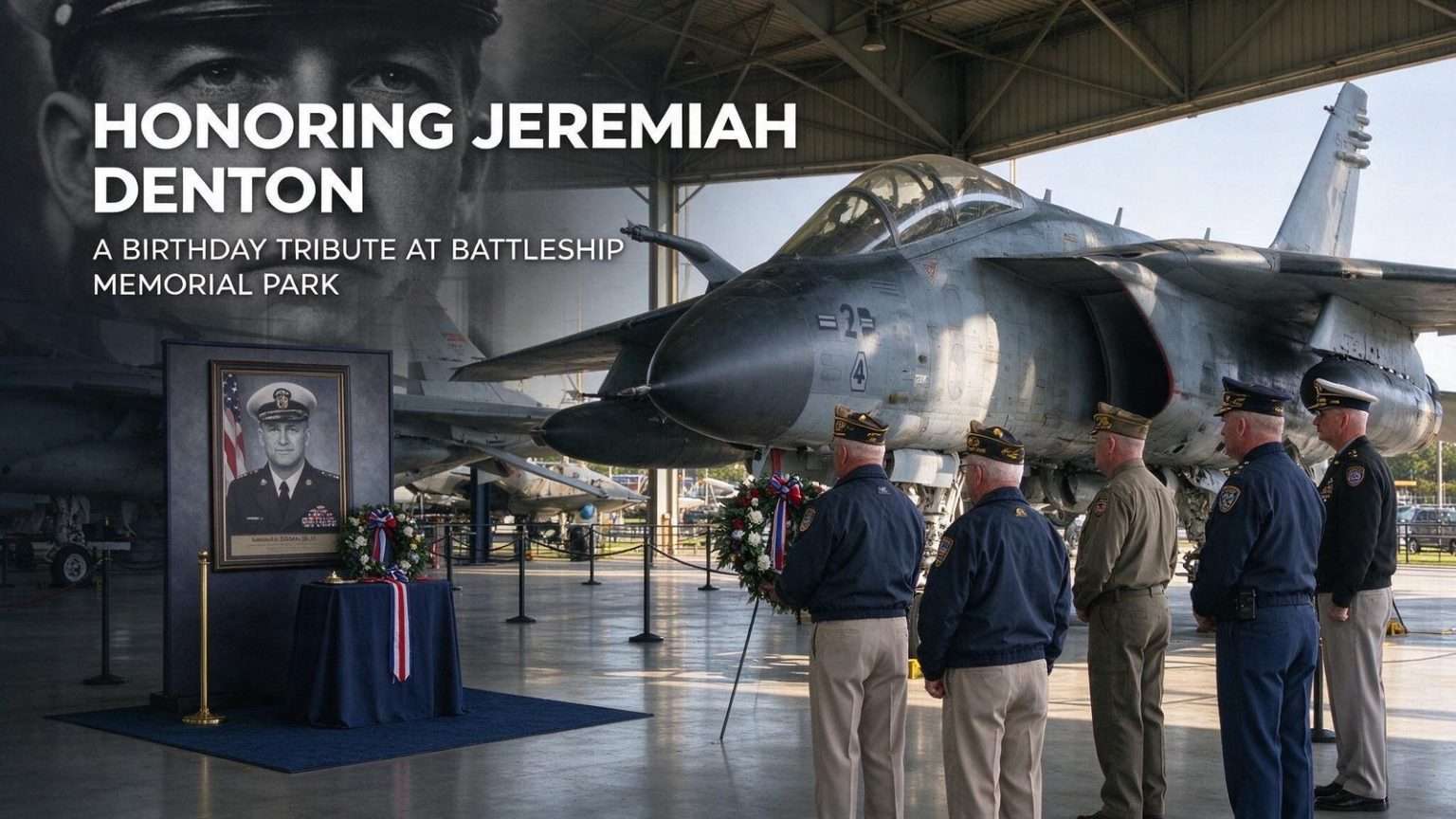
Mobile will honor one of its most celebrated native sons with a birthday tribute at Battleship Memorial Park, marking what would have been the 90th birthday of former U.S. Senator, retired Navy rear admiral and prisoner-of-war Jeremiah A. Denton Jr. The event brings together the park’s military heritage and the story of a man whose life spanned the defining conflicts and political transformations of the second half of the twentieth century.
The celebration is scheduled for mid-morning inside the park’s Aircraft Pavilion, the sprawling exhibit hall that shelters historic aircraft beside the battleship USS Alabama. The Pavilion has hosted ceremonies of this kind before, and its setting — surrounded by the Navy and Air Force aircraft it exists to preserve — gives a tribute to a Naval aviator a particular resonance that a banquet hall could not.
The Battleship Commission, which oversees the memorial park, is also designating the day as an annual Denton Day in honor of the occasion. The designation means the tribute is not a one-time observance but a standing date on the park’s calendar, joining the other commemorations the Commission hosts each year on behalf of Alabama’s most visited military memorial.
Denton, a Mobile native, died earlier this year in Virginia Beach, Virginia. His death at 89 closed a life whose arc — from the streets of Mobile to a North Vietnamese prison cell to the United States Senate — made him one of the most distinctive figures the city has produced. His life story became one of the defining Alabama narratives of the Vietnam War era, retold in classrooms, documentaries, and memorial ceremonies across the state.
Seven years as a prisoner of war
As a Navy commander, Denton was shot down and captured by North Vietnamese forces, spending more than seven and a half years as a prisoner of war. The shoot-down cost him his freedom in the middle of his Navy career, and the years that followed tested him in ways that would define the rest of his life. He and his fellow prisoners endured isolation, interrogation, and torture under a regime that treated captured aviators as propaganda assets rather than prisoners entitled to humane treatment.
During that captivity, he became internationally known for an act of defiance captured on camera in 1966, when his captors forced him to participate in a propaganda film. Rather than cooperate, Denton blinked out the word ‘torture’ in Morse code, signaling to American military intelligence that he and other prisoners were being abused despite the regime’s claims otherwise. The performance, watched by millions who had no idea what the blinking meant, is now regarded as one of the most remarkable acts of resistance of the war — a message sent in plain sight of the enemy and decoded only on the American side.
The Morse code episode became the moment most people associate with Denton’s name, but the prisoners’ resistance ran far deeper than a single televised act. Communication among prisoners, maintained secretly and against rules, sustained morale through years of captivity, and Denton was among those recognized after the war for leadership in those ranks.
After his release, Denton continued his Navy career and eventually retired as a rear admiral. The years of captivity had not ended his advancement, and his postwar service included senior positions that drew on his experience as an aviator and a leader of men under extreme pressure.
From the Navy to the Senate
He went on to make Alabama political history by becoming the first Republican elected to the U.S. Senate from the state since Reconstruction, representing Alabama through the 1980s. The 1980 election that sent him to Washington broke a political monopoly that had held for more than a century and helped set the state on the political course it has followed since. In the Senate, Denton became known for his work on national security matters, his interest in the conduct of foreign adversaries, and his advocacy for prisoners of war and missing service members — issues he understood from the inside as few legislators ever have.
His time in office also connected him to the POW/MIA cause in lasting ways. Having endured captivity himself, Denton brought an authority to the subject that made him a leading voice on the treatment of American prisoners and the accounting for those who did not come home. Colleagues on both sides of the aisle treated his judgment on those matters as singular.
After leaving the Senate, Denton remained a public figure in Alabama, writing, speaking, and engaging with the state’s civic and religious life. But his deepest institutional tie in his hometown ran to the park on Mobile Bay where this week’s tribute takes place.
The A-6 Intruder and the park that bears the story
Denton’s connection to Battleship Memorial Park deepened in 2008, when a restored Navy A-6 Intruder aircraft, similar to the type he once flew, was unveiled at the park in his honor. The all-weather attack jet, with its distinctive swept wings and twin engines, was the aircraft Navy and Marine Corps crews flew on the missions Denton was flying when he was shot down. Its restoration and placement at the park gave Mobile a tangible link to his service — not a monument in the abstract, but the very kind of machine in which he went to war.
That aircraft remains part of the park’s collection today, standing as a tribute to his military service alongside the other historic vessels and planes on display. Visitors walking the Pavilion floor can see the Intruder a short distance from dozens of other aircraft, and the Denton connection is part of the story volunteers and staff tell when explaining what makes the plane significant.
Battleship Memorial Park itself is one of Alabama’s signature attractions. Built around the USS Alabama, the World War II battleship that earned nine battle stars in the Pacific, the park also includes the submarine USS Drum, tanks, artillery, aircraft, and memorials to Alabamians who served in every American war. The park’s location on the Mobile Bay shoreline makes it a landmark visible from the causeway, and its aircraft pavilion allows the collection to be preserved out of the salt air that would otherwise claim it.
The Battleship Commission, the state entity that operates the park, has long used events like this week’s tribute to connect the park’s static exhibits with the people behind them. Aircraft and ships tell their stories best when the visitors in the room include those who flew, sailed, or built them — and as the WWII generation has thinned, the park’s ceremonies have increasingly honored figures like Denton, whose careers bridged the WWII-era park and the later wars its memorials remember.
An annual observance
Organizers say the birthday event is meant to celebrate both Denton’s wartime courage and his decades of public service to Alabama, giving residents an opportunity to reflect on the legacy of a figure whose story encompasses some of the hardest chapters of the American century. The mid-morning format makes the event accessible to school groups, veterans organizations, and families, all of which the park expects to draw.
The designation of an annual Denton Day adds the observance to a calendar of commemorations that includes Memorial Day, Veterans Day, and other military anniversaries at the park. For the Commission, naming a day for Denton puts him in the company of the park’s own history — an institution built to honor Alabama service members, now marking annually the man many consider the most famous Alabama prisoner of war.
For Mobile, the tribute is also a hometown story. Denton grew up in the city, and his path — from local schools to the Naval Academy to the Gulf of Tonkin to the Senate — is one the city claims with particular pride. Ceremonies of this kind serve to pass that story to a generation with no memory of the Vietnam era, for whom the name on the aircraft pavilion display may otherwise be just another exhibit label.
Veterans groups in the Mobile area are expected to participate, as they do in the park’s major ceremonies, and the program typically includes remarks from park leadership and invited guests, along with recognition of POW/MIA families in attendance. The Aircraft Pavilion setting means the tribute proceeds rain or shine, a practical consideration for a mid-summer observance on the Gulf Coast.
What would have been Denton’s 90th birthday becomes, at the park, an occasion to do what Battleship Memorial Park exists to do: keep the story of service alive in the place where it began. The A-6 Intruder will stand nearby as the conversation happens — the aircraft he flew, in the park he loved, on the bay that fronts his hometown.