Oakleigh Neighbors Rally to Save a Beloved Oak Limb in Mobile
A complaint to Mobile's 311 line asked the city to remove a low-hanging oak limb at Washington Square, but Oakleigh residents pushed back.
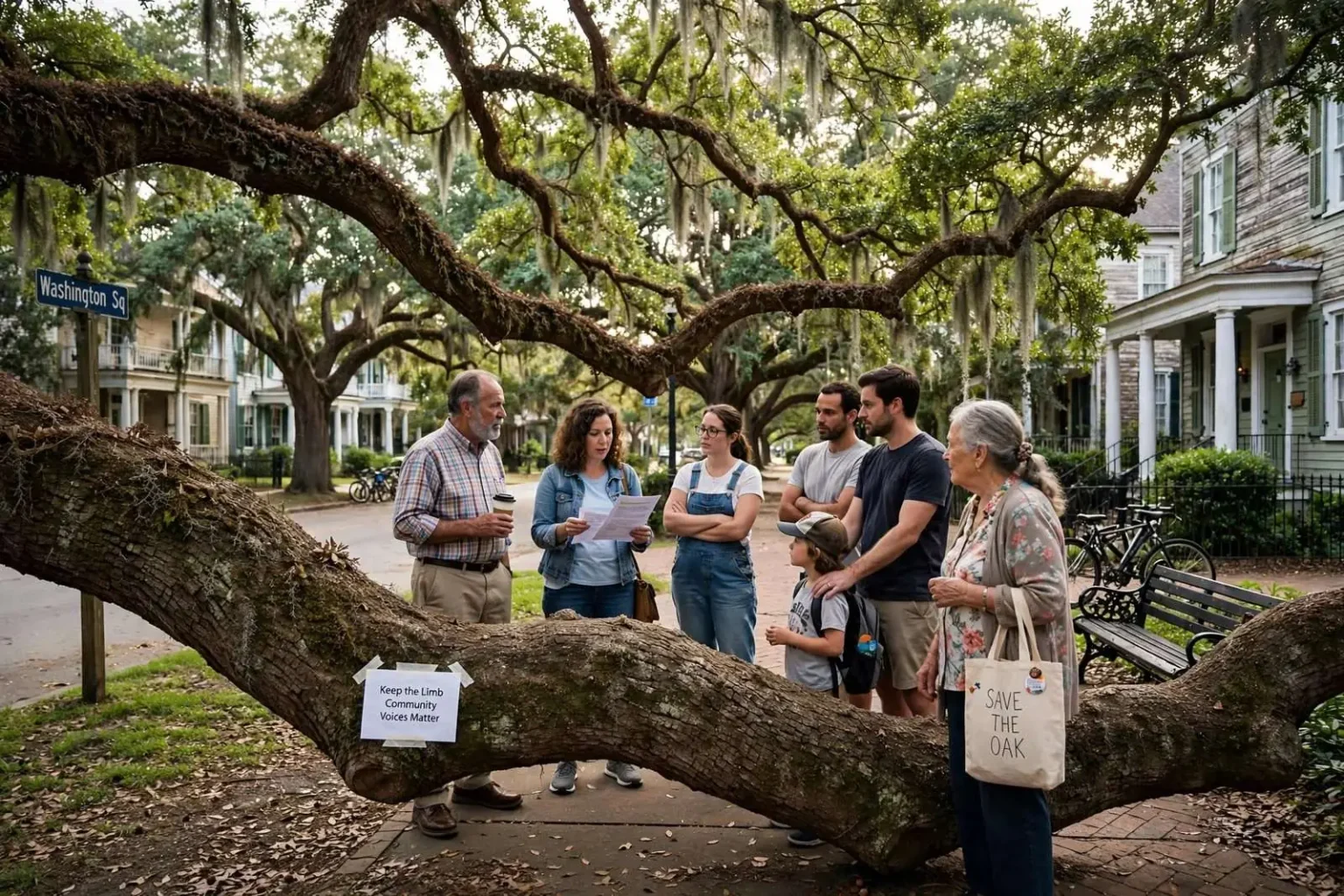
One of the signature features of Washington Square in Mobile’s Oakleigh Garden District is an old, sprawling oak tree with a wide, low branch that stretches out over the sidewalk. For generations, children have climbed and swung from the limb, which sits low enough to the ground that even young kids can reach it — a bit of living playground equipment the neighborhood never had to install, and one of the details that makes the square feel less like a park and more like a front yard shared by everyone around it.
The tree is such a fixture of the neighborhood that a photo of it appears on the city’s parks department webpage, a place of honor that made what happened next all the more startling to residents. Someone recently called the city’s 311 line asking that the limb be cut down as a public nuisance, setting off a quiet but revealing test of how Mobile weighs a single complaint against a community’s attachment to one of its landmark trees.
Word Spreads Through the Neighborhood
News of the request quickly reached the Oakleigh Garden District’s neighborhood association, whose president sent an email to residents alerting them to the complaint and inviting their opinions. In the message, he wrote that he personally couldn’t imagine removing the limb, but said he didn’t feel it was his call to make alone for the whole neighborhood — a restraint that ended up shaping the entire episode. Rather than organizing a campaign or dismissing the complaint outright, the association’s leadership handed the question to the residents themselves.
The responses that came back reflected the depth of feeling the old oak commands. Longtime residents recalled swinging from the limb as children and watching their own kids do the same decades later, and even newer arrivals in the historic district described the tree as part of what drew them to the neighborhood. The square sits in one of Mobile’s oldest residential areas, where the canopy of live oaks overhanging the sidewalks is as much a defining feature as the houses beneath them.
The 311 System and How the City Responds
Mobile’s 311 line exists precisely for requests like this one — a single point of contact where residents can report everything from potholes and missed trash pickups to damaged sidewalks and overgrown lots. Every call generates a service request that is routed to the department responsible, and in routine cases the process works quietly and well. But not every complaint that arrives deserves a chainsaw, and the system depends on the judgment of the employees who field the requests to sort the genuine hazards from the grievances of a single caller.
That judgment is where this story becomes more than a neighborhood anecdote. City staff took the request seriously enough to consult with preservation officials before making a decision — a step that reflects both the tree’s location in a historic district and the recognition that removing a limb from a landmark oak is not a routine maintenance call.
The Preservation Check
After the 311 call came in, a member of Mobile’s Parks and Recreation Department reached out to the Mobile Historic Development Commission for guidance. The commission serves as the city’s review body for historic resources, and its involvement in questions about features of the historic districts — including the trees and streetscapes that give neighborhoods like Oakleigh their character — gives the city a chance to weigh more than the bare text of a complaint before acting on it.
The commission’s director said his office received about a dozen responses from residents on the matter before he and the parks employee decided to reject the removal request. Those responses, arriving organically once the neighborhood association’s email began circulating, gave the review process something a lone complaint never has: a documented sense of what the community actually wants. The director said the episode illustrated good judgment on the part of city staff, who recognized that the appropriate response to a single nuisance call about a beloved landmark was verification and consultation rather than immediate removal.
Why Live Oaks Are Treated Differently
Mobile’s relationship with its live oaks is unlike its relationship with any other part of the urban forest. The trees can live for centuries, their limbs routinely extend over public rights-of-way, and many of the most famous specimens predate the neighborhoods that grew up around them. City policies and preservation practice both treat mature oaks as assets to be protected, and removal of major limbs is generally a last resort reserved for trees that are genuinely dead, diseased or dangerous. An old branch that generations of children have swung from — and that remains sturdy enough to bear them — sits at the opposite end of that spectrum.
The director said not every complaint that comes through the 311 system warrants action, and this was a case where city employees recognized that some requests simply don’t need to be granted. He described the oak limb as an extraordinary feature of the neighborhood, one worth protecting rather than removing — language that effectively closed the question and affirmed the standard the city will apply when the next such call arrives.
Washington Square and the Oakleigh Garden District
Washington Square is one of the small historic parks that dot Mobile’s oldest residential neighborhoods, and the Oakleigh Garden District around it takes its name from the antebellum Oakleigh mansion complex that anchors the area. The district’s grid of streets, its collection of historic homes and its canopy of oaks make it one of the city’s most photographed neighborhoods, and features like the climbing limb in Washington Square are the kind of texture that separates a historic district from a collection of old buildings. When the city’s parks department chose imagery for its webpage, the oak with its inviting branch was representative enough to make the cut.
Neighborhood associations in the historic districts function as a kind of early-warning system for exactly this kind of issue. The Oakleigh association’s email list connects hundreds of households who care about the square, the sidewalks and the trees, and the episode showed the system working as designed: a complaint surfaced, the association informed its members, residents responded to the reviewing agency, and the decision landed with the community’s preference documented.
A Lesson in How Cities Handle Small Decisions
For city governments, the case is a small one with an outsize lesson. Most municipal decisions never make the news; they are made by employees answering service requests, and the cumulative effect of their judgment defines how a city treats its heritage. Here, the employees who received a request to cut down a piece of the neighborhood’s identity chose to ask questions first — of the Historic Development Commission, of the record, and of the residents who responded — and the limb survived because of it.
For now, the limb will remain exactly as generations of Oakleigh children have known it — low enough to climb, sturdy enough to swing from, and firmly rooted as a piece of the neighborhood’s identity. Neighborhood leaders say they hope the outcome sends a message to anyone tempted to file a similar complaint in the future: the community will be heard on questions about its landmark trees, and the city, when asked to choose between a single nuisance call and a living piece of Mobile’s history, knows which side it is on.
The episode also offers a quiet template for other neighborhoods watching their own oak canopies age. Complaints about overhanging limbs, falling leaves and obstructed sidewalks are inevitable in a city where the trees are older than the houses, and the outcome in Washington Square suggests the process works best when residents engage, preservation officials weigh in, and the people who field 311 calls remember that not every nuisance request deserves to be granted.
The Oak Canopy That Defines Mobile
Any discussion of a single oak limb in Mobile eventually widens into the story of the city’s canopy as a whole. Live oaks line the avenues of Spring Hill, frame the squares of the downtown historic districts and shade the sidewalks of neighborhoods like Oakleigh, where mature trees often predate the houses they stand beside. The canopy is simultaneously an environmental asset — cooling streets, absorbing stormwater and buffering wind — and a cultural one, appearing on postcards, in preservation literature and in the childhood memories of generations of Mobilians who climbed before they drove.
Maintaining that canopy requires constant negotiation between the trees and the city around them. Limbs over public sidewalks must be kept safe, roots must be accommodated in paving projects, and storms periodically force hard decisions about damaged trees. The system works when requests for work on landmark trees trigger expertise rather than reflex, which is precisely the sequence that played out in Washington Square: a service request, a referral to the Historic Development Commission, a review of the community’s response, and a decision grounded in the tree’s condition and its significance rather than in the volume of the complaint.
What Neighbors Say Now
In the weeks since the removal request was rejected, the limb has quietly returned to its ordinary job — holding children, marking the square’s entrance in photographs and reminding passers-by why the neighborhood fought to keep it. Association leaders say the episode strengthened the network of residents who watch over the district’s public features, because the email chain that alerted the neighborhood also created a ready list of people who will speak up the next time a landmark tree, fence or sidewalk feature is questioned.
The parks employee who consulted the commission, and the commission director who weighed a dozen resident responses before declining to approve the removal, ended the episode with the city holding a clear precedent: a single 311 call is a request to be reviewed, not a verdict to be executed. In a historic district where the trees are as old as the architecture, that standard may prove to be the most durable thing the Washington Square oak ever produced — apart, of course, from the shade, the photographs and the generations of children still swinging from its branch.