Two Little Girls, a Front Porch in Oakleigh and a Yard Sign Nobody Expected
Five days before the presidential election, a Mobile attorney sat on his Oakleigh porch in a funny hat and overheard two trick-or-treaters puzzle over the campaign signs in a white neighborhood's yards.
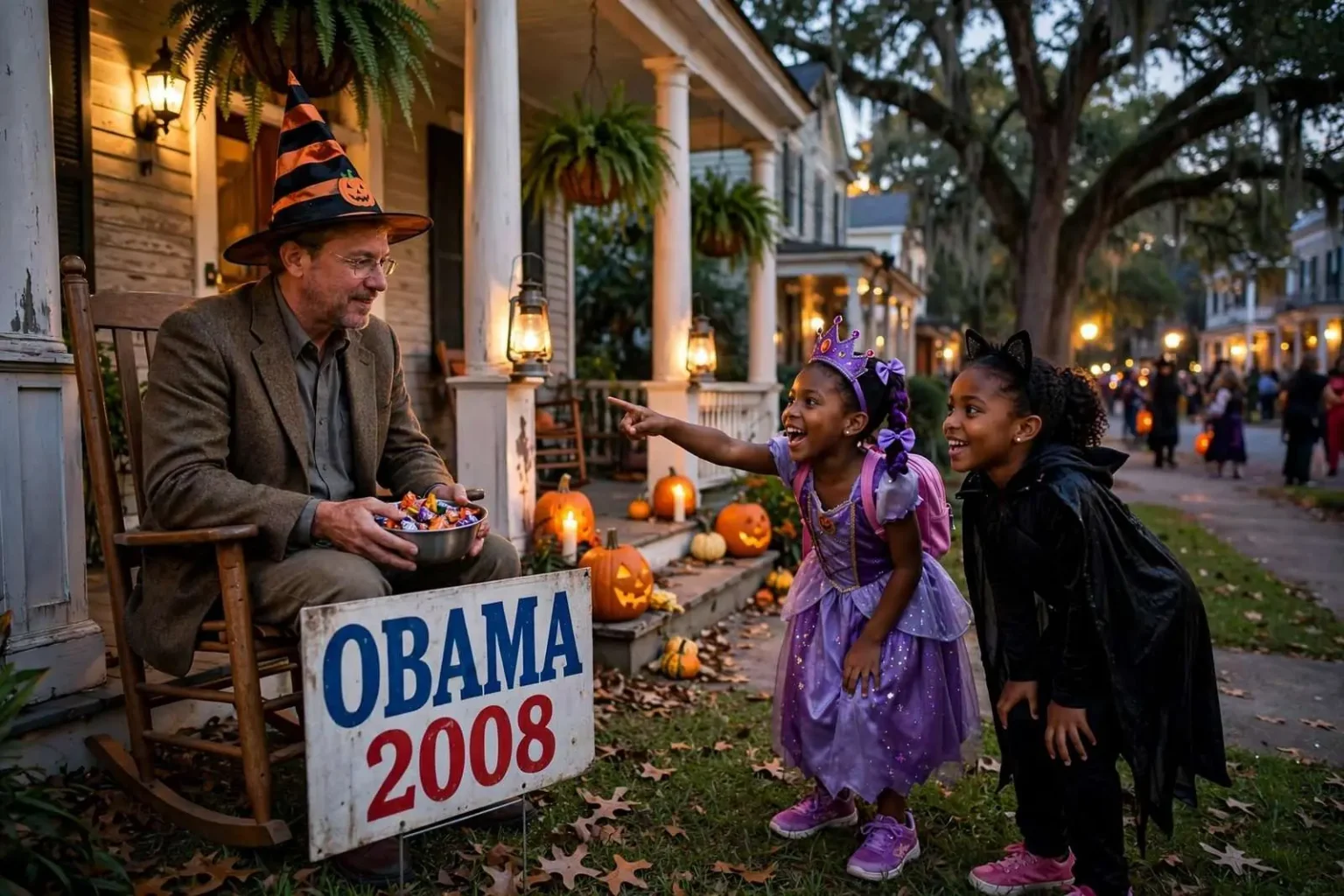
On Halloween night, five days before Americans went to the polls to choose a president, a Mobile lawyer sat in a rocking chair on his front porch in the historic Oakleigh Garden District, wearing a funny hat and handing out candy. What he overheard there, he wrote afterward, said something about the 2008 campaign that the polling and the punditry had missed.
The lawyer was Chip Herrington, 45, an attorney who two years earlier had been the Democratic nominee for juvenile judge in Mobile County. He lives on Charles Street with his wife and two children.
In a first-person account written the following day and circulated as the election closed in, he described the scene in careful detail — the ancient live oaks, the gas lanterns that line those old streets, and the steady traffic of children at the door.
Halloween 2008 fell on a Friday, five days out from the Nov. 4 election, and the neighborhood’s streets carried more than the usual excitement of the holiday. A presidential campaign that had dominated the national conversation for two years was in its final stretch, and in the Oakleigh Garden District — one of Mobile’s oldest and most closely knit historic neighborhoods — it showed up on the front lawns.
A Neighborhood of Edges
Geography mattered to the story he told. Every neighbor on his own street is white, Herrington wrote, but within a few blocks in every direction the neighbors are mostly black. The result, every October, is a stream of trick-or-treaters of both races on the same sidewalks.
The Oakleigh Garden District sits just south of downtown Mobile, a grid of century-old homes shaded by live oaks and lighted by the gas lanterns the neighborhood association keeps burning along the walks. Its streets — Charles Street among them — form one of the city’s most popular walking neighborhoods, and on Halloween that becomes a crowd: families from blocks around converge on porches that have been handing out candy for generations. Children whose parents may not know each other’s names know each other’s doors.
This year the porches carried something extra. Herrington had an Obama campaign sign in his front yard, and so did five of his neighbors.
The signs had not gone unnoticed. All of them had been stolen several times, he wrote. He had found himself explaining, as politely as he could manage, to people appalled that he could support the Illinois senator, that he and Gen. Colin Powell had reached the same conclusion about who was the better candidate for the country.
The reference was to the retired chairman of the Joint Chiefs of Staff, whose endorsement of Obama days earlier had been among the campaign’s most-discussed moments. For Herrington, it was a shorthand answer in difficult conversations — a way of saying that supporting the candidate was not the radical act his questioners seemed to think it was.
Herrington was blunt about the setting.
“Make no mistake, this is the Deep South,” he wrote. “Despite great progress, there still exists a level of distrust between the races.”
The Exchange
Then, on Halloween night, a noisy crowd of black children came up the walk while their parents watched from the street. The children saw the signs. Then they saw the man in the rocking chair.
“Oooo, Kiesha look! This is the Obama house!”
The moment, small and unscripted, is what the account was written to preserve. Children who had noticed a yard sign the way children notice anything — with delight and volume — had identified a stranger’s house as one that agreed with something they cared about, in a city where the authors of the account and his neighbors had spent weeks defending that same sign from thieves.
Herrington’s reflection on the exchange was that it captured something the campaign’s professional observers had not. Polling could measure support for the candidates; pundits could debate what the election would mean for the South. But a porch in the Oakleigh Garden District, where a lawyer in a funny hat handed out candy to children of both races who knew his yard by its sign, offered a different kind of data — the kind collected by neighborhoods rather than pollsters.
What the Porch Saw
The account circulated as the election closed in, passed among Mobile readers who recognized both the setting and the truth of it. The Oakleigh Garden District’s Halloween — live oaks, gas lanterns, sidewalks thick with children — is a local institution, and the image of campaign signs stolen and replaced, stolen and replaced, in the run-up to the vote was familiar to plenty of households that year.
Herrington’s own political history gave the story a second layer. Two years earlier he had been the Democratic nominee for juvenile judge in Mobile County, a race that put him in front of voters across the county in a year when local judicial contests are the main event. He knew campaigns from the inside; the account he wrote was a professional observer’s notebook, kept on his own porch.
The detail he lingered on was the geography — the white street, the black blocks around it, the shared October sidewalks. Mobile’s historic districts sit at the seams of the city’s racial geography, and the Oakleigh Garden District’s trick-or-treat economy depends on that fact: the houses closest to downtown and the medical center draw families from every direction, and the evening belongs to everyone who walks it.
Five days later, Americans elected Barack Obama the country’s first African-American president. In Mobile, John McCain carried the state by a comfortable margin, as Republican presidential candidates have done for decades. The election’s maps would show Alabama’s red; the account from Charles Street recorded something the maps cannot — the sound of children celebrating a yard sign on a Halloween night, in a neighborhood that had spent the season proving both of Herrington’s observations at once: that distrust still lives here, and that progress walks the same sidewalks.
The account’s lasting value is its refusal to choose between the two. A lawyer in a rocking chair, handing out candy five days before a historic election, watched his neighborhood be exactly what it is — the Deep South, and a place where a crowd of children could greet a stranger’s porch with unguarded joy — and had the presence of mind to write it down before the moment, like the campaign itself, passed.
The stolen signs deserve their own accounting, because they carried the season’s ugliest note. Five neighbors and Herrington together kept six Obama signs in their yards, and every one of them was stolen repeatedly over the final weeks of the campaign — a petty crime wave that residents reported and replaced without ever catching anyone in the act. In a neighborhood that prides itself on front-porch sociability, the thefts were the exception that proved the limits of the rule: the same streets that produced the Halloween exchange also produced the need for Herrington’s careful explanations to callers who could not understand his politics.
He described those conversations without rancor, noting that he did his best to stay polite with people appalled at his choice. The Powell comparison was his most effective reply — a decorated general and Republican, saying publicly what Herrington believed privately, that the Illinois senator was the better candidate for the country. It was an argument borrowed from the other side of the aisle, used in a Deep South living room, and it evidently carried more weight than anything a campaign could mail.
The children’s shout, by contrast, required no argument at all. Whatever their parents thought of the candidates, the kids on the sidewalk had absorbed the season’s central fact — that a Black man was five days from the presidency — and had translated it into the language of childhood: this house, right here, is the Obama house. The porch had become a landmark, the way porches do on Halloween, one stop in a route of candy and costumes that crossed every boundary the adult city maintained.
Herrington’s account stops short of any grand conclusion, which is part of why it traveled. He did not claim the evening proved the South had changed, nor that the sign thefts proved it had not. He recorded the gas lanterns, the oaks, the shout, the thefts, the distrust, and let the reader hold all of it at once — a portrait of a place in the days between Halloween and history.
For Mobile readers, the account also named a neighborhood truth that locals know and outsiders miss. The Oakleigh Garden District is integrated in exactly the pattern Herrington described — blocks that tip one way, blocks that tip another, and shared institutions between them — and its annual Halloween crowd is one of the city’s most naturally integrated events. The porch on Charles Street that night sat at the exact center of that machine, rocking gently, handing out candy, listening.
Five days later the votes were counted, and the country made its choice. Whatever the election meant in the aggregate, the account from the Oakleigh Garden District preserved its smallest unit: one yard, one sign, one evening of children’s voices on a Deep South sidewalk — evidence, of a kind no poll can collect, of both how far the region had come and how far it had yet to go.