A Plumbing Blockage Closed Figures Pool in the Middle of the Hottest Stretch of Summer. It’s Back Open.
Mobile Parks and Recreation has reopened Figures Pool on Donald Street after crews cleared a plumbing blockage caused by debris in the system, restoring access less than a day after the closure.
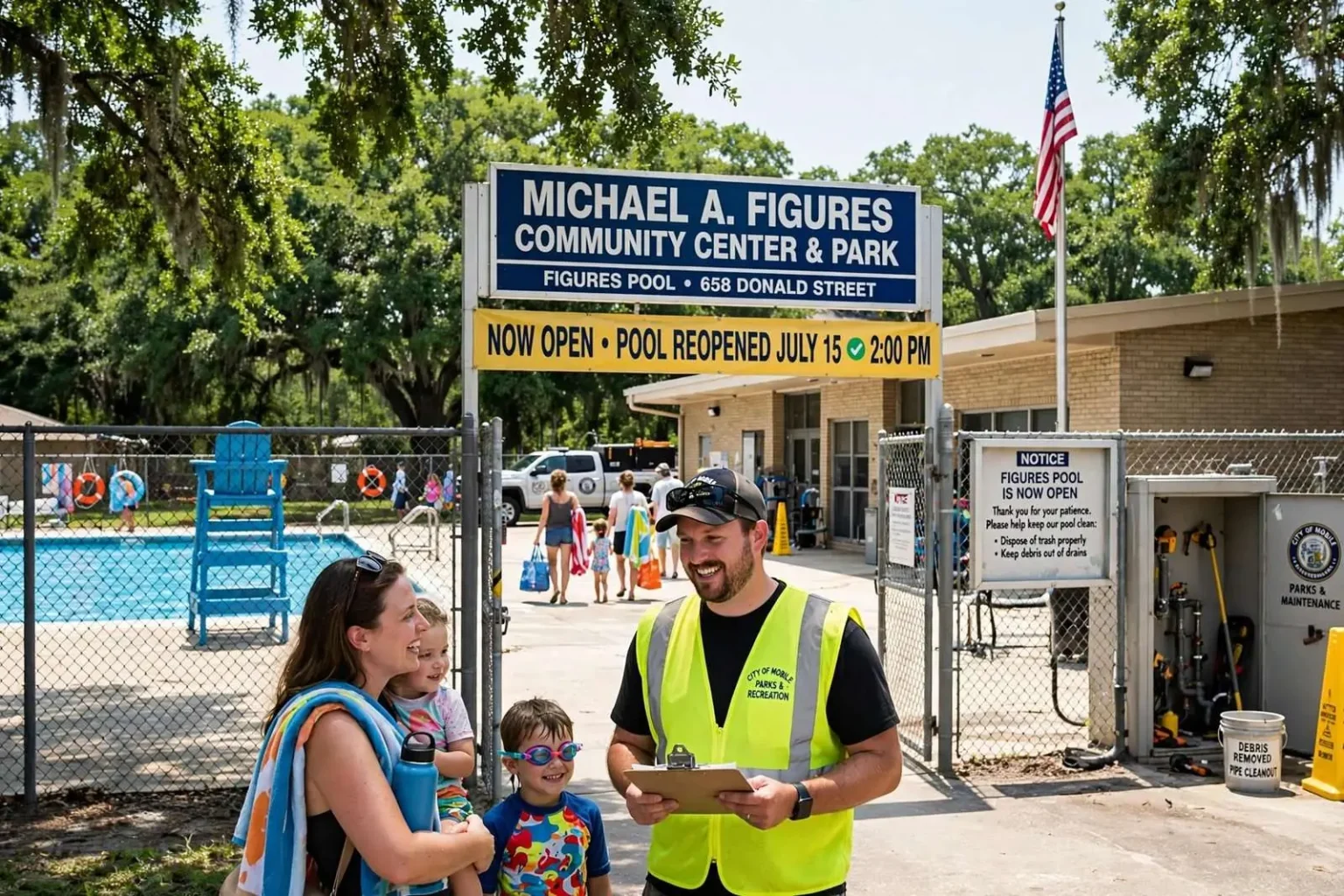
Figures pool is back open, and the culprit was debris in the pipes. The City of Mobile temporarily shut down the pool, located at 658 Donald Street, after a plumbing blockage caused by debris in the system — an inconvenient but fixable problem that briefly took one of the city’s busiest public pools offline at the worst possible moment of the summer.
The announcement came through the City of Mobile Parks and Recreation Facebook page, the department’s primary channel for alerting residents to closures, schedule changes, and program updates. For families that plan their days around public pool hours, a same-day notice on social media has become the difference between a wasted trip and a quick change of plans, and the department’s posts about the closure drew immediate attention from neighbors in the surrounding community.
Crews Went to Work
City crews worked to clear the blockage and get the pool back open as quickly as possible. Plumbing failures in older pool facilities are rarely dramatic but always disruptive: a blocked line can affect circulation, filtration, and drainage, and pool operators cannot responsibly keep a facility open when water quality systems are compromised. The fix requires locating the obstruction, clearing it, and verifying that the system cycles properly before swimmers are allowed back in.
Parks and Recreation thanked residents for their patience during the closure and asked for help preventing a repeat. “(We) encourage all visitors to help keep our facilities operating by properly disposing of trash and personal items.” The request points to an ongoing challenge for any urban parks department — pools, splash pads, and community centers absorb heavy summer use, and small items that end up where they should not can shut down systems that serve thousands.
The appeal is also a reminder of how much of the city’s recreational infrastructure depends on individual behavior. Debris in a pool’s plumbing typically arrives through the deck drains and gutters that carry water off the facility, and keeping wrappers, bottles, and personal items out of those systems is the cheapest maintenance the city can ask of the public.
Bad Timing for a Closure
The shutdown landed in the middle of one of the hottest and most heavily used stretches of the pool season. July on the Gulf Coast routinely brings heat indexes well into the triple digits, and Mobile’s public pools shoulder a demand that peaks precisely when the weather is least forgiving. Even a single day of closure sends families looking for alternatives — neighbors with backyard pools, splash fountains, or air-conditioned spaces — that not every household in the area can reach.
Public pools like Figures serve as one of the few free or low-cost ways for Mobile families to get out of the heat during July, and even a brief closure is felt in the surrounding neighborhood. For children on summer break, a neighborhood pool is often the centerpiece of the day; for older residents and families without air conditioning, it can be a genuine refuge. That dual role — recreation and heat relief — is why cities across the South treat pool operations as a public health service and not merely an amenity.
Anyone planning outdoor activity during a Gulf Coast July should take the usual precautions: drink water before feeling thirsty, take shade breaks, and keep a close eye on children and older adults, who are the most vulnerable to heat illness. Health officials repeat that guidance every summer because the region’s combination of heat and humidity limits the body’s ability to cool itself, meaning heat exhaustion can develop faster than people expect — particularly during outdoor activity in the afternoon hours.
The guidance applies as much to the trip to the pool as to time in it. Walks to neighborhood facilities, waits in line, and time on hot pool decks all add to heat exposure, and the families most dependent on public pools are often those for whom the alternative is a hot apartment or a long walk. When a pool closes unexpectedly, the heat risk simply moves somewhere else in the neighborhood.
Update: Pool Reopens
Mobile Parks and Recreation closed Figures Pool around 7:15 a.m. on July 14 after the plumbing blockage was discovered. The early-morning discovery meant the problem was caught before the facility opened for its daily swim hours, sparing visitors from being cleared out mid-session and giving maintenance crews the entire workday to diagnose the system.
The maintenance team worked quickly to resolve the issue, and by 2 p.m. on July 15, the pool was officially reopened. The roughly 31-hour turnaround is fast by the standards of municipal pool repairs, where parts, contractors, and water-quality testing can stretch a closure across a week or more. Reopening the facility at midday on a Friday restored the pool for the weekend, when public swim hours draw their biggest crowds.
The quick reopening also reflected well on the city’s maintenance operation. Municipal pools run on lean budgets and small crews, and a blockage discovered at opening time could easily have become a multi-day outage in a system with older plumbing. Getting Figures back online in about a day required the crew to find and clear the debris, confirm that circulation and filtration were functioning, and balance the water before the first swimmers returned.
Figures Pool is located inside the Michael A. Figures Community Center and Park at 658 Donald Street and is now back in normal operation for the rest of the summer season. The facility carries the name of Michael A. Figures, the Mobile state senator whose career in the Alabama Legislature and leadership in the Senate made him one of the most significant political figures in the city’s modern history, and the community center bearing his name serves as a hub for recreation and programs in the neighborhood around Donald Street.
The center and park anchor one of Mobile’s long-standing residential areas, offering athletic fields, programming, and the pool that draws families from blocks around during the summer months. Facilities like this one concentrate the city’s park investment in walkable neighborhoods — the model that puts a swimming pool, a gymnasium, and after-school programming within reach of families who may not have reliable transportation across town.
For now, the story ends the way residents hoped: a one-day closure, a cleared pipe, and a reopened pool in the middle of July. The city’s request to visitors — proper disposal of trash and personal items — remains the standing homework assignment. Every item that stays out of the drains is one less blockage, one less morning announcement, and one more uninterrupted swim season for the families who count on Figures Pool when the Gulf Coast heat settles in.
The episode offers a useful snapshot of how municipal aquatics actually operate in a Gulf Coast city. Mobile’s public pool season typically runs from early June through the end of July or into August, compressed into the weeks when school is out and demand is highest, and every day of that season matters to the families who structure summer around it. A pool that closes even briefly during peak weeks loses swim sessions that cannot be recovered, which is why the speed of the Figures repair mattered as much as the repair itself.
Maintenance demands on public pools are constant even without mishaps. Daily water testing, chemical balancing, skimming, vacuuming, and filter checks are the visible work; the invisible work happens in pump rooms and plumbing runs that most visitors never see. In facilities where storm debris, grass clippings, and litter wash into deck drains during the region’s frequent afternoon downpours, keeping lines clear is a running battle — one that a city crew can lose in a single storm if the drains are already loaded with trash.
That is the practical logic behind the department’s request for visitors to dispose of trash properly. A wrapper that makes it into a trash can costs the city nothing; the same wrapper blown into a gutter can end up lodged in a pipe and cost a day of pool operation across an entire neighborhood. The economics scale across the whole parks system: every preventable closure diverts crew hours from scheduled maintenance somewhere else, so public cooperation is genuinely part of the maintenance budget.
The closure also highlighted the role the department’s social media presence now plays in city services. A generation ago, a pool closure was learned at the gate; today, the Facebook announcement reaches parents before they leave the house, and the same channel carried the good news of the reopening the next afternoon. For a department whose facilities serve thousands of visitors a week in summer, timely online communication has become as important to the service as the maintenance itself.
Mobile’s summer heat makes the stakes concrete. The National Weather Service’s heat advisories for the central Gulf Coast regularly warn that heat indexes in July can reach dangerous levels for outdoor exertion, and public health guidance consistently ranks access to cooled or water-based spaces among the most effective defenses against heat illness in children and older adults. A neighborhood pool that opens on time every day is, in that light, a piece of the city’s heat-response infrastructure — which is why a 31-hour closure, handled quickly, was the best possible outcome of a blockage discovered at 7:15 on a July morning.
With the system cleared and the season’s hottest weeks still ahead, Figures Pool returns to its summer role: the place where the neighborhood around the Michael A. Figures Community Center cools off, learns to swim, and meets the summer on its own terms. The city’s message to visitors is unchanged — take care of the facility, and it will keep taking care of the neighborhood through the rest of the season.