A Phantom Website Pushed Steve Nodine for Mayor. He Said He Wasn’t Running.
An anonymous website urged Mobile County Commissioner Steve Nodine to challenge Mayor Sam Jones in 2009. Nodine said flatly that he would not run, and his allies accused the mayor's camp of manufacturing an opponent.
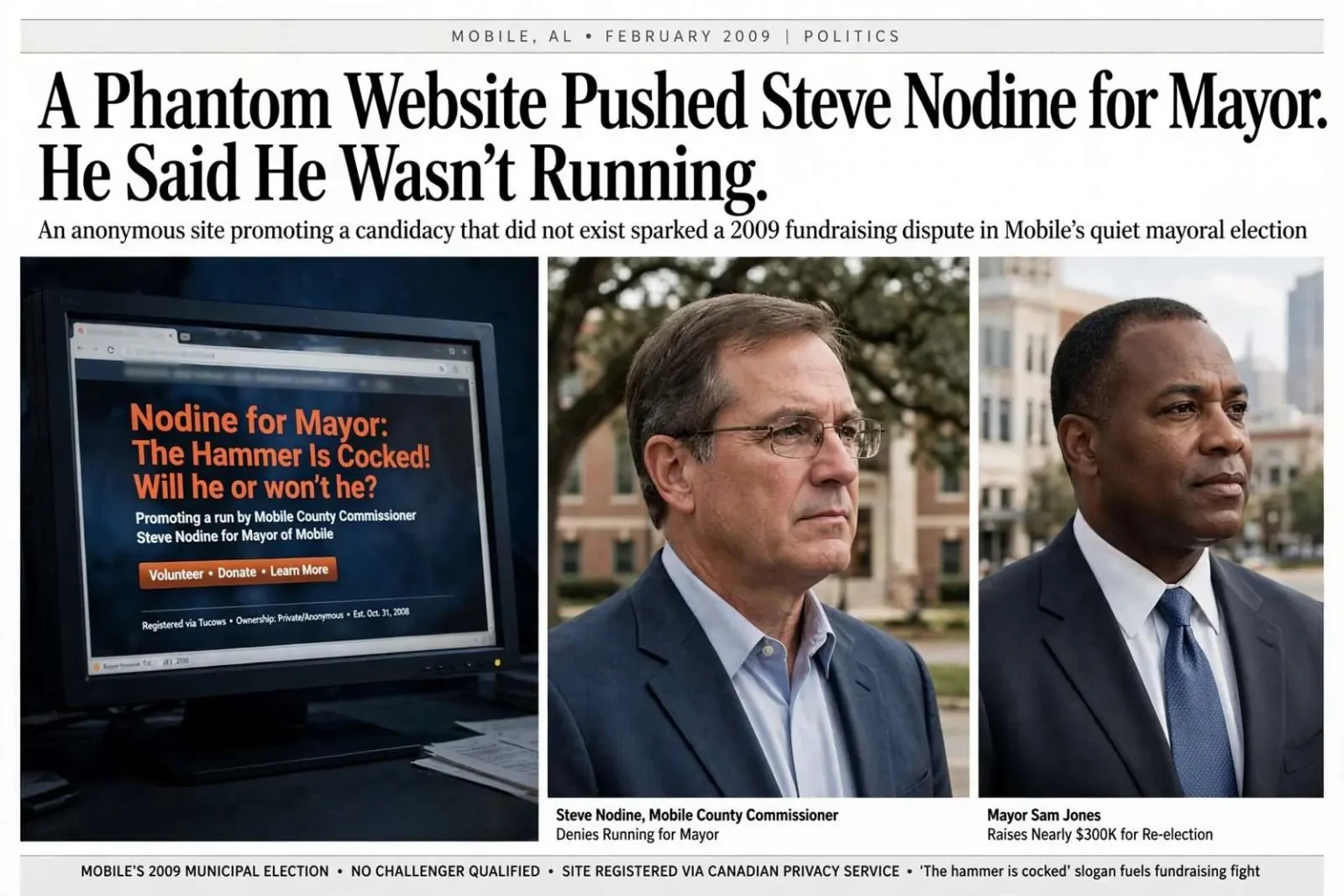
An anonymously registered website promoting a candidacy that did not exist became, in early February 2009, the strangest artifact of Mobile’s municipal election season — and the occasion for a public quarrel over how Mayor Sam Jones was raising money for a race in which he appeared to have no opponent.
The dispute arrived with the campaign year barely underway. Mobile’s municipal elections were scheduled for Tuesday, Aug. 25, and qualifying had not yet opened, but the fundraising season was in full swing — and into that quiet contest stepped a website nobody would claim.
‘The hammer is cocked’
The site, headlined “Nodine for Mayor: The Hammer Is Cocked! Will he or won’t he?” promoted a run by Mobile County Commissioner Steve Nodine. It had been registered around Halloween of the previous year, and its ownership was masked behind a Toronto-based domain registrar, Tucows, which sells domain names and privacy services through a large reseller network. The only verifiable information about the site’s origin barely tied it to this hemisphere.
The timing of the registration had its own significance. Halloween 2008 fell just days before the November general election, when local political attention was fixed elsewhere, and whoever set up the site did so through channels that required no disclosure of identity. The arrangement meant that a page openly soliciting speculation about a citywide candidacy could not be traced to any campaign, committee or individual without legal process.
Nodine’s answer was unequivocal. Not only was the hammer not cocked, he said, he was not even half-cocked. There was no chance he would run for mayor that year.
The denial closed the question of the candidacy but opened a larger one: if Nodine was not running, why did a site saying he might still exist — and who benefited from the speculation?
The fundraising fight
Jones filed his annual campaign finance report on Monday, Feb. 2, showing a balance of nearly $300,000 after a series of receptions and fundraisers in advance of his re-election bid. Municipal elections were set for Tuesday, Aug. 25.
The balance placed the mayor among the best-funded incumbents in the city’s history at a comparable point in a cycle, and the report drew scrutiny precisely because no credible challenger had emerged. Receptions and fundraisers through the fall and winter had kept the committee collecting while the field of opponents remained empty.
Nodine and Republican political consultant Jon Gray, who had worked on Nodine’s past campaigns, contended that the site was likely a device to keep the mayor’s fundraising machinery running. No foe, no dough.
“I am certain it was set up by Jones’ team as a catalyst to raise money,” Gray said. “Jones can’t raise money without an opponent and they have been tossing around Nodine’s name for months. Nodine denied it, so now they create a mysterious website with a concealed owner.”
By suggesting Nodine would run, Gray argued, the mayor’s side could stockpile money to spend against Republicans in future cycles.
Gray’s theory rested on a practical political logic. A mayor with a huge account and no opponent can direct money to allied causes and candidates, and the specter of a high-profile countywide Republican switcher running for City Hall gave donors an urgency they would not otherwise feel in a one-sided municipal race.
Jones scoffed.
“I was not aware of the website until it was brought to my attention today, and we certainly do not have anything to do with it,” the mayor said. He used the occasion to point to the breadth of his support. “This support more than anything else shows how people in Mobile of many different political stripes are working together to continue to move our great community forward.”
Nodine countered that Republican donors in that broad coalition told him the mayor’s fundraisers were invoking his name to close contributions. “Mayor Jones and [City Attorney] Larry Wettermark and his supporters continue to use Steve Nodine for Mayor as a rallying cry, which I think hurts him more than it helps him,” Nodine said. He said he had no knowledge of who created the site.
The commissioner’s complaint cut in two directions at once. He was, by his own account, being drafted into a race he wanted no part of, and the people doing the drafting were fundraising off his name without his consent. At the same time, the repeated invocation of a Nodine candidacy kept the commissioner’s name in the political conversation at no cost to him — a dynamic that made some observers wonder whether the ambiguity suited more than one side.
Gray’s advice to donors was blunt: “I would hope that anyone with half a brain would say, ‘Sam, come see me when Nodine qualifies and I will write you a check the same day.'”
An unlikely rivalry
The subtext was that Jones and Nodine were not really enemies. Jones, elected in 2005 as Mobile’s first Black mayor, had spent years as a Democratic county commissioner before moving to the non-partisan mayor’s office. Nodine, a Republican and a former city councilman, had clashed with the mayor’s allies at times but had also worked with him on economic development.
Their political histories overlapped in ways that made the public sniping ring hollow. Jones had served on the Mobile County Commission before his election as mayor, the same body Nodine then sat on, and the two had inherited and built on the same agenda of industrial recruitment and infrastructure. Municipal elections in Mobile are officially non-partisan, which meant the mayor’s Democratic roots and Nodine’s Republican credentials mattered mainly in fundraising circles rather than on the ballot itself.
“Sam and I make a helluva good team the way things are,” Nodine said. “We’ve worked these mega projects in a partnership and we’ve been very successful, along with his city council and my fellow commissioners.”
He said his own work was unfinished — the campaign to land the Air Force aerial refueling tanker contract for Mobile, the widening of U.S. 98 and other road projects — and pointed to crime as the issue the city needed to confront in the election.
The tanker contract was the dominant economic story of the era in Mobile. The competition to build the Air Force’s next-generation refueling aircraft had drawn a proposed assembly line to the city’s Brookley Aeroplex, and local officials of both parties had staked enormous political capital on winning it. Nodine’s argument was that stepping into a mayor’s race would mean walking away from that fight — and from road projects like the U.S. 98 widening that were years in the making.
Nodine did allow that he was hearing an “extraordinary outpouring of support” from the business community, though he declined to name anyone.
Gray, for his part, disavowed any connection to the website and hinted that his client had other ambitions: “There are higher grounds he might be interested in should an opportunity come about, but I can guarantee you it is not mayor.”
The consultant’s formulation left the door deliberately ajar. “Higher grounds” was read locally as a reference to countywide or state office, and it kept Nodine’s name attached to future speculation even as it removed him from the August ballot. Whether that ambiguity was a service to Nodine or a distraction from the website’s mystery depended on who was doing the reading.
How the season actually unfolded
Jones was in fact re-elected that August, winning a second term without the hard race the phantom website had seemed to forecast. The mayor’s fundraising advantage and the fragmented opposition field combined to settle the election with none of the drama that February’s squabble had promised, and the Nodine-for-Mayor site faded as quickly as it had appeared.
The episode became a small case study in how modern campaign finance and anonymous web tools interact. A domain registered in another country, behind a privacy service, had been enough to inject a fictional candidacy into a city’s political dialogue for months — and to shape how incumbents raised and donors gave, without anyone ever taking responsibility for it.
For Mobile voters in the summer of 2009, the practical questions were simpler. The mayor had the money and the incumbency. The commissioner said he was staying put. And the site that had claimed otherwise never explained itself at all.
What came after
Nodine’s own political career ended far less happily; he resigned from the county commission in 2010 amid a criminal investigation.
The resignation closed a chapter that had begun with the same credentials that made him a recurring subject of mayoral speculation — a former city councilman turned county commissioner with a gregarious public style and a network that reached across party lines. By the time the 2009 municipal season arrived, the county commission seat was the office he held, and within a year of Jones’s re-election it was gone.
Jones, meanwhile, served out his second term as mayor, the capstone to a career that had run from the county commission to City Hall. The 2009 election he won without an opponent remained, in local political lore, the race that a website almost made interesting.
The broader lesson stayed with Mobile’s political class: in an era of anonymous domains and privacy registration, a candidate who never qualifies can still move money, shape coverage and dominate a season’s conversation. The hammer, it turned out, was never cocked — but for one strange spring, plenty of people in Mobile were betting on the bang.