University of South Alabama Fairhope
Mobile and Baldwin County Students Named to 2014 Top Academic Team
High school counselors across Mobile and Baldwin counties nominated top scholars for a regional academic recognition team in 2014.
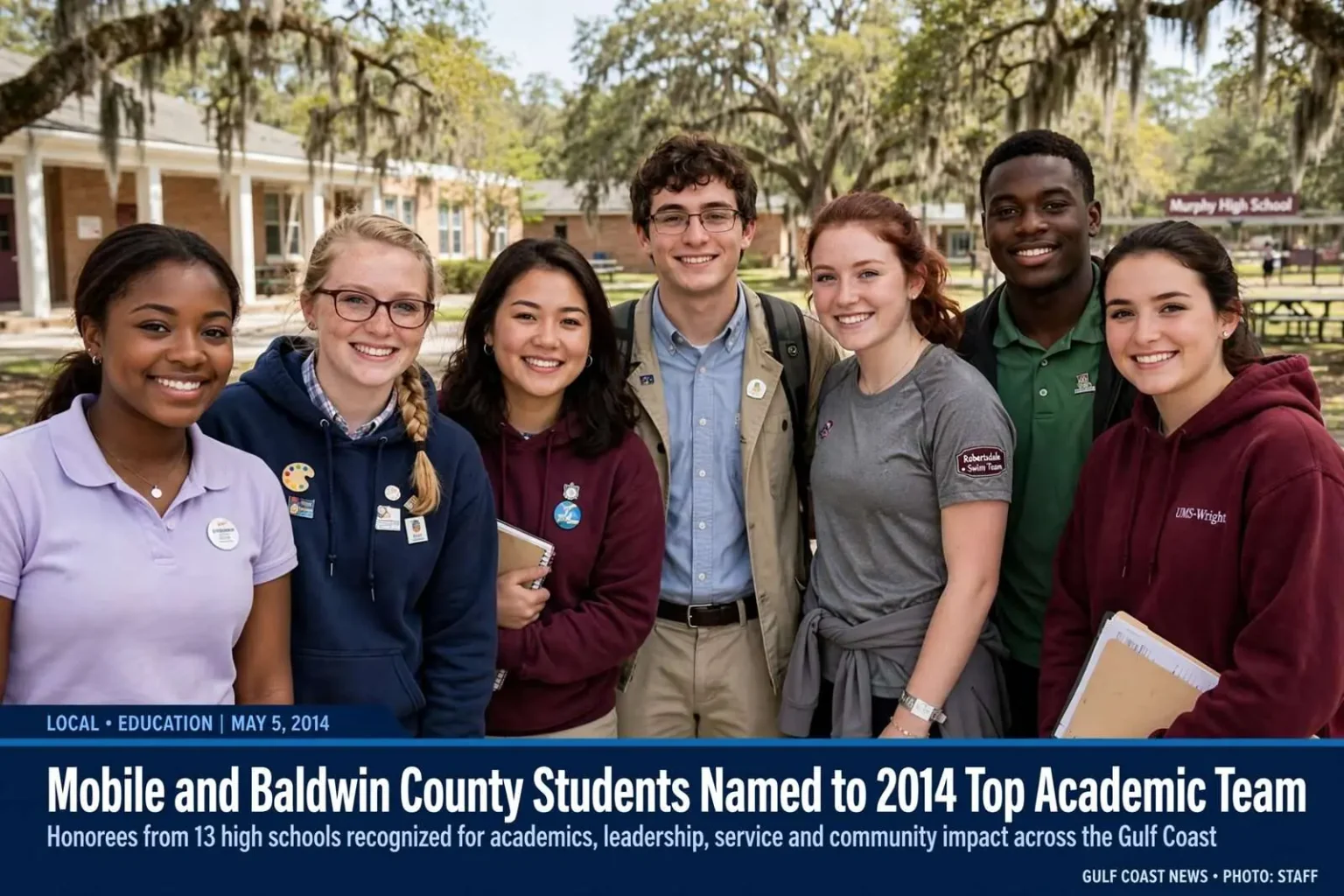
Each spring, high school counselors throughout Mobile and Baldwin counties nominate their most accomplished seniors for a regional academic honor recognizing students who combine strong grades with leadership, service, and extracurricular achievement. The class of 2014 produced a wide-ranging group of honorees pursuing fields from biomedical engineering to environmental science, pharmacy, and education. The annual recognition has become a tradition across the two-county region, bringing together top seniors from large city schools, suburban programs and small-town campuses who might otherwise never share a stage, and giving colleges, employers and neighbors a look at the caliber of students the Gulf Coast is sending into the world.
Scholars With Big Plans
Hadley Montgomery, valedictorian at Murphy High School, earned scholarships to the University of the South at Sewanee and said she hoped to focus her studies on environmental sustainability. Montgomery finished her Murphy career at the top of one of Mobile’s largest and most storied public high schools, a campus whose graduates have gone on to leadership roles across the state for generations. Her interest in sustainability reflected a growing current among Gulf Coast students — a generation shaped by the BP oil spill and coastal restoration debates — who want to build careers protecting the region’s environment and economy at the same time.
Elizabeth Denton, an award-winning artist from Baker High School, said she wanted to blend her interests in the environment and visual art into a future career that could make a tangible impact. Denton’s path illustrated the range of the honorees: not every member of the team was headed toward engineering or medicine, and the region’s schools have increasingly nurtured students who see the arts as a serious academic and professional pursuit. Baker, located in west Mobile County, has built a reputation for giving students room to develop creative talents alongside traditional coursework.
Katherine Rhodes, valedictorian at Chickasaw High School, planned to attend Auburn University before pursuing missionary work, and spent the summer working as a camp counselor and photographer at a local church camp. Rhodes represented a newer name on the regional academic map — Chickasaw, which became its own city in 2011, took over its school system from Mobile County and graduated its early classes in the years just before this honor class, making her achievement part of the young city’s own story.
Fran Harris, valedictorian at UMS-Wright Preparatory School, aimed to become a neurosurgeon and researcher, building on experience she had already gained as a research fellow at the University of South Alabama College of Medicine. Few high school students anywhere can claim hands-on research experience at a medical school, and Harris’s fellowship at USA placed her among the rare honorees already working in the field she planned to enter. Her ambition also pointed to a recurring theme among Mobile-Baldwin academic standouts: many of the region’s most promising students are drawn to health sciences, often with an eye toward coming back to practice on the Gulf Coast.
Athletes and Volunteers Among the Honorees
Several members of the team balanced their academic success with competitive athletics, including standout basketball, baseball, swimming, and cross-country athletes from schools such as Alma Bryant, St. Luke’s Episcopal, McGill-Toolen Catholic, Davidson, Robertsdale, LeFlore Magnet, Bayside Academy, and Blount High. The list reads like a tour of the two-county region — from the coastal campuses of Baldwin County to the magnet and parochial programs in the heart of Mobile — and it underlines how widely academic excellence is distributed across South Alabama. Student-athletes on the team spoke to the reality of most honors students’ lives: hours of practice and travel layered on top of advanced coursework, community service and college applications.
Trista Phelps, valedictorian at Robertsdale High School, earned a swimming scholarship to the Florida Institute of Technology. Phelps’ achievement carried extra weight in a region where swimming talent has to be developed against the odds — without the deep bench of year-round aquatic facilities that larger metros enjoy — and her scholarship meant she would continue competing at the collegiate level while studying at a university known for its engineering and science programs.
Service Sets This Class Apart
Community service was a hallmark of many honorees’ applications. Breonna July, salutatorian at Vigor High School, served as a youth ambassador for several community organizations focused on teen pregnancy prevention and substance abuse awareness. Work like July’s is a reminder that the region’s top students are often already tackling its hardest problems — volunteering in peer-education programs that carry far more weight with teenagers than anything adults can deliver. Vigor, in Prichard, has a long tradition of producing leaders in the Mobile area, and July’s record of advocacy continued that lineage.
Across the honoree class, counselors pointed to the same pattern: the students who rose to the top of the nomination pool were rarely the ones who merely posted the highest grade averages. They were the students who founded clubs, organized drives, tutored younger classmates, played in the band, managed jobs and still kept their coursework at the top of the class. The regional academic team was designed to capture that whole picture — grades, leadership, service and extracurricular achievement together — rather than rewarding a single number.
What the Honor Means for the Region
For the schools involved, having students named to the team is a point of pride and a signal to families evaluating their options. Public comprehensives like Murphy, Baker, Vigor, Robertsdale and Blount, magnet programs like LeFlore, parochial institutions like McGill-Toolen and St. Luke’s Episcopal, and private schools like UMS-Wright and Bayside Academy all compete for students across the two counties, and a strong showing on the academic team is evidence that excellence is available in every corner of the system.
The honors also carry practical weight for the students themselves. College admissions offices and scholarship committees look for precisely the combination the award recognizes — academic rigor demonstrated over four years, leadership documented by adults outside the family, and a service record that shows commitment to community. For students from smaller schools, in particular, regional recognition can be the credential that puts a Gulf Coast application at the top of an out-of-state pile.
A Pipeline Toward the Coast’s Future
The fields the class of 2014 planned to pursue — biomedical engineering, environmental science, pharmacy, medicine, education, the arts — track closely with the needs of the Gulf Coast economy. The region’s hospitals and the University of South Alabama’s health system are among the largest employers between New Orleans and Tallahassee, and the growth of biomedical research in Mobile has created a local pipeline for students who once assumed they had to leave for Atlanta or Birmingham to find careers in science. Environmental science, meanwhile, has taken on renewed urgency along the coast, where restoration projects, fisheries management and water quality monitoring have become major employers in their own right.
Educators across the two counties often note that the surest predictor of a region’s future prosperity is what its best and brightest students decide to study — and whether they come home afterward. Honorees like these, who leave for Auburn, Sewanee, the Florida Institute of Technology and other campuses with clear professional goals, are the population that Mobile and Baldwin counties hope to draw back as their hospitals expand, their coastal industries diversify and their schools seek the next generation of teachers.
That is the quiet promise embedded in an honor like this one. Awards recognize the past four years; the region’s interest is in the forty that follow. If even a fraction of this class returns to practice medicine in Mobile, teach in Baldwin County or engineer the coast’s next generation of infrastructure, the two counties will have made an excellent long-term investment in the students their counselors nominated this spring — and the best measure of this team will arrive, not on the stage where they were honored, but in the decades of work that came after it.
Advice the Honorees’ Paths Offer
The paths taken by the 2014 team members offer a practical playbook for the classes behind them. Start early: several honorees had already built research experience, summer employment or sustained volunteer commitments by the time they were seniors. Use the counselors: the nomination process runs through high school counseling offices, which means the students who build relationships there are the ones who get noticed. And pursue depth rather than a long list of shallow activities — the profiles that stood out in this class belonged to students who had committed to a few things and led within them.
For the honorees themselves, the spring of 2014 was a season of decisions: choosing among scholarship offers, saying goodbye to classmates of thirteen years, and preparing for campuses across the Southeast. The region that watched them grow up — from Murphy’s historic campus to the growing communities of Baldwin County — will be watching where they go next, and hoping that many of the names on this year’s academic team become the doctors, engineers, artists, teachers and advocates of South Alabama’s next generation.