Two Boats Destroyed in Early Morning Fire at Orange Beach Marina
Orange Beach firefighters battled a pre-dawn blaze that destroyed two boats at Bear Point Marina, with no injuries reported.
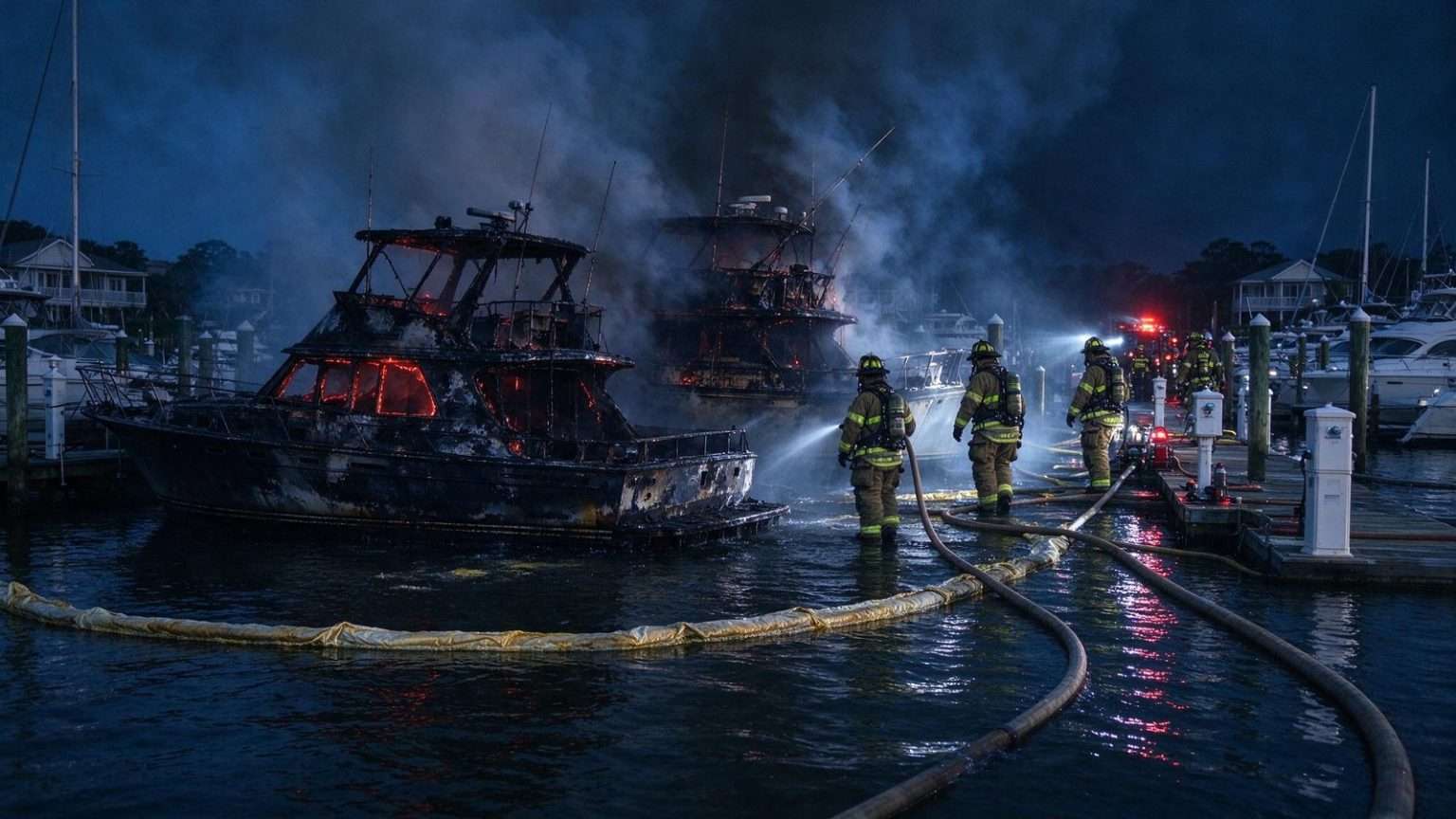
ORANGE BEACH, Ala. — Fire crews in Orange Beach spent part of Monday’s early morning hours battling flames that consumed two boats docked at Bear Point Marina on the city’s east end. The overnight blaze lit up the waterfront neighborhood as firefighters from Orange Beach Fire and Rescue worked to keep the fire from reaching other vessels packed into the marina’s slips.
Orange Beach Fire and Rescue responded to a report of a boat fire at the marina, located on Bay La Launch Avenue, around 12:30 a.m. on June 30. When crews arrived, they found a 35-foot vessel fully engulfed in flames alongside a 48-foot boat that was already showing heavy fire. The intensity of the initial fire left little chance of saving either vessel, and the response shifted to protecting everything around it.
Firefighters worked to keep the blaze from spreading beyond the two boats already burning, though a third vessel docked in a neighboring slip sustained some radiant heat damage. Boat fires present a difficult set of challenges for crews: fiberglass hulls and interior furnishings burn hot, fuel tanks aboard recreational vessels can feed the flames, and the close spacing of marina slips allows fire to jump from boat to boat with alarming speed if lines cannot be established quickly.
Fire officials said crews laid down absorbent boom material around the marina slips afterward as a precaution against any fuel that may have leaked from the damaged boats into the surrounding water. Booming is a standard environmental response after a vessel fire along the coast, since gasoline and diesel released from burned or ruptured tanks can spread quickly across the surface of a harbor or bay and harm marine life long after the flames are out.
Both of the destroyed vessels were described as live-aboard boats, meaning they are regularly used as residences by their owners. Despite that, nobody was on board either boat when the fire broke out, and no injuries were reported among residents, boaters or responding firefighters.
Live-aboard vessels are a familiar sight in Orange Beach, where the cost of waterfront housing pushes some residents onto the water year-round and marinas cater to owners who treat their boats as full-time homes. A fire aboard a live-aboard craft carries stakes beyond the property itself, since these boats typically hold clothing, documents, medications and everything else their owners keep in a household — losses that are rarely recoverable from a fully engulfed hull.
Crews remained on scene for several hours overnight, and the marina was cleared by around 4:30 a.m. once the fire had been fully extinguished and the area deemed safe. The four-hour response is typical for a dockside fire of this scale, where firefighters must not only knock down the flames but also check for hidden hot spots, monitor for rekindling, and confirm that no fuel continues to seep into the water before other boaters are allowed back into the area.
The exact cause of the fire had not been determined as of Monday, and it remained under investigation by fire officials. Investigators looking into boat fires typically examine shore-power electrical connections, battery charging systems, fuel lines and galley appliances, since each is a common ignition source on docked vessels. Until that work is complete, officials generally cannot rule out any cause, and damage estimates are rarely released in the early stages of a marine fire investigation.
Marina fires are a recurring hazard along the Alabama Gulf Coast, where fuel lines, electrical systems and close quarters between docked vessels can allow a single fire to spread quickly to neighboring boats. Fire departments in Orange Beach, Gulf Shores and across the region drill on waterfront responses for exactly that reason, and many marinas post rules limiting shore-power use, grilling and fueling practices to reduce the risk of an overnight blaze.
Bear Point Marina sits along the Intracoastal Waterway in Orange Beach, an area with a heavy concentration of recreational and live-aboard vessels, particularly during the summer boating season. The Intracoastal serves as the marine highway running behind the barrier island communities of the Alabama coast, and its marinas fill up in the summer months with pleasure craft, charter boats and cruising vessels moving between Florida, Alabama and Mississippi.
The east end of Orange Beach around Bay La Launch Avenue is popular with boat owners in part because of its quick access to Perdido Bay and the Intracoastal, and the marina’s neighborhood mixes waterfront homes with dock facilities that hold boats of widely varying sizes. That mix of large vessels in tight quarters is what makes marina fires so dangerous in the first place — a 48-foot boat beside a 35-foot boat leaves almost no gap for flames to skip across once one hull is burning.
No further updates on the cause or damage estimate were available at the time. Fire officials encouraged boaters to review their own vessels’ electrical and fuel systems, keep working fire extinguishers aboard and report any smoke or fuel odors at the docks immediately, advice that takes on added urgency whenever an overnight marina fire destroys multiple boats in a single neighborhood.
How crews fight a marina blaze
A boat fire at a dock is one of the hardest calls a coastal fire department can draw. Unlike a structure fire, there is no hydrant at the end of a pier in most cases, so Orange Beach firefighters must stretch long hose lines from apparatus parked on shore, lay floating pumps if needed, and attack the fire from both the dock and the water. Tidal currents and wind push smoke and heat across adjacent slips, and burning fiberglass produces thick, toxic smoke that forces crews to work in breathing apparatus even in the open air.
The first priority on any marina fire is separation. Crews try to move unburned boats out of adjacent slips or push burning vessels away from the dock if conditions allow, because the fastest way to multiply a boat fire is to let it hop from hull to hull. Fireboats and rescue craft based along the Alabama coast give departments like Orange Beach Fire and Rescue the ability to attack from the water side, where the hull of a burning vessel can be cooled directly even when the dock side is impassable.
Environmental protection is the second priority, and the absorbent boom deployed around the Bear Point Marina slips is the standard tool for that job. The boom floats on the surface and soaks up petroleum products while repelling water, containing sheens of fuel before they spread across a harbor. Responders also watch for debris floating away from the burn scene, since charred hull fragments and soaked cushions can carry fuel residue across open water. State and federal environmental agencies are typically notified after any fire involving significant fuel loss, and cleanup contractors can be called in when sheens spread beyond the containment area.
Overnight fires add a further layer of difficulty. With fewer staff and fewer witnesses around, marina fires are often well developed before the first alarm goes out, which is exactly the scenario reported at Bear Point Marina, where the 35-foot vessel was already fully engulfed by the time crews arrived minutes after the 12:30 a.m. call. Early detection systems, including smoke alarms wired to shore power and marine monitored security systems, are increasingly common on live-aboard vessels for that reason.
What comes next for the marina and its boaters
In the days after a marina fire, the investigation typically proceeds in stages: fire officials document the scene and interview witnesses, insurance adjusters survey the destroyed and damaged vessels, and salvage crews raise or remove anything that sank or partially submerged. Marina operators meanwhile assess the docks themselves, since intense heat can warp utility pedestals, melt water and electrical lines, and undermine the structural integrity of the pier even where no flames touched it. Slip holders are usually kept out of the affected area until those inspections clear the docks as safe.
For the owners of the two live-aboard vessels, the loss reaches past the boats themselves. Marine insurance policies vary widely in what they cover for vessels used as residences, and many policies written for recreational use exclude or limit live-aboard arrangements altogether. Coast Guard documentation and state registration records help investigators and insurers confirm vessel identities even after a total loss, but personal property aboard is frequently uninsured.
The incident also lands during the busiest stretch of the coastal boating calendar. Summer weekends on the Alabama Gulf Coast bring heavy traffic to the Intracoastal Waterway, Perdido Bay and the Gulf of Mexico, and marinas along the route operate near capacity through the season. A fire that takes slips out of service ripples through that system, forcing displaced boaters to find temporary dockage at other facilities in Orange Beach, Gulf Shores or across Perdido Key.
Boating safety officials consistently remind Gulf Coast vessel owners that most dockside fires begin with problems that are preventable: corroded electrical connections on shore-power cords, batteries left charging unattended, fuel vapors trapped in bilges before engine startup, and appliances or grills used too close to flammable surfaces. Running bilge blowers before ignition, inspecting wiring annually, keeping flammables off the dock box and knowing where the marina’s fuel shutoffs are located are the standard recommendations that fire departments repeat after incidents like this one.
No injuries were reported at Bear Point Marina, and that outcome — everyone accounted for, the fire contained to two vessels, the environment boomed and monitored — is the result crews measure themselves against on calls like this. The investigation into the cause continues, and further updates are expected once fire officials complete their work at the scene.