University of South Alabama Mobile
University of South Alabama Names New Dean for Mitchell College of Business
USA's Mitchell College of Business welcomes a new dean this July, succeeding a leader who guided the school for 25 years.
A Veteran Business Educator Takes the Helm
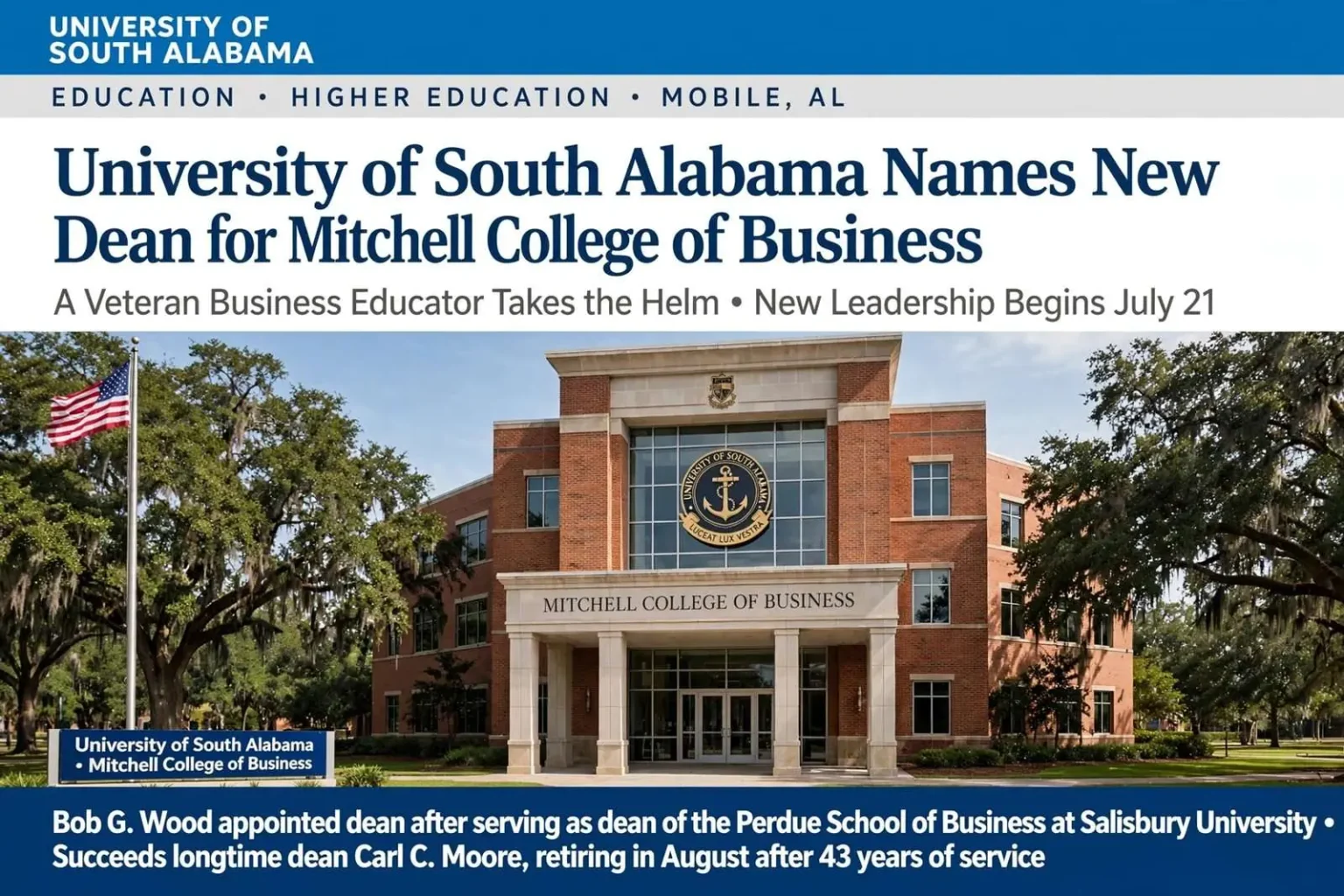
The University of South Alabama in Mobile has selected a new dean to lead its Mitchell College of Business, with the incoming administrator set to begin his duties on July 21. Bob G. Wood, who most recently served as dean of the Perdue School of Business at Salisbury University in Maryland, was named to the position following an announcement at the University of South Alabama Board of Trustees meeting on June 6. The search closed out a leadership transition that the college had been preparing for over the past year, and it hands one of the region’s most established business schools to an administrator with a track record of building entrepreneurship programs. Wood arrives as the Mitchell College works to expand its footprint among students and employers across the Gulf Coast.
He succeeds longtime dean Carl C. Moore, who is retiring in August after 43 years of service to the university, including a quarter-century leading the business college. Moore’s tenure spans a period in which the Mitchell College grew from a regional commuter school into an accredited institution with graduate programs, research activity and deep ties to Mobile’s banking, healthcare and manufacturing employers. Few academic administrators anywhere last 25 years in a dean’s office, and the length of Moore’s run means the incoming dean inherits relationships and expectations built over a generation. University officials have framed the transition as both a celebration of Moore’s legacy and an opportunity for renewal.
A Track Record of Innovation
During his four years at the helm of the Perdue School, Wood built a reputation for reshaping business education. He was named the 2014 recipient of the Beta Alpha Psi Outstanding Dean Award, recognizing his leadership in the field. Beta Alpha Psi, the international honor organization for financial information students and professionals, presents the award to deans its student chapters identify as exceptional advocates, a distinction that reflects support from the students themselves rather than a committee of administrators. For Wood, the award came as a capstone to his Maryland tenure.
Under his direction, Salisbury’s flagship student entrepreneurship competition grew from a modest event into a three-round contest judged by regional business professionals, with student prize money climbing from $5,000 to more than $60,000. The growth transformed what had been a campus exercise into a serious competition that drew teams from across the region and gave student ventures real seed capital. Competitions of that kind have become a signature tool for business schools trying to turn classroom theory into company formation, and the Maryland program’s expansion put the Perdue School on the map among entrepreneurship educators.
He also helped direct proceeds from a $1 million private foundation grant toward creating the Shore Hatchery, an initiative supporting entrepreneurial ventures across the mid-Atlantic region. The Shore Hatchery differs from a student competition in that it funds working entrepreneurs, awarding seed money to existing businesses that commit to creating jobs on the Eastern Shore. The program turned the business school into an economic development player in its region, a model that Gulf Coast higher education watchers will be curious to see whether Wood attempts to replicate in Mobile.
That work culminated in May 2014, when the Perdue School and Salisbury University hosted one of only six nationwide “open call” auditions for the ABC television series “Shark Tank.” The auditions drew hundreds of aspiring entrepreneurs to the Maryland campus, each hoping for a chance to pitch television producers and, eventually, the show’s panel of investors. Hosting an open call required space, staffing and coordination that only a university campus could provide, and it gave the school national visibility. Landing one of the six audition sites is the kind of credential that follows a dean to his next post.
Rebuilding the MBA and the Student Pipeline
Wood also reorganized the Perdue School’s MBA offerings into a seven-week, hybrid-format program that students could complete in a single year. The redesign reflects the direction graduate business education has been moving nationwide, as traditional two-year, semester-based programs lose working students to faster and more flexible formats. Compressing courses into seven-week blocks lets working professionals finish a degree without leaving their jobs, and the hybrid delivery, mixing online work with face-to-face sessions, cuts the commute burden that keeps many Mobile-area professionals out of the classroom. The Mitchell College’s own MBA program serves a similar population drawn from the city’s hospitals, banks and chemical and aerospace employers.
He expanded the school’s executive advisory council and created a new career advisory board made up of young professionals to mentor current students. The two boards serve different purposes: senior executives advise a dean on curriculum and strategy, while early-career alumni help students understand what the job market actually looks like and how to navigate it. Wood’s creation of the mentor-focused board recognized that students often relate better to graduates five years out of school than to executives 25 years in. Both models are likely to interest Mobile employers, who have long complained that graduates leave the state for lack of professional connections.
Another signature initiative, dubbed “Business in the Atrium,” created a regular, informal setting for students and area employers to connect. The events bring recruiters, executives and entrepreneurs onto campus in a setting designed for conversation rather than formal career-fair lines, letting students ask unscripted questions about industries and career paths. Programs like this address the persistent gap between classroom learning and employer expectations, and they give regional companies a low-cost way to build a recruiting presence. The initiative became one of the Perdue School’s most visible outreach efforts during Wood’s tenure.
Background in Higher Education and Industry
Before his time in Maryland, Wood served as associate dean and held the Heidtke Professorship of Finance at Tennessee Tech University, where he oversaw the buildout of both campus and online MBA programs and saw enrollment grow by 150 percent during his tenure. The Cookeville, Tennessee, school’s business college expanded its graduate footprint dramatically during his years there, and the online program’s growth anticipated the shift that now dominates the field. The Heidtke Professorship, an endowed chair, reflected his standing as a finance scholar as well as an administrator. The 150 percent enrollment growth figure is the kind of result search committees look for when they hire a dean from a peer institution.
A native of Jonesboro, Arkansas, Wood holds a bachelor’s degree and an MBA from Arkansas State University, along with a doctorate in finance from Louisiana State University. The academic path runs through two regional universities and the Southeast’s flagship business doctoral program in Baton Rouge, giving him deep familiarity with the educational landscape of the region South Alabama serves. LSU’s finance doctoral program has placed graduates in faculty and administrative posts across the Southeast, and Wood’s training there anchors his scholarly credentials.
Prior to entering academia full time, he worked in the private sector for Abbott Laboratories, the Upjohn Company, and Dean Witter Reynolds. The trio spans pharmaceutical manufacturing and the securities industry, and the practical background has informed his approach to curriculum throughout his academic career. Deans who have carried a corporate payroll understand what employers need from graduates in a way that career academics sometimes do not. Wood and his wife, Terri, have three children, and the family’s move to Mobile adds another chapter to a career that has already crossed four states.
Following a Long Legacy at the Mitchell College
University officials say they expect Wood to build on Moore’s long legacy as the Mitchell College of Business continues to expand its programs for students across the Mobile area. The college holds accreditation for its business and accounting programs and enrolls a substantial share of the university’s undergraduate population, feeding Mobile’s banking, healthcare, logistics and petrochemical sectors. The July 21 start date puts Wood in place ahead of the fall semester, giving him a few weeks to meet faculty, review budgets and begin the listening tour that new deans typically conduct. His early priorities, based on his record, are likely to include entrepreneurship programming and stronger employer connections, the two areas where his Maryland tenure left its clearest marks.
The stakes for Mobile are considerable. The city’s economy has been diversifying around the port, aerospace manufacturing and healthcare, and business schools play a quiet but central role in whether that growth is staffed by local graduates or by transplants. A dean with a demonstrated ability to raise prize money, land foundation grants and attract national programs to campus could shift how the region’s business community engages with the university. Employers who spent a quarter century working with Moore will now build a relationship with a successor whose own playbook emphasizes exactly that kind of partnership.
For the university itself, the hire closes out a transition that began with Moore’s retirement announcement and ends with a dean arriving from out of state with a national award and a Shark Tank audition site on his resume. Whether the Shore Hatchery model, the one-year hybrid MBA and the mentoring boards translate from Maryland’s Eastern Shore to the Gulf Coast will become clear over the next few years. What is certain is that the Mitchell College’s next chapter begins on July 21 under leadership that has, twice now, grown a business school’s programs and enrollment through the kind of innovation that regional employers notice.