Ann Street Resurfacing Wraps Up as Dunkin’ Donuts, Old Shell Road Restaurant Proposals Divide Neighbors
Mobile has finished a long-awaited resurfacing of Ann Street, even as proposed developments on Government Street and Old Shell Road near Lavretta Park draw pushback from nearby residents.
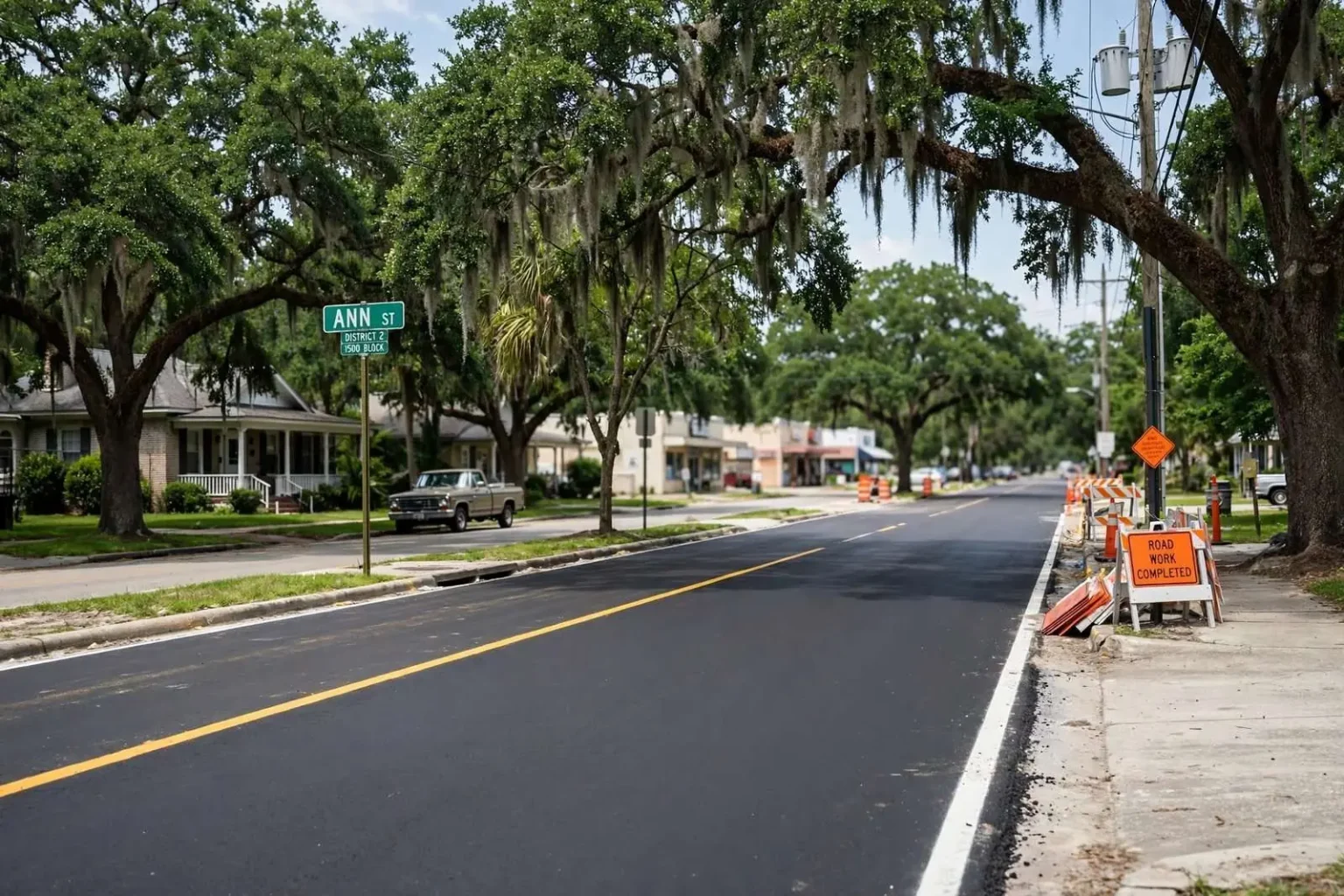
Mobile’s street crews have closed out a summer project that residents along Ann Street had been requesting for years, wrapping up a full resurfacing of one of the city’s most heavily traveled and long-neglected corridors in early July. The work gave the roadway, long pocked with potholes and visibly deteriorating pavement, a fresh driving surface just in time for the Fourth of July holiday. For commuters, school buses and delivery traffic that use the street every day, the difference between the old surface and the new one was hard to miss.
What made the project distinctive was not its timing but its method. Rather than the routine mill-and-pave approach used on most repaving jobs, crews ground down the existing top layer of roadway, added a filament-reinforced inlay, and then resurfaced the street. The technique was new to Mobile, and it was promoted as a cost-effective way to buy years of additional life from aging pavement without undertaking a far more expensive rebuild.
The push for that approach came from District 2 Councilman Levon Manzie, whose district includes the corridor. Manzie learned that the method had been used in Pittsburgh as a cost-effective stop-gap measure for aging streets, and he concluded that a city facing a long backlog of worn roadways could benefit from the same thinking. He brought the idea to Mayor Sandy Stimpson and City Engineer Nick Amberger, and the city moved forward with the project soon after the conversation began.
Cost was the central consideration. A full reconstruction of Ann Street had been estimated at roughly $8 million, a price tag that made a complete rebuild unlikely in the near term given the competing demands on the city’s capital budget from streets and drains across Mobile. The ground-down, reinforced-inlay approach offered a middle path: substantially improved pavement at a fraction of the cost of starting over, while keeping the corridor open to the traffic volume it carries.
A corridor that had waited years
The resurfacing work was carried out during some of the hottest weeks of the summer, a stretch when crews typically contend with asphalt that cures quickly and equipment that runs close to its limits. Even so, the job stayed on schedule and was finished in time for the Independence Day holiday, sparing residents and businesses along the corridor a construction zone through the peak of the season.
Manzie had fielded years of requests from constituents to address the street’s condition, and the complaints were rarely about anything exotic: the pavement was rough, the potholes kept returning after patching, and drivers weaved across lanes to avoid the worst spots. Residents who regularly drive the corridor have welcomed the improved surface, and early reactions from those who use the road daily suggest the smoother ride was worth the wait.
The project also carries a lesson for the rest of the city’s street network. Mobile, like most older Gulf Coast cities, has far more pavement than it can rebuild in any given budget cycle, and officials have increasingly looked for techniques that stretch maintenance dollars across more miles. If the filament-reinforced inlay performs as advertised on Ann Street, the method could become a template for other corridors where full reconstruction remains out of reach.
While Ann Street has gotten its facelift, two proposed developments on nearby streets have generated far more debate among neighbors than any paving project could. The flashpoint is a familiar one for Mobile’s older corridors: a national chain wants to build, and residents who live along the affected streets are asking hard questions about what the project would change.
The more prominent of the two proposals calls for a Dunkin’ Donuts on Government Street near Dexter Avenue, a stretch of one of the city’s most historic east-west corridors. The site sits not far from where a Krispy Kreme once operated before closing and being replaced by a Dairy Queen, so the corner is no stranger to doughnut shops and drive-thru traffic. Even so, the prospect of adding another one has divided people who live nearby.
The firm behind the Government Street project has put its plans on hold for now amid pushback from nearby residents, an acknowledgment that the proposal was not moving through the neighborhood quietly. A pause can mean many things in commercial real estate — a redesign, a different site plan, or a quiet withdrawal — but for the moment the project is stalled while objections are sorted out.
Neighbors involved in the debate say their concerns center not on the brand of doughnut on offer but on the practical effects of another drive-thru restaurant in the corridor. Those effects include additional traffic on streets that already carry steady volumes, noise from early-morning and late-evening service, litter that accumulates around high-turnover restaurant sites, and the potential loss of mature oak trees that line the street and define its character.
A second proposal across town
The Government Street fight is not the only one brewing. A second Dunkin’ Donuts location has also been proposed for Springhill, giving the chain two potential entry points into Mobile’s close-in neighborhoods at roughly the same time. Attention has likewise focused on a restaurant proposal along Old Shell Road, where residents have raised similar questions about traffic and neighborhood fit.
The back-to-back proposals have turned what might otherwise be routine commercial projects into a broader conversation about how the city’s older, tree-lined residential corridors absorb new development. Drive-thru restaurants occupy a particular place in that conversation: they generate jobs and tax revenue, but their business model depends on steady vehicle traffic and frequent turnover, qualities that do not always sit comfortably beside homes, sidewalks and mature landscaping.
For the moment, the Government Street proposal is on hold, and there is no announced timetable for whether the developer will revise the plan, select a different site, or push ahead as originally drawn. Residents who object say they intend to stay engaged, and the spring of activity around Springhill and Old Shell Road suggests the broader debate over restaurants in residential-adjacent corridors is only beginning.
Why drive-thru debates run hot in Mobile
Conflicts like the ones brewing on Government Street, in Springhill and along Old Shell Road follow a pattern that plays out across Mobile and similar Southern cities. A commercial proposal arrives with a well-known brand attached, and the immediate reaction from many neighbors is positive. The friction emerges later, when the site plan shows curb cuts, stacking lanes, dumpster locations, signage and tree removal. Those details, more than the logo on the sign, determine how a project actually feels to the people who live around it.
Traffic is usually the first concern raised, and not without reason. A drive-thru restaurant concentrates dozens of vehicle trips into narrow windows at breakfast and lunch, with cars idling in stacking lanes and entering and exiting directly onto streets that may also serve school zones or cut-through traffic. Noise follows close behind: delivery trucks arrive before dawn, and speaker systems and parking-lot activity extend into the evening hours in a way that a sit-down restaurant typically does not.
Litter is a chronic complaint around drive-thru sites as well, since packaging leaves the premises in vehicles and tends to accumulate along nearby rights-of-way. And in a city as attached to its tree canopy as Mobile, the prospect of removing mature oaks to make room for parking and stacking lanes can turn mild skepticism into organized opposition. The oaks that line corridors such as Government Street took generations to grow, and residents know that once they are cleared for a pad site, no redevelopment brings them back.
How these disputes typically get resolved
Projects like the ones now under discussion move through the city’s standard development channels, which give both sides opportunities to make their case. Depending on the site’s zoning and the specifics of a plan, approvals may involve site plan review, and council members whose districts include the sites often hear from residents before and after formal filings. A councilman who has already worked closely with neighborhood groups on issues like the Ann Street repaving is likely to find restaurant proposals on those same corridors dominating his constituent mail as well.
Developers, for their part, have a range of options short of walking away. Site plans can be reoriented to preserve trees, curb cuts can be consolidated, hours can be adjusted, and landscaping buffers can be enhanced in response to objections. Putting plans on hold, as the Government Street firm has done, is often the first step in that kind of recalibration rather than the last.
What is clear is that the two conversations now running through central Mobile are connected. The same residents who spent years asking for smoother pavement on Ann Street are now weighing what new development should look like on the streets around it. One is a question of maintenance, the other of character, and both speak to how a growing city balances convenience and commerce against the residential quality of its oldest neighborhoods. How the doughnut debates resolve may shape how the next round of proposals — on Government Street, in Springhill, or on Old Shell Road — is received.